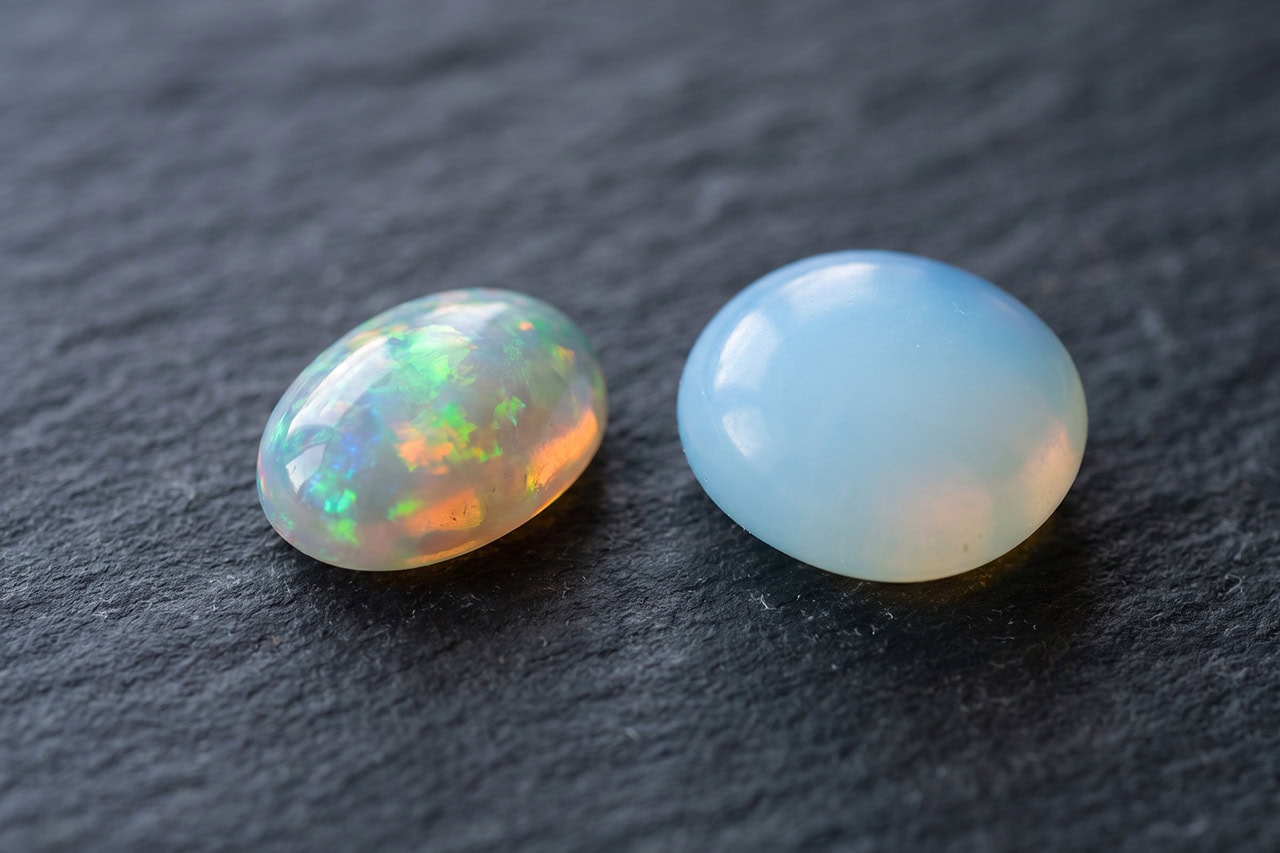
Opal is a natural gemstone, a form of hydrated silica that can flash rainbow colours from inside. Opalite is not a stone at all. It is manufactured glass, milky and evenly glowing, with none of that internal fire. The single clearest divider is play-of-colour, which opal has and opalite cannot produce.
The names are almost the whole problem. Opalite ends in the syllable that names a mineral, and it sits on a shelf beside real stones, so it reads as a kind of opal, a smaller cousin of the same family. It is closer to a vintage glass marble than to a gem. The material was never underground, never grew, and shares nothing with opal but a borrowed sound and a soft glow, and a great many people buy it believing they have bought a piece of the earth.
The gap between the two is not a matter of grade or degree. It is the gap between something that formed in rock over ages and something that came out of a furnace, and it leaves a physical fingerprint anyone can check.
A stone that was never underground
Opal is a genuine mineraloid, hydrated silicon dioxide, silica with water held inside its structure. It forms slowly where silica-rich water seeps into cavities and dries, and it has been valued long enough to hold a place among the traditional birthstones, as the stone for October. Precious opal’s glory is the shifting internal rainbow that gemmology calls play-of-colour. On the Mohs scale it is soft for a gem, somewhere around 5.5 to 6.5, and it keeps a little water in it always, which is part of what makes it delicate.
Opalite is a trade name, and mostly it means opalescent glass made to glow. It is produced in quantity to bend light so it reads a soft milky blue in daylight and a warmer honey tone when lit from behind. The word travels under other names too, sea opal and opalized glass among them, each chosen to sound a little more natural than the last. None of that is a scandal in itself. Glass made to be pretty is an old and honest craft. The difficulty is only the name it borrows and what that name lets a seller imply.
Opal is a natural gem and opalite is a factory product, and calling them a pair is the marketing talking. The two also behave differently under light, in a way no naming can smooth over.
The one thing glass cannot fake
Play-of-colour is not a tint and not a general shimmer. It is structural. Precious opal is built from countless microscopic spheres of silica, all close to the same size, packed into an orderly three-dimensional grid. Light entering that grid is diffracted, bent and split by the regular spacing the way it is by any fine grating, and the result is pure spectral colour that moves and changes as the angle shifts. Red here, green a degree away, blue beyond that, and no two opals arranged quite alike. The colour comes from the architecture rather than from any pigment.
Opalite has no such architecture. It is amorphous glass, and its glow is ordinary scattering of light, the same effect that makes a glass of milky water look faintly blue. Turn a piece of opalite and it may shift gently between its cool daylight blue and its warm backlit honey, but it never throws the darting, sorted spectral flashes of real opal, because there is no ordered lattice inside it to sort the light. If a stone glows evenly and never breaks into moving fire, it is almost certainly not precious opal.
One honest caveat keeps this from being a single decisive test. Not all natural opal shows play-of-colour either. Common opal, the plain material the trade calls potch, is genuine opal with no fire at all, so an even glow does not by itself prove a piece is glass. What it does is send you to the other cues, which line up quickly.
Reading a piece for glass
A few checks settle most pieces once the fire test has raised the question. The most telling is what a loupe finds. Because opalite is glass, it can hold small round gas bubbles trapped as it cooled, and those bubbles never occur in natural opal, so a single clear bubble often ends the discussion on its own. Uniformity is the next cue. Opalite’s milky blue is remarkably even, sometimes with the flawless clarity of glass, where natural opal carries internal texture and irregularity that a factory melt does not. Real opal formed grain by grain in rock, and almost always keeps some faint structure or unevenness inside it, the kind of thing a uniform melt has no way to reproduce. The two-way colour shift is a third, that particular trick of looking bluish in normal light and glowing orange or honey when light passes through from behind, which is characteristic of the glass rather than the gem.
Then there is price, and here the gap is loud. Opalite sells for a few coins a piece because it is cheap to make in bulk, while fine natural opal runs to real money by the carat. A large, flawless, evenly glowing opal at a bargain price is opalite, and the tag is doing the same work as the bubble under the loupe. The trade names are worth knowing for the same reason, since a piece sold as sea opal is a piece asking to be checked, the way any grand natural-sounding name is on this kind of material.
Enjoying opalite honestly
The fair account is the same one that fits every look-alike. Opalite sold openly, as glass, at a glass price, is a perfectly nice thing to own. Its soft glow is genuinely pretty and plenty of people like it for exactly what it is. The only trap is the name doing dishonest work, opalite sold as opal or implied to be a natural gem, so that a buyer pays for the earth and receives a furnace.
There is a practical footnote that runs the same direction. Natural opal is already a tender gem that needs gentle handling, since the water in it means it can craze or crack if it dries out, and opalite, being glass, is softer still and chips and scratches more easily than it looks as though it should. Neither is a stone to knock about daily in a ring. What crystal practice makes of opal’s gentler cousins, the soft-coloured natural opals, we look at in what pink opal symbolises, and the wider question of where a stone’s colour comes from runs through why crystals are different colours.
That leaves the pleasant part of the decision to you. If it is the moving fire you are after, the thing that has held people’s eyes for centuries, only natural opal has it, and you pay accordingly and handle it with care. If it is simply the milky-blue glow, opalite gives you that for a few coins, bought as glass and enjoyed as glass. The one line not to cross is paying opal’s price for either the glow or the name. Genuine opal, play-of-colour and all, is written up in the Crystalance Mineral Library.
Sources
- geology.com, Opal (hydrated silica mineraloid SiO2 nH2O; play-of-colour from diffraction by an ordered array of silica spheres; common opal lacks it): https://geology.com/gemstones/opal/
- GIA, October birthstones (opal as an October birthstone): https://www.gia.edu/birthstones/october-birthstones
- Opalite, trade-name summary (a name for synthetic opalescent glass and related simulants): https://en.wikipedia.org/wiki/Opalite