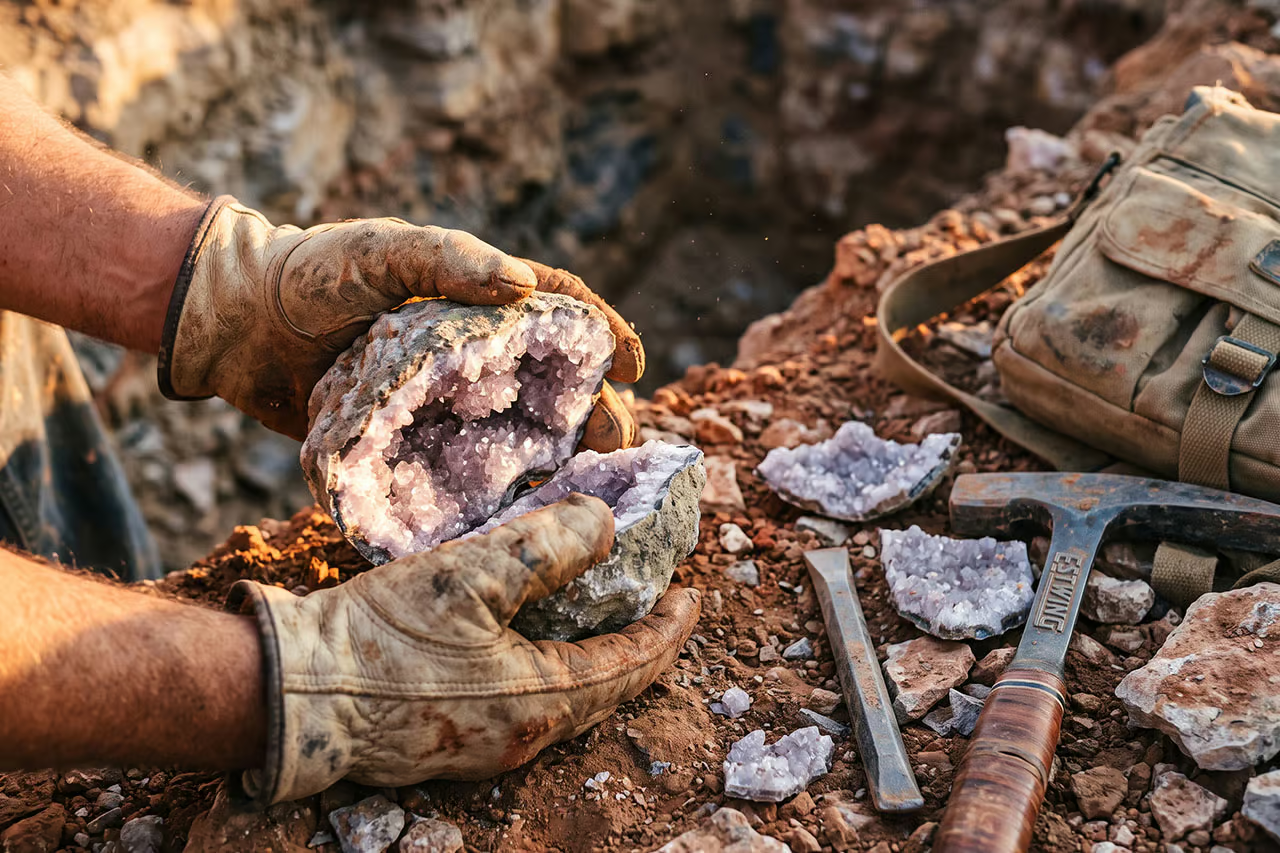
A geode is a cavity in rock that partly filled with crystals growing inward from its wall. The crystals people buy it for are not the end of that sequence. In the Brazilian amethyst geodes, three more minerals arrived after the amethyst did.
Gilg and colleagues worked out the order for the Rio Grande do Sul deposits and found four stages. Celadonite, chalcedony and pyrite came first, under reducing conditions. Amethyst arrived in the second stage, alongside goethite and anhydrite. Early calcite came third. Barite, later calcite and gypsum came fourth, with no order stated inside that stage.
The purple is therefore stage two of four. Amethyst is the last of the silica phases, a much narrower claim than the last thing to grow, and the difference shows on any cut face where a crust of white calcite or a bladed barite crystal sits over the top of the purple.
A halved geode therefore reads outward, through the layers, in the order they were laid down, and not inward toward the sparkle.
Reading a cut face from the outside in
The rind goes first, and it is not one thing. Götze, Möckel and Pan give the succession from the margin toward the centre as spherulitic and micro-granular chalcedony, then fibrous chalcedony, then macrocrystalline quartz. Three textures of the same substance, silica, deposited as the conditions changed. On a polished slice this shows up as the grey and blue-white banding people look past on the way to the colour.
Each band is a period when the fluid chemistry held steady, and every boundary between two of them marks a change. Thick, finely banded rind around a small crystal-lined pocket means a long slow history. A thin rind with a wide open centre means the silica arrived more sparingly, or for less time, or both.
Colour zoning inside the cavity carries information of its own. On a small amethyst geode we keep, the points near the centre are noticeably darker than those around the edges, and the two zones separate cleanly when light strikes the cut face at an angle. A gradient like that is a change in the fluid written into a single generation of crystals, which is what the rind does across several.
Elapsed time is the quantity the layers do not encode. No published study puts a figure on how long a geode takes to fill. The 2020 review of agate genesis, by the same authors who established the textural succession, states no growth rate and no formation time, The one bracket in the literature is coarse. Wall-lining agate can be regarded as forming within a few million years of its host rock. Any specific figure attached to a geode in a shop has no published basis behind it.
Temperature has a published basis and a narrow one. Gilg’s group put the colourless quartz and amethyst at Ametista do Sul between 40 and 80 degrees, from fluids reaching 80 to 90 degrees moving into a basaltic host below 45, and identifies the fluids as low-temperature sedimentary brines. That figure belongs to one district and one study. It establishes a direction more than a value. These grew warm rather than molten, long after the lava had stopped glowing.
Where the hollow came from
The hollow is what makes a geode a geode. Kentucky Geological Survey gives the test. Quartz crystals grow inward from the initial rind and partially fill the space to form a quartz geode, and if the void fills completely, what you have is a solid nodule or concretion instead. Geodes differ from concretions in being hollow, with crystals growing inward from an outer shell, where a concretion is solid and grows outward from a central core.
Where the hollow came from depends on the rock, and the two answers have nothing to do with each other. In the basalts of southern Brazil and Uruguay, the source of the large amethyst geodes that reach shops in Europe and North America, the origin of the cavity has been argued over since 2007 and is not settled. One position holds that the space was a gas bubble. Proust and Fontaine modelled the geodes as products of magmatic gas exsolving from a supersaturated melt with no need for external water, and Morteani and colleagues describe them as protogeodes formed by bubbles of carbon-dioxide-rich fluid from the basalt. The other position holds that the basalt had already cooled to brittle conditions and been altered to smectite and zeolites before the cavities existed, which points to a low-temperature, epigenetic origin rather than a bubble frozen into hot lava. Duarte and colleagues place the whole mineralising process after the eruption, at low temperature, with meteoric water heavily involved.
Both camps are live and neither has been refuted. The trapped-bubble story circulates as settled fact and is in truth one of two competing accounts, and the one currently under challenge.
The sedimentary route is a different story with a different rock. The Keokuk geodes of the Iowa, Missouri and Illinois borders weather out of the lower Warsaw Formation, which the Illinois State Geological Survey describes as grey shale containing beds of argillaceous limestone. Shale, not the limestone the popular accounts usually name. Iowa Geological Survey records them as typically two to six inches across, with specimens up to thirty inches known, and notes that seventeen minerals beyond the usual ones have been identified in them. The mechanism usually cited for geodes of this type comes from Chowns and Elkins, who studied Tennessee occurrences in 1974 and found them to be pseudomorphs after early diagenetic anhydrite nodules: a shape inherited from a mineral that later dissolved away. That work was done in Tennessee and extended to Keokuk afterwards, so it is the established account for one district and the applied account for the other.
Precise dates exist for the province, though not yet for the part that matters most. Rocha and colleagues dated the silicic sequences of the southern Parana province by uranium-lead on zircon, returning about 133.6 million years for the Palmas rocks and about 132.9 for the Chapeco. The basalt flows that host the amethyst geodes are a separate unit, undated in that study, and the authors argue the earliest of them could be at least half a million years older still. Early Cretaceous is as far as the numbers reach. The interval between a basalt cooling and its cavity filling has no published figure at all.
A nodule that filled solid is not a failed geode. It is the same process run to completion, carrying the same layered record with no cavity left at the end. Cracking is what sorts the two categories in a shop, and it destroys the outer face of exactly the layers that would have told you which one you were holding. How the crystals inside compete for the remaining space once the rind is down is the subject of how crystal clusters are formed.
The banded rind is agate, so on a cut geode the Crystalance Mineral Library entry for agate does more work than the one for amethyst. An uncracked geode is priced entirely on what might be inside it, and the layers that would date the sequence are already on the outside, unpriced.
Sources
- Albert Gilg and others, “Mineralisation of amethyst-bearing geodes in Ametista do Sul (Brazil) from low-temperature sedimentary brines”, Mineralium Deposita 49(7), 2014, for the four-stage paragenesis with amethyst in stage II, for barite, calcite and gypsum in stage IV, for crystallisation between 40 and 80 degrees, and for the sedimentary-brine source.
- Jens Götze, Robert Möckel and Yuanming Pan, “Mineralogy, Geochemistry and Genesis of Agate”, Minerals 10(11), 2020, for the margin-to-centre succession of chalcedony textures, and for carrying no statement of growth rate or duration.
- Terry Moxon and Stephen Reed, “Agate and chalcedony from igneous and sedimentary hosts”, Mineralogical Magazine 70(5), 2006, for wall-lining agate forming within a few million years of its host.
- Dominique Proust and Claude Fontaine, “Amethyst-bearing lava flows in the Parana Basin”, Geological Magazine 144(1), 2007, for the magmatic-gas exsolution model; and Giulio Morteani and others, “The genesis of the amethyst geodes at Artigas”, International Journal of Earth Sciences 99(4), 2010, for protogeodes formed by carbon-dioxide-rich bubbles.
- Leo Hartmann and others, “Geochemical stratigraphy and fault-block structures of the Entre Rios amethyst geode mining district, Parana volcanic province, southern Brazil”, Anais da Academia Brasileira de Ciencias 86(1), 2014, for the low-temperature epigenetic hypothesis and for the brittle, smectite- and zeolite-altered state of the basalt before the cavities formed. The post-eruption, low-temperature, meteoric-water account is set out in Luiz Duarte and others, “Mineral chemistry and isotopic composition of the Los Catalanes amethyst deposits”, Mineralium Deposita 46(3), 2011.
- Brenda Rocha and others, “Rapid eruption of silicic magmas from the Parana magmatic province (Brazil) did not trigger the Valanginian event”, Geology 48(12), 2020, for zircon uranium-lead ages of about 133.6 Ma and roughly 700,000 years of silicic magmatism.
- Stephen Greb, “How Geodes Form”, Kentucky Geological Survey, 2012, for inward growth from the rind and for a completely filled void giving a nodule or concretion; and Rocks and Minerals: Geodes, Kentucky Geological Survey, for concretions being solid and growing outward from a central core.
- Timothy Chowns and James Elkins, “The origin of quartz geodes and cauliflower cherts through the silicification of anhydrite nodules”, Journal of Sedimentary Research 44(3), 1974, for Tennessee geodes as pseudomorphs after early diagenetic anhydrite nodules.
- Iowa Geodes, Iowa Geological Survey, for the lower Warsaw Formation, the two-to-six-inch typical size, specimens to thirty inches, and seventeen additional minerals; and Warsaw Shale, Illinois State Geological Survey, for the Warsaw as grey shale with beds of argillaceous limestone.