Because the atoms inside sit on a repeating lattice, and a face forms parallel to the planes where those atoms are packed most densely. The angles between faces are fixed by that arrangement. The overall shape is not, which is a separate question with a different answer.
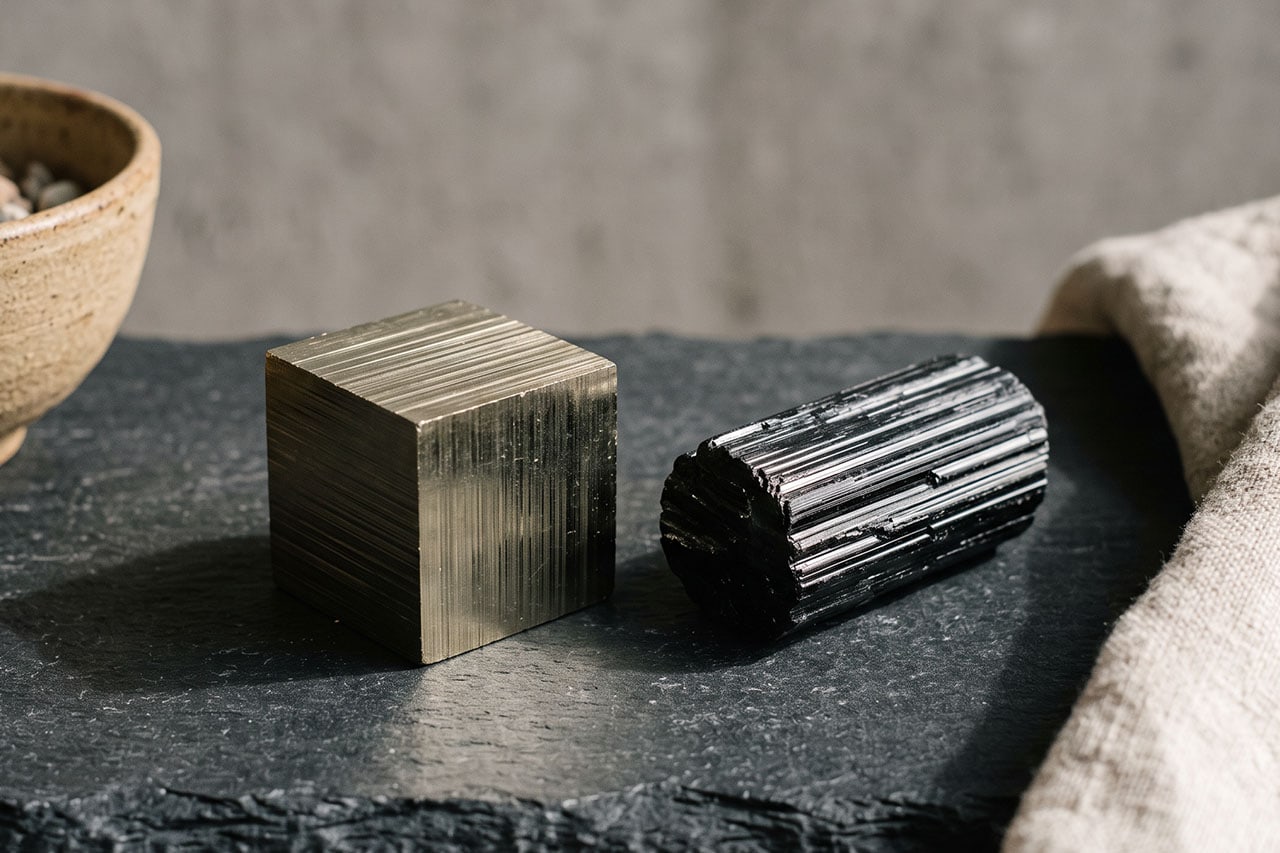
A pyrite cube has less symmetry than a cube. Look closely at a good one and each face is ruled with fine parallel scratches, and the scratches run one way on the top face and at right angles to that on the face beside it. The Handbook of Mineralogy gives the habit as typically cubic, pyritohedral, octahedral and combinations of those, and then adds four words about the surface: “Striated conforming to pyritohedral symmetry.”
Six square faces meeting at right angles is a cube by any ordinary description, and the Handbook calls the habit cubic. What is not cubic is the symmetry underneath it. Pyrite’s point group is 2/m 3, which carries half the symmetry operations a true cube has, and the striations are where that shows up on the surface. A collector who has learned to read them can pick pyrite out from across a table.
The outline and the striations report two different things about the same object, and the striations are the more informative of the two.
Faces follow the densest planes
Flatness is the thing to explain, and orderliness alone does not explain it. A regular interior could in principle produce almost any outline. What makes the outline flat was set out in 1937 by J.D.H. Donnay and David Harker, in a paper for the journal of the Mineralogical Society of America under the unhurried title “A New Law of Crystal Morphology Extending the Law of Bravais”.
Their statement of the underlying law runs in two parts. First, “the observed crystal faces are parallel to the net planes with the highest reticular densities (or smallest mesh areas).” Second, “the greater the reticular density (or the smaller the mesh area) the more important the corresponding form.”
Reticular density needs unpacking. Imagine slicing the atomic lattice with a flat plane, at any angle you like. Some angles cut through crowded sheets of atoms and some cut through sparse ones, and reticular density is how many atoms per unit area lie on the plane you chose. Crystal faces are not arbitrary. They lie parallel to the crowded sheets, and the more crowded the sheet, the larger and more prominent the face that corresponds to it.
A flat face is flat for an unglamorous reason. It is a plane of atoms that already existed inside the material, now exposed at the surface, and it is flat the way a page of a book is flat.
Donnay and Harker use pyrite as one of their worked examples, which is how a mineral and a mechanism come to be described in the same breath.
There is a second half to the mechanism, and it is about time instead of geometry. Faces do not all advance outward at the same speed. Work by Liu and Bennema in Physical Review B in 1996 put the consequence formally: an orientation with a higher growth rate has less chance of appearing on the finished crystal, so a crystal ends up bounded by the faces with sufficiently low growth rates. Zhou restated it compactly in Crystals in 2019, writing that a polyhedral morphology is generated by slow-growing faces, because the fast-growing ones grow out and are not displayed in the final habit.
Prominence, in other words, is set by advance rate. A face that creeps along stays large in the finished crystal, and one that races ahead ends up as a thin edge.
Habit is a record of conditions
Take two quartz crystals from opposite ends of the world, one squat and one long and slender, and they will give you the same angle between the same pair of prism faces. That angle is a property of the structure and it does not vary. But the two crystals do not look alike, and no amount of knowing the structure will predict which one you get.
Donnay and Harker say as much in the paper that extends the law. Listing the known objections to the Law of Bravais, they give as the first that “the forms present on a crystal do not depend only on factors within the crystal, but on external factors as well (conditions of crystallization)”, and as the second that “even in the most favorable instances the law holds for dominant forms only.” Those objections, they write, have given the law the status of a first approximation. An approximation that good earns its place, and it will still not tell you what a particular crystal is going to look like.
The Open University’s OpenLearn material puts the split in ordinary language. The angles between faces are always fixed, being defined by the crystal structure, while the exact shape of crystals of the same mineral can vary depending on the conditions at the time of growth.
There are two questions here that look like one. What symmetry does this mineral have, which is settled and internal, and what shape did this particular specimen come out as, which is a record of the space it had, the chemistry around it, how fast it grew and what it grew against. The word for the second is habit, and a habit records circumstances rather than identity.
My own black tourmaline shows the first question from another direction. It is a raw schorl piece, unpolished, scored with deep parallel grooves that run the full length of the material, the tourmaline habit that makes the species recognisable across a room. In pyrite the marks fall on faces at right angles to each other; in schorl they all run one way. Both are the internal arrangement reaching the surface at a scale a person can see, and a tumbled stone conceals the lot.
The history behind the fixed-angle half is shorter and more contested than the name on it suggests. Nicolaus Steno is usually credited with discovering that interfacial angles are constant, in 1669. Menchetti, writing in Substantia in 2021, points out that the famous phrase “non mutatis angulis” appears only in the captions to Steno’s plates, illustrating sections of quartz crystals, and quotes Authier’s assessment that Steno “presents it as a fact of observation, without proof, and not as an universal law.” The generalisation to all minerals came a century later, from Jean-Baptiste Romé de l’Isle, working with a contact goniometer built by Arnould Carangeot, which Tutton dates to 1780 and the IUCr to 1783. The IUCr’s dictionary agrees on the sequence, from Steno’s observation on quartz through Guglielmini to Romé de l’Isle’s generalisation.
The received version compresses about a hundred years into a name. What Steno wrote was an observation about quartz, printed under a picture. What the textbooks call Steno’s Law is what Romé de l’Isle made of it afterwards.
Ask which crystal system a mineral belongs to and the answer is the same wherever the specimen came from. Ask what shape a piece will be and there is no answer until you have the piece in front of you. The Crystalance Mineral Library can settle the first question for any species, and the second is settled by wherever the stone happened to grow. The stones with the most flat faces make the useful test case, since sparkle is largely a count of surfaces catching light at once.
Sources
- Handbook of Mineralogy, pyrite, for the cubic system and point group 2/m 3, for the habit as typically cubic, pyritohedral, octahedral and combinations of these, and for “Striated conforming to pyritohedral symmetry”.
- Donnay, J.D.H. and Harker, D. (1937), “A New Law of Crystal Morphology Extending the Law of Bravais”, American Mineralogist 22, 446-467, for the two-part statement of the law of Bravais quoted above, for the listed objections to it including the dependence on conditions of crystallization and the restriction to dominant forms, for those objections giving the law the status of a first approximation, and for pyrite as a worked example. The link is http only.
- Liu, X.-Y. and Bennema, P. (1996), “Theoretical consideration of the growth morphology of crystals”, Physical Review B 53(5), 2314-2325, for a higher growth rate meaning less chance of a face appearing, and for the crystal being bounded by faces with sufficiently low growth rates.
- Zhou, W. (2019), “Reversed Crystal Growth”, Crystals 9(1) 7, for polyhedral morphology being generated by slow-growing faces while fast-growing faces grow out and are not displayed.
- Menchetti, S. (2021), “How do Crystals Grow? Steno’s Approach”, Substantia 5(1) Suppl., 77-87, for “non mutatis angulis” appearing only in Steno’s plate captions for sections of quartz crystals, for Authier’s assessment that Steno presented it as observation rather than universal law, and for the generalisation by Romé de l’Isle a century later.
- IUCr Online Dictionary of Crystallography, law of the constancy of interfacial angles, for the sequence from Steno’s observation on quartz in 1669 through Guglielmini to Romé de l’Isle’s generalisation of 1783, and for the goniometer designed by Arnould Carangeot. Tutton’s Crystals (1911) dates the contact goniometer to 1780; the two dates are both in print.
- The Open University, OpenLearn, an introduction to minerals and rocks under the microscope, for the angles between faces being fixed by the crystal structure while the exact shape of crystals of the same mineral varies with the conditions at the time of growth.