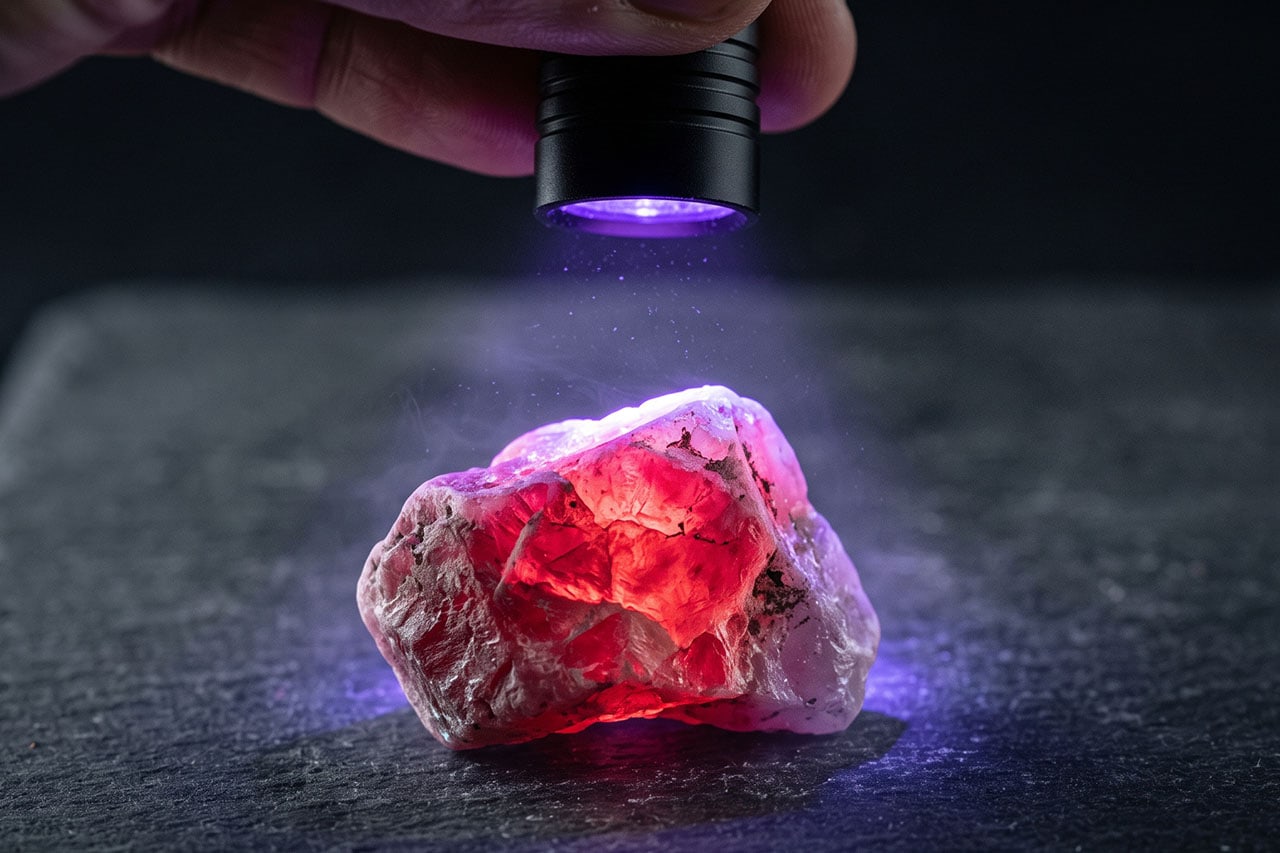
Ultraviolet light goes in, and light you can see comes back out at a longer wavelength. What does the absorbing is usually a trace atom of something else, present in tiny quantities, which is why two pieces of one mineral can behave completely differently under the same lamp.
Tungsten prospectors worked at night. The US Geological Survey’s own advice to prospectors lists the equipment: a black light, meaning an ultraviolet lamp, “commonly used in prospecting for fluorescent ore minerals such as scheelite (a tungsten ore), is also useful in detecting fluorescent rock-forming minerals such as calcite, barite, or fluorite, which can be indicators of associated metallic minerals”.
The lamp was working equipment for decades, not a curiosity. Scheelite shows a blue luminescence under ultraviolet, and USGS Bulletin 1052-C attributes it to the tungstate ion in the mineral’s own formula. A prospector could sweep a rock face after dark and read tungsten off it, and could pick up calcite, barite and fluorite in the same pass as pointers to metallic ore.
A lamp does not report a mineral. It reports whatever is inside the mineral answering it, and what answers is usually not the mineral itself.
The atoms that do the glowing
The Sterling Hill Mining Museum, sitting on one of the two most famous fluorescent mineral localities in the world, states the mechanism in one example. Calcite, willemite and wollastonite in their pure state do not fluoresce, and “add a little divalent manganese (Mn2+) and they will fluoresce red, green, and yellow, respectively.”
Three different host minerals take one guest ion and give back three different colours. The atom doing the work is called an activator, and it is generally present in fractions of a per cent.
Not every glow works that way. Scheelite’s blue and the green of some uranium minerals come from the tungstate and uranyl ions, both of which are part of the mineral’s formula and not visitors in it. Bulletin 1052-C, published in 1958, sets those apart from fluorite, where “most of its luminescence is now attributed to rare-earth activators.”
A second class of atom does not glow but makes the glow possible. The same USGS bulletin notes that the brilliant red fluorescence of calcite under ultraviolet light requires a sensitizing impurity such as lead. GIA describes the arrangement more generally. Sensitizers absorb the incoming light strongly and hand the energy on to the activator, and the activator is the atom that emits. Lead in a fluorescent calcite is doing the first job and not the second. The word activator gets attached to it anyway, on more pages than it should be.
A third class kills the effect. Quenchers absorb the energy and release it as heat instead of light, and the ones the literature names are iron above all, with cobalt and nickel also known. Iron is why so much of what a collector picks up stays dark under a lamp. It substitutes readily into almost anything, and a very small amount will shut down a mineral that would otherwise be spectacular.
Copper is not on that list. Neither GIA’s account of quenching in coloured stones nor the cathodoluminescence literature includes it, and copper’s better-known role in luminescence runs the other way, as an activator in manufactured phosphors.
Why one lamp is not enough
Ultraviolet is a range, not a setting. The International Commission on Non-Ionizing Radiation Protection divides it into UVA at 315 to 400 nanometres, UVB at 280 to 315, and UVC at 100 to 280.
Mineral lamps come in two standard flavours, and GIA gives them as long-wave at 365 nanometres and short-wave at 254. Those are not two strengths of the same thing. They are two different energies, and a mineral that answers one may be entirely dark under the other. Cheap UV torches are long-wave, and a collection tested only with one of those has been half tested.
Franklin and Sterling Hill in New Jersey are where the difference shows most dramatically, and short-wave is the wavelength that district is famous under. The Franklin Mineral Museum gives more than 350 mineral species from the local area, and more than 90 of them fluoresce, “quite a few of them brightly”.
Sterling Hill’s own estimate is that about 15 per cent of the roughly 5,000 known mineral species are known to fluoresce. One in seven, give or take. Common enough to justify buying a lamp, rare enough that a shelf will mostly stay dark under it.
Short-wave lamps come with a caution that belongs in the same paragraph as the recommendation. ICNIRP states that UVC radiation is particularly injurious to the eyes, and that exposure at short distances to bare lamps exceeds the exposure limit for the eye and the skin in only a few seconds. A proper mineral lamp is filtered and housed. A bare short-wave tube is laboratory equipment, and it should be treated as such.
The fluorite I own is a polished rainbow spike, banded violet through blue into green, and in the years it has been here it has never gone under a lamp of either wavelength. Neither has anything else I own. Fluorite’s glow is attributed to rare-earth activators and not to the calcium fluoride, so what this particular spike would do under a lamp is a question about its trace chemistry. No photograph of it will answer that, and neither will this article.
Tenebrescence, and the diamond discount
Hackmanite belongs somewhere else entirely. It does not glow under ultraviolet light. It darkens.
The effect has its own name. Medved, writing in American Mineralogist in 1954, records that “the term ‘tenebrescence,’ Latin-tenebrae (shadows), has been applied to this reversible process”, and gives the darkening under long-wave ultraviolet as the property that makes hackmanite unique. Medved’s paper describes the induced colour as magenta and quotes Allan’s much earlier account of “a brilliant pink tinge, but this on exposure to light goes off in a few hours”. The mechanism is a colour centre, a defect that traps an electron, and it runs in both directions.
Nothing in that is fluorescence, except that a lamp is involved. A fluorescing mineral gives light back out; a tenebrescent one keeps hold of what it takes in and changes colour.
Diamond fluorescence belongs in the wrong place for a different reason, and this one takes a worry away. It is priced as a flaw. GIA’s figures are that approximately 25 to 35 per cent of diamonds show some degree of fluorescence, that in more than 95 per cent of those the visible colour is blue, and that GIA studies show the strength of fluorescence has no widely noticeable effect on appearance for the overwhelming majority of stones. The 1997 study behind that found no systematic effect for the average observer, and found that strongly blue fluorescent diamonds were perceived to have a better colour appearance viewed face up.
A panel of observers could not reliably see the thing the discount is applied for. Anyone steering around fluorescence on principle when buying a diamond is paying for a distinction those observers could not make.
Anyone wanting to try this needs the right lamp before anything else, and a species name to start from, since the trade name on a tag will not get you to a fluorescence report. Start from the Crystalance Mineral Library for the species name, and from a fluorite entry if there is a piece of it to hand, since fluorite is the species most likely to reward the first attempt.
Sources
- USGS, Suggestions for Prospecting, General Interest Publications of the U.S. Geological Survey, for the black light commonly used in prospecting for fluorescent ore minerals such as scheelite, and for calcite, barite and fluorite as indicators of associated metallic minerals.
- Barnes, D.F. (1958), USGS Bulletin 1052-C, Infrared Luminescence of Minerals, for scheelite showing a blue luminescence caused by the tungstate ion and some uranium minerals a green luminescence caused by the uranyl ion, for rare-earth activators in fluorite, and for lead as a sensitizing impurity required for the red fluorescence of calcite.
- Sterling Hill Mining Museum, fluorescence, for calcite, willemite and wollastonite fluorescing red, green and yellow with divalent manganese added, and for about 15 per cent of the roughly 5,000 known mineral species being known to fluoresce.
- “Glowing Gems: Fluorescence and Phosphorescence of Diamonds, Colored Stones, and Pearls”, Gems & Gemology Winter 2024, for long-wave at 365 nm and short-wave at 254 nm, for sensitizers and coactivators transferring energy to the activator, and for Fe3+, Fe2+, Co2+ and Ni2+ as common quenchers in coloured stones.
- SERC, cathodoluminescence theory, for Fe2+ as the most important quencher in minerals, with Co2+, Ni2+ and Fe3+ also known.
- Franklin Mineral Museum, mineral science, for more than 350 mineral species from the local area and more than 90 of them fluorescing under ultraviolet light.
- ICNIRP 14/2007, Protecting Workers from Ultraviolet Radiation, for the UVA, UVB and UVC wavelength bands, for UVC being particularly injurious to the eyes, and for bare-lamp exposure at short distances exceeding the limit for eye and skin in only a few seconds.
- Medved, D.B. (1954), “Hackmanite and its tenebrescent properties”, American Mineralogist 39, 615-629, for the term tenebrescence, for darkening under long-wave ultraviolet as hackmanite’s unique property, for the magenta coloration and Allan’s “brilliant pink tinge” that “on exposure to light goes off in a few hours”, and for the colour-centre mechanism. The link is http only.
- GIA 4Cs, understanding diamond fluorescence, for approximately 25 to 35 per cent of diamonds showing fluorescence, more than 95 per cent of those fluorescing blue, and fluorescence having no widely noticeable effect on appearance for the overwhelming majority of stones.
- Moses, T.M. et al. (1997), “A Contribution to Understanding the Effect of Blue Fluorescence on the Appearance of Diamonds”, Gems & Gemology Winter 1997, for no systematic effects detected for the average observer and for strongly blue fluorescent diamonds being perceived as better in colour appearance table-up.