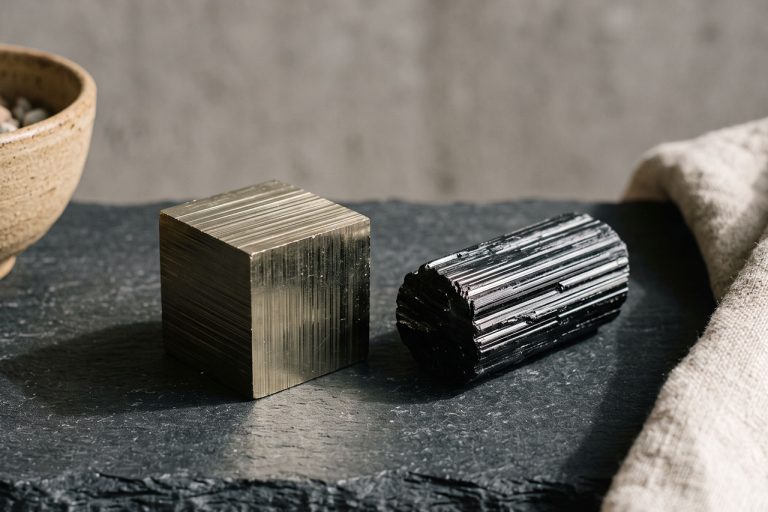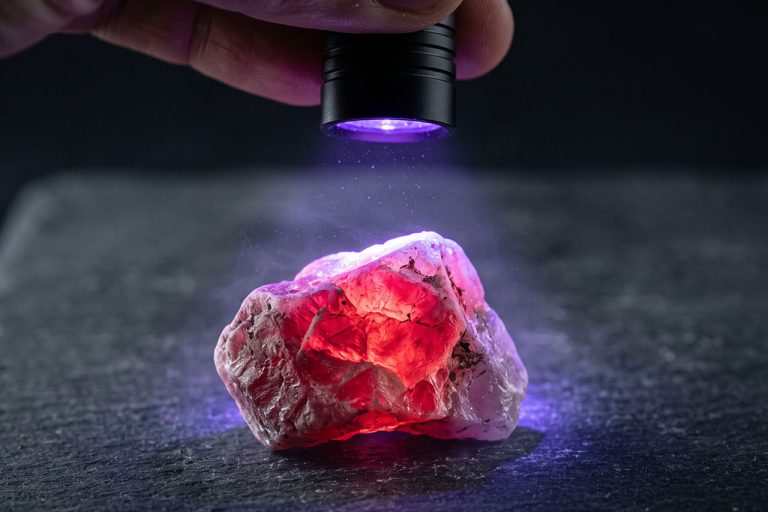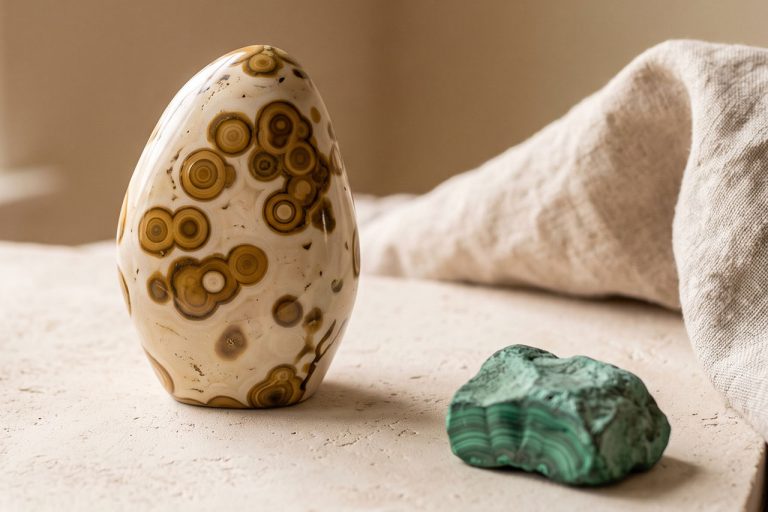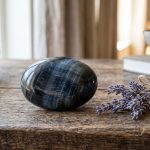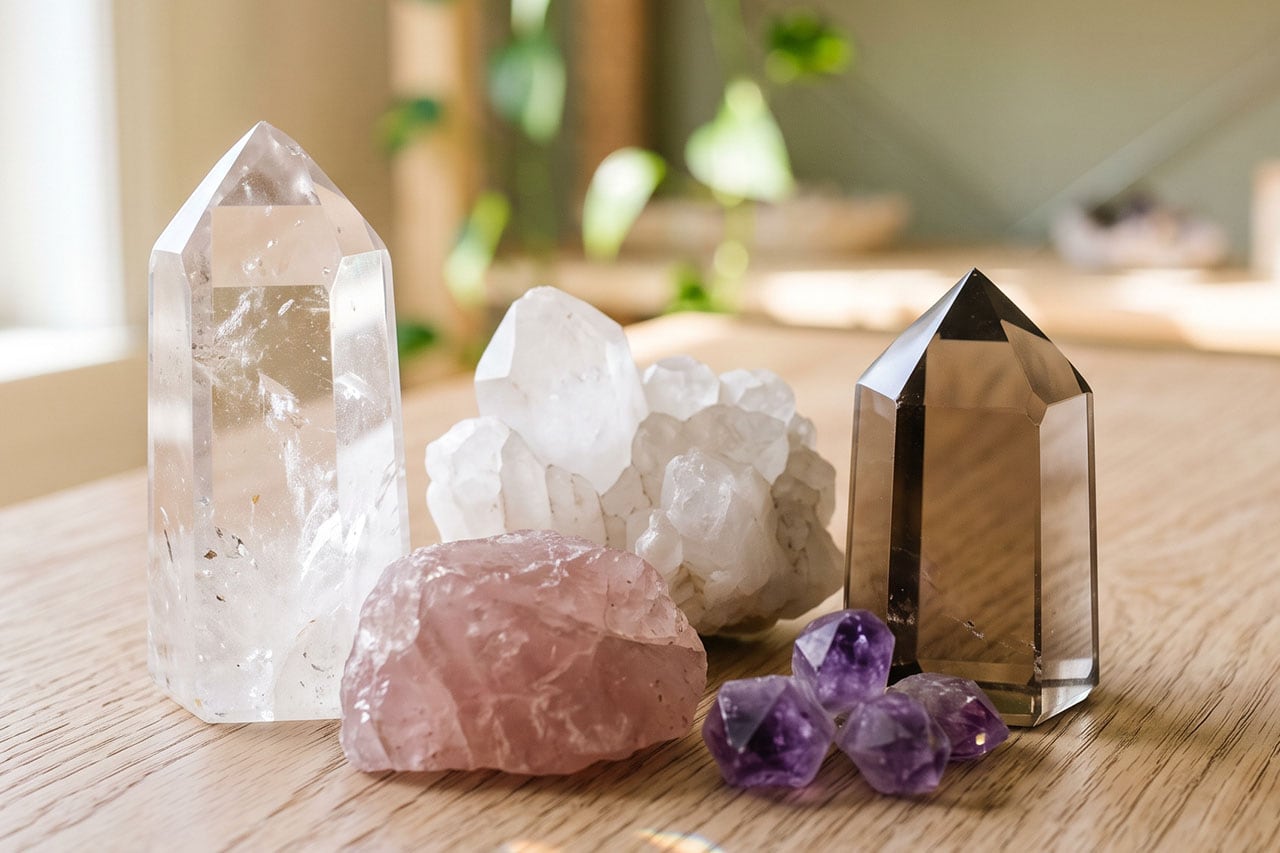
Amethyst, citrine, smoky quartz and rose quartz are quartz. Agate, jasper, carnelian, onyx and chrysoprase are quartz too, and tiger’s eye and aventurine are shelved with them. Where the tidy version stops being accurate is the claim that all of that is one substance.
In agates from Bou Hamza in Morocco, measured texture by texture, up to 31.8 per cent of the stone by weight is not quartz. It is moganite, which is not a variety of quartz or a habit of it or a trade name for it. Moganite is a separate approved species with its own IMA number and its own formula, and that formula has water in it where quartz’s does not.
The varieties, then, do not differ only in crystal size and trace impurities. Across one whole half of the family, they differ in which mineral is present.
Everything that sits under the quartz name
The list is longer than a shop shelf makes it look, and it splits by how big the crystals are.
At one end are the stones that grow crystals you can see. Clear quartz, amethyst, citrine, smoky quartz, rose quartz, milky quartz, prasiolite: all silicon dioxide, all capable of forming the six-sided prism with a pointed termination that people picture when they hear the word crystal, all differing from each other in colour and in almost nothing else.
At the other end are the stones whose crystals are too small to resolve by eye. Agate, jasper, carnelian, onyx, sard, chrysoprase, bloodstone and flint all belong here, and chalcedony is the family name for the material they are made of. A slab of carnelian shows no grain of any kind. It is still built from quartz crystallites, and they are simply too small to see.
Then two stones sold alongside the rest that need a footnote each. Aventurine is not a mineral at all but a rock. GIA’s 2025 review of phenomenal gemstones records that the name was first adopted in mineralogy for quartzite, a metamorphic rock made mostly of interlocking quartz grains, and the glitter comes from flakes of green chromium-bearing mica scattered through it. Tiger’s eye is stranger still, and the reason takes a section of its own.
The chalcedony half carries a second mineral
Moganite entered the register as a species in 1999, from Spain. Its formula is written SiO2 with water attached. That is a different compound from SiO2 on its own, and it is enough on its own to put the material outside the family name.
The quantities are not trivial. A 2024 study in Mineralogical Magazine by Monico and colleagues reports moganite present in chalcedony at 5 to 20 weight per cent, rising to between 22 and 30 in the material sold as aquaprase. The Moroccan agate work published the same year in Scientific Reports found the content varying with the internal texture of the stone, from nothing in some textures to 31.8 per cent in others, and describes moganite as another but metastable silica polymorph intergrown with the quartz.
Metastable does the work in that sentence. Moganite is not a stable arrangement of silicon and oxygen at surface conditions, and over geological time it gives way to ordinary quartz. An agate is less a fixed object than one caught partway through a slow change, and the proportion in a given piece is a measurement of where that piece has got to.
None of this is visible, and none of it changes how a piece of agate behaves on a windowsill. What it does change is the claim. Chalcedony is a mixture. Calling it quartz is a reasonable shorthand and it is not a full description.
The same review that reports the moganite figures also lists what else turns up in agate layers alongside the quartz: opal in two forms, cristobalite, quartzine, and both mineral inclusions and water. An agate band is a small assemblage, and the assemblage varies from one band to the next in the same nodule.
Three more places the one-substance answer fails
Chrysoprase is the neat case. Its apple green does not come from nickel substituting into the quartz lattice, the way iron sits in amethyst. It comes from separate nickel-bearing silicate minerals dispersed through the stone as inclusions. Monico’s group identify willemseite as the phase responsible; Jiang and Guo, publishing in Scientific Reports in 2021, identify pimelite. Both are nickel silicates and neither is quartz, and the disagreement between the two papers has not been settled.
Aventurine, as above, is a rock rather than a mineral, which puts it outside the family in the strict sense while leaving it entirely in place on the shelf. Quartz is the bulk of it and quartz is not what makes it aventurine. Strip out the mica and what is left is quartzite, which nobody sells.
Tiger’s eye is the one where the part you are buying is not quartz. GIA’s 2025 review states directly that the chatoyancy of tiger’s eye is created by fibrous mineral inclusions and not by the columnar quartz crystals, and that the typical golden-brown colour comes from iron-rich amphibole needles weathered to iron oxides. The tiger’s eye I know best is a polished tower, golden and bronze in strong parallel bands, and the travelling light that makes it worth owning belongs to the amphibole rather than to the quartz around it.
How the amphibole and the quartz came to be arranged that way is genuinely disputed. Heaney and Fisher proposed a crack-seal growth model in Geology in 2003. Gutzmer, Beukes and Cairncross published a formal challenge to it in the same journal the following year, and Heaney and Fisher replied to that. GIA’s review presents the crack-seal account without mentioning the exchange. Anyone writing that tiger’s eye is a pseudomorph of quartz after crocidolite is repeating one side of an argument that is still open.
What the family name is still good for
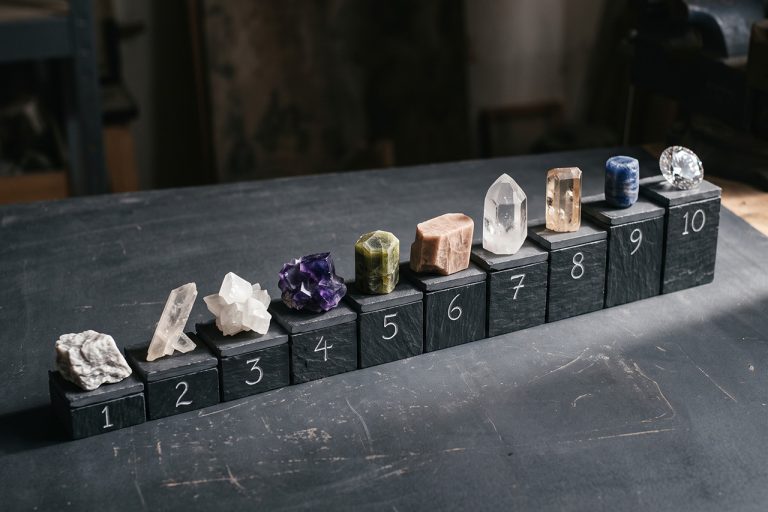
It is a reasonable guide to hardness, with a caveat. The quartz figure of 7 belongs to the species, and the chalcedony half of the family does not quite reach it: GIA gives bloodstone, which is a chalcedony, at 6.5 to 7. The number on a tag is a species figure, and the object it is attached to is frequently not a single crystal of that species.
It is also a warning about treatment, because the material is porous enough to take it. The CIBJO Retailers’ Reference Guide states that chalcedony “can be dyed in practically all colours, due to its porous nature”, and that “Much of the black chalcedony sold on the market is treated black”. GIA’s position on citrine is similar: yellow quartz colours are rare in nature, and most citrine on the market started as amethyst and was heated. Neither is fraud when it is disclosed. Both are things a buyer is entitled to be told.
The name earns its keep once it stops being asked to mean one substance. Someone who knows that agate, jasper, carnelian and onyx share a base material has a short set of questions to put to any of them. What is dispersed through this piece, how large are the crystals in it, and what has been done to it since it left the ground. A quartz page in the Crystalance Mineral Library will answer the first of those and start the second. The last one is a question for a seller.
Sources
- Powolny, T., Dumanska-Slowik, M., Szczerbowska-Boruchowska, M. and Woszczyna, M. (2024), “Water and moganite participation in agates from Bou Hamza (Morocco)”, Scientific Reports 14, 22473, for moganite content between 0.0 and 31.8 weight per cent depending on silica texture, and for moganite as another but metastable silica polymorph.
- Monico, S. et al. (2024), “Similarities and differences among selected gemmological varieties of chalcedony: chemistry, mineralogy and microstructure”, Mineralogical Magazine 88(2), 136-146, for moganite at 5 to 20 weight per cent in chalcedony rising to 22 to 30 in aquaprase, and for willemseite as the phase colouring chrysoprase.
- IMA-CNMNC Master List of Mineral Names, September 2026, for moganite as a valid species, IMA 1999-035, from Spain, with the formula SiO2 with water attached.
- Jiang, Y. and Guo, Y. (2021), “Genesis and influencing factors of the colour of chrysoprase”, Scientific Reports 11, 9939, for pimelite as the inclusion responsible for the chrysoprase colour.
- Sun, Z. et al., “Structures Behind the Spectacle: A Review of Optical Effects in Phenomenal Gemstones and Their Underlying Nanotextures”, Gems & Gemology Summer 2025, for the name aventurine first being adopted in mineralogy for quartzite, for the chatoyancy of tiger’s eye coming from fibrous mineral inclusions and not the columnar quartz, and for the golden-brown colour coming from iron-rich amphibole needles weathered to iron oxides.
- Heaney, P.J. and Fisher, D.M. (2003), “New interpretation of the origin of tiger’s-eye”, Geology 31(4), 323, with the Comment by Gutzmer, J., Beukes, N.J. and Cairncross, B. (2004), Geology 32(1), e44, and the authors’ Reply at e45, for the dispute over the formation model.
- GIA, March birthstones, for bloodstone, a chalcedony, at 6.5 to 7 on the Mohs scale.
- CIBJO Retailers’ Reference Guide, Gemstones, for chalcedony being dyeable in practically all colours due to its porous nature, and for much of the black chalcedony on the market being treated black.
- GIA, treated citrine, for yellow quartz colours being rare in nature and most citrine being heated amethyst.
- Gotze, J., Mockel, R. and Pan, Y. (2020), “Mineralogy, Geochemistry and Genesis of Agate: A Review”, Minerals 10(11) 1037, for agate layers intergrown or intercalated with macrocrystalline quartz, quartzine, opal-A, opal-CT, cristobalite and moganite, plus mineral inclusions and water.