Druzy is a crust of very small crystals grown across a surface, and the word used to point at the opposite thing. In sixteenth-century German mining speech a Druse was the cavity in the rock. The crystals borrowed the name roughly two hundred years later.
The dictionary of the Berlin-Brandenburg Academy of Sciences dates both senses. In miners’ language, a hollow space in stone, sixteenth century; then minerals formed as connected crystals, eighteenth century. It adds a third fact, in three words: die Etymologie ist ungeklärt. Where Druse came from before it entered mining speech has never been established, several candidates have been proposed, and the dictionary endorses none of them.
A meaning that holds for two hundred years is well settled, and the older sense stayed in use anyway. Britannica still lists druse as an alternative name for a miarolitic cavity, meaning a hole. The gem trade uses the newer sense exclusively, and the spelling drifted to druzy on the way. Both are current. They are pointing at different objects.
What the word did next
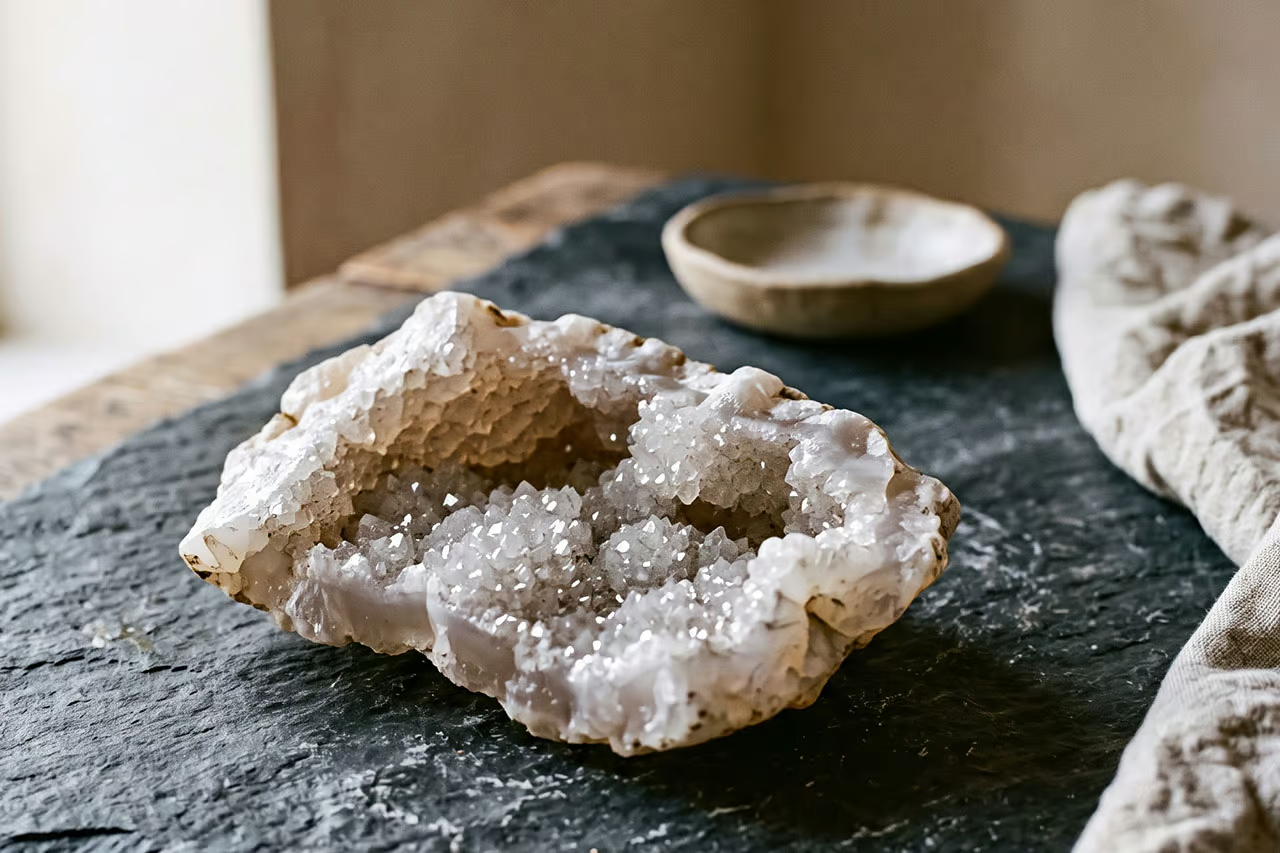
The trade definition is a description of an appearance. GIA gives drusy as clusters of small crystals that sparkle like snow or sugar coatings on the minute crystals of rock surfaces, and treats druzy and drusy as one word with two spellings. Neither spelling carries any information about the stone, the mineral or whether anything has been done to it.
Sedimentary petrology kept a stricter version that describes a geometry instead. The SEPM glossary defines drusy cement as sparry calcite lining the pore walls of a limestone, with the characteristic of increasing in crystal size toward the pore centre. Note the mineral in that definition. Petrology’s drusy is calcite in a carbonate rock, not quartz in a cavity, so the word was never a quartz word to begin with. The jewellery trade attached it to quartz because that is what turned up in the material it was selling.
GIA is naming what covers the surface. SEPM describes what happens across the space between that surface and the middle of the pore. Both are accounts of one event from opposite ends, and the sixteenth-century miner who called the hole a Druse was standing at the SEPM end of it.
No source gives a size in millimetres, incidentally. Every definition says small, fine or minute and stops there. A page that draws the line at a specific measurement has invented it. The working test is whether you find yourself counting individual crystals or looking at a texture.
Both senses are describing one object
A druzy crust and a crystal-lined cavity are not two things that happen to resemble each other. A crust is what lines a cavity, so naming the hole and naming the lining are two ways of pointing at one object, which is why one word did both jobs for two centuries without much confusion.
The mechanism sits underneath both senses and belongs to the older one. Crystals on the wall of a space compete for the room in the middle, and the survivors widen toward the centre. SEPM records that gradient in limestone pores, and it is the same competition set out in how crystal clusters are formed. Where the space is large and the competition runs a long way, the result is separate points a buyer can count. A shallow space, or a crust caught early, gives a texture instead. One process, different amounts of it.
The two words never sorted themselves into a stage sequence for that reason. A crust is not young and a cluster is not old; what separates them is how much room there was. Druzy turns up on the inner walls of geodes and on the broken faces of agate nodules because those are where a small enclosed space gets opened up and looked at.
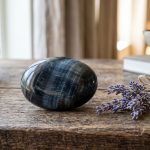
The habit and the appeal can pull in the same direction. Grape agate, a botryoidal purple chalcedony from Sulawesi sold under a trade name that is not its mineral name, is not druzy at all: its surface is rounded lobes and not crystal faces. A piece of it on our own shelf makes the neighbouring point anyway. Anyone buying it has looked straight at the fact that the material grew in small units. The small units are the reason.
Druzy jewellery ages differently from a polished stone, and the reason is the same geometry. Those crystal tips are unsupported on every side except the one they grew from, and they stand proud of the surface, which a polished cabochon of the same mineral does not. Grit also settles into the gaps between them where no cloth reaches. Neither is a defect in the material. Both follow from a surface made entirely of terminations, and a jeweller who sets druzy in a bezel is working around exactly this.
How druzy gets its colour
The jewellery trade colours druzy in two quite different ways, and GIA documents both. GIA lists coating among the treatments a gem can receive and describes it as the application of a metallic substance to produce iridescence. Its Jaipur field report sets out the process: coating is done in a vacuum, by electron beam or sputtering, often involving 24 to 36 separate coats at thicknesses typically between 100 and 400 nanometres. Gold coatings produce a gold colour directly, while titanium oxide and silicon oxide films work by light interference and can be tuned to a range of colours. The report also carries a figure that reframes the economics of the product. The finished coated drusy yields about one percent weight retention from the original geode.
Dye is the other route, and it behaves differently. GIA includes chalcedony and quartz among dyed materials and notes that many dyes can be removed if the gem comes into contact with a solvent such as alcohol or acetone. A coating is a film sitting on the surface. A dye is a colourant that has gone into the pore space, which is why a solvent can reach it and cannot reach the other. A treated piece is not a worse piece. It is a differently described one, and a buyer is entitled to the description before paying.
The obligation to say which is not a matter of etiquette. GIA’s position is that disclosing a treatment is necessary and legally required for anyone selling a gem, and it extends that explicitly to consumer-to-consumer trade. The Federal Trade Commission’s jewellery guides set out when the obligation bites in the United States: where a treatment is not permanent, where it creates special care requirements, or where it significantly affects the value of the gemstone.
Those three conditions are the ones to hold a druzy listing against. A rainbow sheen is a coating, and a metallic film sitting on unsupported crystal tips is a fair candidate for at least the first two of them. Ask a seller which treatment, and ask before the sale rather than after it.
A druzy surface can be quartz or chalcedony, and the Crystalance Mineral Library is where those two part company, because the word itself will not separate them. It names the shape of the growth and says nothing about the species.
A geologist writing about a granite with small crystal-lined cavities in it will still call them druses today, and mean the holes.
Sources
- Druse, Digitales Wörterbuch der deutschen Sprache, Berlin-Brandenburg Academy of Sciences, for the sixteenth-century mining sense of a hollow in stone, the eighteenth-century shift to the crystals, and the unresolved etymology.
- Druse, Encyclopaedia Britannica, for druse as an alternative name for a miarolitic cavity.
- “Dreamy Drusy: Minute Crystals Shimmer in Dramatic Jewelry Designs”, GIA, for drusy as clusters of small sparkling crystals on rock surfaces and for the alternative spelling.
- Drusy cement, SEPM STRATA, for drusy cement as sparry calcite lining pore walls with crystal size increasing toward the pore centre.
- Gem Treatments and the Chart of Commercially Available Gem Treatments, GIA, for coating as the application of a metallic substance to produce iridescence, for dye removal by solvents, and for the disclosure obligation; and the Jaipur field report, Gems and Gemology Winter 2016, for the vacuum coating process, 24 to 36 coats at 100 to 400 nanometres, and about one percent weight retention.
- 16 CFR 23.24, US Federal Trade Commission jewellery guides, for the conditions that trigger a disclosure obligation.