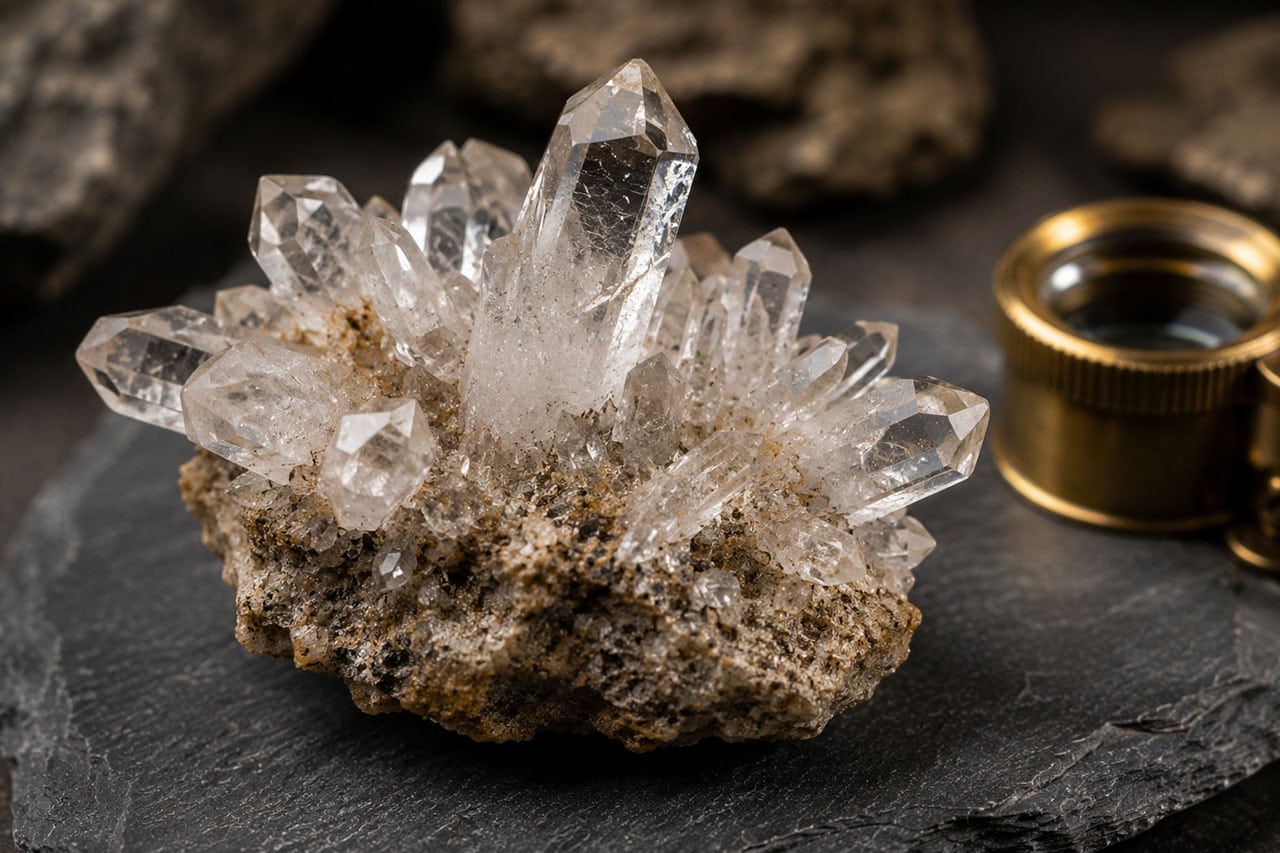
Crystal clusters form by elimination. Many crystals nucleate on a cavity wall pointing in random directions, and the ones whose fastest growth direction happens to aim into open space overgrow and bury their neighbours. The points on a finished cluster are the survivors of that.
On the wall of a fresh cavity the crystals start out pointing in every direction available. Frisia describes exactly that at the base of a columnar fabric: small crystals with random growth directions, sitting there as testimony of a nucleation episode. Nothing at that stage is aiming outward on purpose. The orientation is arbitrary, because on a wall that carries no crystals of its own there is nothing for a new one to line up against.
What happens next decides everything about the object that eventually reaches a shelf. Self and Hill give the process its name in a sentence: competitive growth on a substrate surface normally leads to a reduction in the number of individuals constituting the aggregate, a situation called selection.
A cluster has fewer crystals on it than started.
How the crowd thins out
Self and Hill name four selection mechanisms and call geometric selection the most influential during the early stages of growth. It is not the only one. Substrate selection favours crystals sitting on a convex protrusion, primogeniture selection favours whichever nucleated first, and some crystals stop for no advantage anybody can identify, which the authors call random selection and describe as unpredictable.
Geometric selection is the one with a rule you can state. Each crystal has a direction along which it grows fastest, and Self and Hill set the criterion as mass transfer. The individual whose greatest growth vector is best aligned with the environment continues growing at the expense of neighbouring individuals of other orientations. A crystal tilted at forty degrees to the wall is still growing, but it is growing into its neighbours, and it runs out of room while a crystal aimed at the open cavity keeps going.
Perpendicular to the wall is usually the winning alignment, and this is where the standard account gets the causation backwards. Perpendicularity is not a direction imposed at nucleation. Self and Hill hedge it twice. There are several geometric rules for selection, they write, and perpendicularity to the substrate is only the most common of them, applying to most mineral veins and to many common varieties of speleothems. It wins because it is the alignment that reaches the solution first, not because a crystal knows where the wall is.
Frisia, working on cave deposits, reports the same competition and the same outcome. Crystals whose greatest growth vector is perpendicular to the substrate are favoured; those oriented differently are outcompeted.
Once numbers fall, the target shifts. Selection at first favours growth perpendicular to each individual irregularity in the wall, and a cavity wall is full of irregularities. As the survivors thin out and thicken, the most successful become the ones oriented toward the bulk volume of the solution instead. The cluster ends up looking organised because two rounds of the same competition happened, one against the local bumps and one against the room.
The idea was systematised in Russian genetic mineralogy by Grigor’ev, whose Ontogeny of Minerals appeared in Lvov in 1961 and in English translation four years later. It reaches the English-language cave and ore literature mainly through that translation.
What the survivors look like
The crystals taper. The USGS descriptive model for epithermal gold and silver deposits, describing vein textures, sets out comb quartz as prismatic, euhedral, parallel-arranged crystals arrayed perpendicular to host rock margins, and adds, citing Adams in 1920, that quartz crystals generally taper, having narrow bases and wider prismatic terminations, and are not identical. Narrow at the bottom and wider at the top is the profile of a crystal that spent its early life squeezed between competitors and its later life with room to spread.
Numbers fall with distance from the wall as well. Bons prints a photomicrograph of an elongate blocky quartz vein from East Gippsland, eight millimetres across the field of view, and the caption reads that growth competition reduced the number of grains away from the vein margin. The winners widen as well as lengthen, an observation Bons traces back to Mügge in 1928.
Sizes vary across a cluster, which undercuts the tidy explanation that clustered crystals match because they all started together. The uniform cases are the ones where nothing competed. Bons gives fibrous veins as the type that hardly shows any growth competition, with all grains having approximately the same shape, and even his own example still widens slightly away from the median line.
Coarsening outward is a tendency and not a law. The same USGS report qualifies it. In crustiform bands, quartz grain size may show systematic gradation from coarse to fine, or the reverse. A banded vein is a stack of separate growth episodes, so the pattern holds inside one increment and not across the stack.
Aggregates that never competed
If the cavity wall already carries crystals of the same species, a new crystal can grow in continuity with what is underneath it. Self and Hill call this autoepitaxial growth, one example of a wider class in which orientation is predetermined instead of selected. They add that growth on textured substrates matters little for cave mineralogy and a great deal for ore mineralogy. Either way the result looks parallel from the start, because it was never anything else.
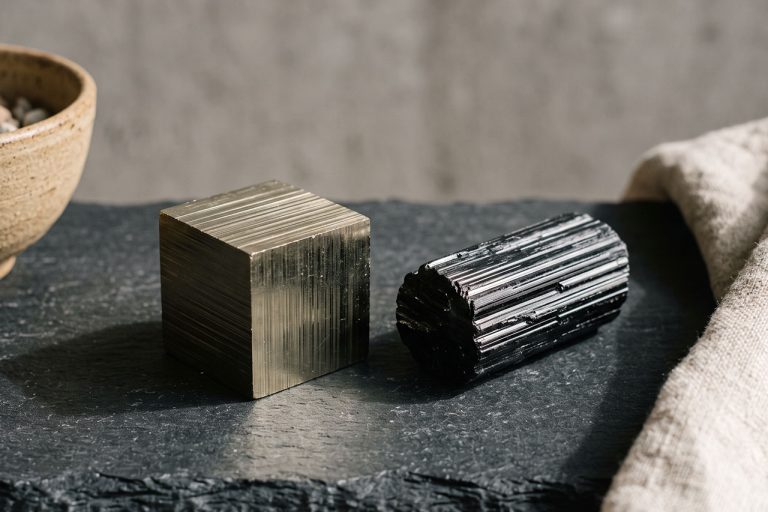
Fibrous material reaches a shelf far more often than either. Black tourmaline reaches retail as a bundle of sub-parallel columns grown side by side, and the raw piece in our own collection is one of those: its breaks run stepped and square across the bundle, following the contacts where one column meets the next. Nothing was eliminated on the way. Every column that started is still standing, which is what an aggregate looks like when the competition never happened.
The words for the cavity
A vug is not a gas bubble. The Geologic Resources Inventory glossary maintained by the National Park Service, whose terms were written by its own report authors or adapted from the standard American Geological Institute glossaries, gives a vug as a small cavity in rock, commonly lined with crystals of a different mineral composition from the enclosing rock. Nothing in the definition mentions gas. The gas bubble is a vesicle: a cavity of variable shape formed by the entrapment of a gas bubble during solidification of lava. Fill a vesicle with secondary minerals and it becomes an amygdule. A small irregular cavity in an igneous rock with crystals of the rock-forming minerals poking into it is miarolitic.
A cluster out of a vesicle came from a lava flow. A cluster out of a vug did not necessarily come from anywhere volcanic at all, and the two get sold under the same word.
The crystals that lost are still in there underneath the visible points, overgrown, which is why a thin section cut across a vein shows grains wedging out against their neighbours all the way in from the margin. A cluster counts only the survivors. Whether a given mineral clusters at all is a fact about its habit, and habit is one of the fields on every page of the Crystalance Mineral Library. The lapidary forms a cluster gets cut down into afterwards have an article of their own, what are crystal points, spheres, clusters and other shapes.
The number of survivors tells you how many nucleated and how many were buried, and the taper tells you that the winners got roomier as they went. Neither figure converts into years, and no published method turns either one into a date.
Sources
- Cyndi Self and Carol Hill, “How Speleothems Grow: An Introduction to the Ontogeny of Cave Minerals”, Journal of Cave and Karst Studies 65(2), 2003, for selection, the mass-transfer criterion, perpendicularity as the most common of several rules, the shift toward the bulk solution, autoepitaxial growth, and Grigor’ev’s place in the literature.
- Silvia Frisia, “Microstratigraphic logging of calcite fabrics in speleothems as tool for palaeoclimate studies”, International Journal of Speleology 44(1), 2015, for random orientations at the nucleation surface and for competitive growth in columnar fabrics.
- Paul Bons, “The formation of veins and their microstructures”, Journal of the Virtual Explorer 2, 2000, for grain numbers falling away from the vein margin, the widening of winner grains, the attribution to Mügge, and uniform grain shape as the diagnostic of fibrous veins.
- David John and others, Descriptive Models for Epithermal Gold-Silver Deposits, USGS Scientific Investigations Report 2010-5070-Q, 2018, for comb quartz, the taper from narrow bases to wider terminations, crystals that are not identical, and gradation in crustiform bands.
- Glossary of Geologic Terms, National Park Service Geologic Resources Inventory, for vug, vesicle, amygdule and miarolitic.