Yes and no. Green and purple fluorite are the same mineral, calcium fluoride, with the same hardness and the same crystal structure. The colour is the only real difference between them, and it comes from tiny flaws in the crystal rather than from any change in what the stone is made of.
A single fluorite crystal can be green in one band and purple in the next. Slice it, and the two colours meet along a line you could put a fingernail to, with nothing between them but a change in the light coming through. The trade sells these zoned pieces as rainbow fluorite, and a spike of it we have had occasion to handle ran from a transparent violet base up through blue and into green before turning back again, the whole sequence recorded in one unbroken stone.
If green and purple can be the same crystal, they can hardly be different stones. What separates them is not chemistry but history, the particular conditions each part of the crystal grew in, written into the stone as colour.
One mineral, read two ways
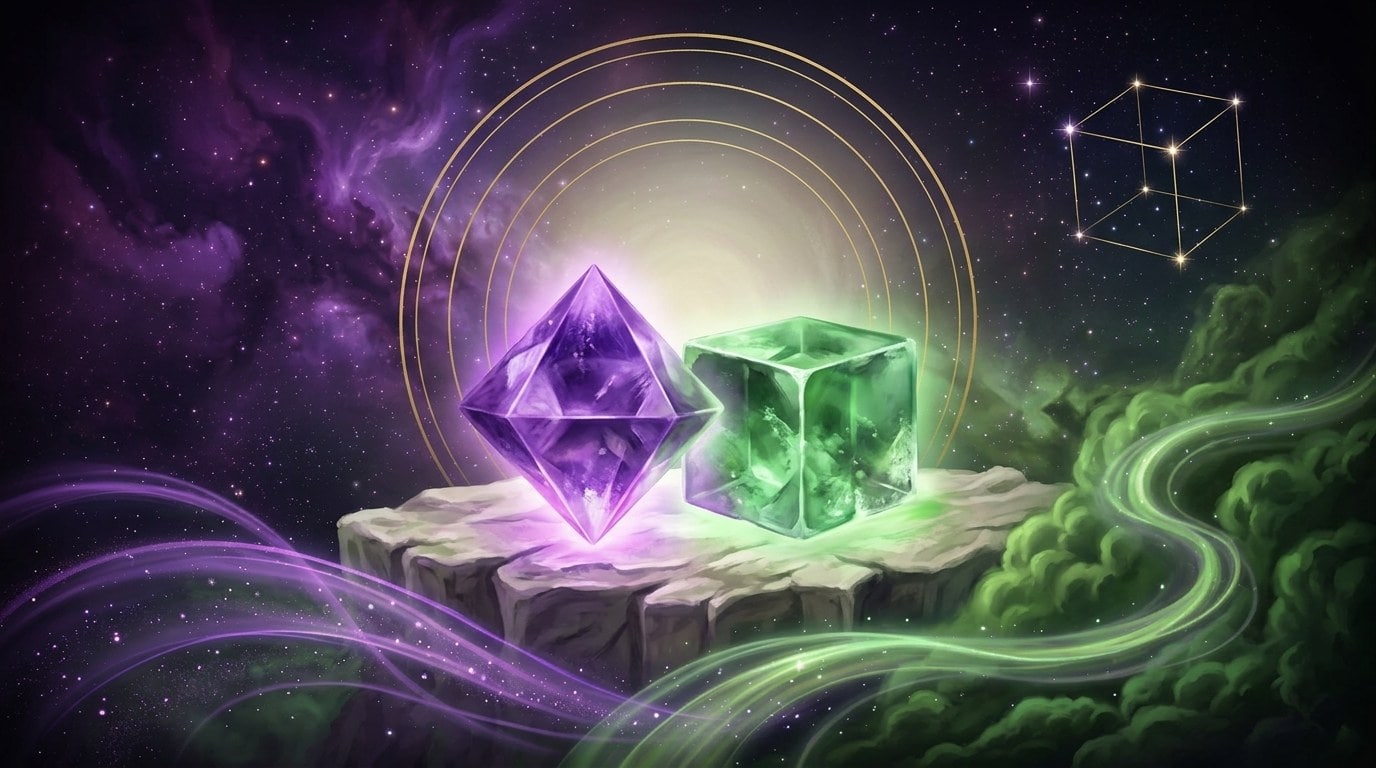
Fluorite is calcium fluoride, the compound CaF2, and it crystallises in the cubic system. Its natural forms are cubes and octahedra, the eight-sided shape a pair of pyramids would make base to base. It sits at 4 on the Mohs scale of scratch resistance, which makes it the reference point for that number, soft enough that a steel knife marks it and too soft to trust in a ring worn every day.
None of that changes with colour. A purple octahedron and a green cube are the same species with the same hardness and the same willingness to split into clean octahedral fragments if you drop them. Collectors prize fluorite partly for that geometry, and jewellers mostly leave it alone for the same reason: a stone that cleaves this willingly is happier in a cabinet than on a hand. It is also why so many of the small polished octahedra in shops were never cut to that shape at all. Fluorite parts so cleanly along its internal planes that a cleaved fragment arrives already eight-sided, and a light polish is all it takes, which is a rare case of the crystal doing the lapidary’s work for it. Green or purple makes no difference to any of this. The cleavage follows the structure, and the structure is identical.
The first answer, then, is that there is no mineralogical difference at all. What remains to explain is not what the stone is, but why it took on a colour at all.
Where the colour comes from
Pure calcium fluoride is colourless. Fluorite arrives at its colours through defects, small irregularities in the lattice, and two kinds do most of the work.
The first is a colour centre, a place where the orderly grid of calcium and fluorine atoms has gone wrong and an electron has settled where it should not be. Natural radiation acting on the crystal over long stretches of geological time can knock atoms out of position and leave these traps behind. An electron caught in one absorbs particular wavelengths of light, and the colour you see is what is left after those wavelengths have been taken out. The second is substitution, where an atom of some other element stands in for calcium as the crystal grows. Rare earth elements such as yttrium slot into the lattice this way and pull the colour in their own direction.
Most natural fluorite carries some of both, which is why pinning one colour to one cause tends to mislead. Purple is often the mark of colour centres and some blue traces back to yttrium, but the same specimen can hold more than one mechanism at once, and a growing crystal that passed through changing chemistry ends up banded, each layer a snapshot of the fluid around it at the time. The physicists who worked this out, Bill and Calas among them, titled their study after exactly that pairing of colour centres and rare-earth ions.
The same ground often gives up both colours, and that is the clearest sign that they are not separate stones from separate places. Fluorite from Derbyshire is the standing example. The banded purple-and-blue variety known as Blue John comes from the same Castleton ground that yields paler and greener material, so within a single deposit the colour changes with the seam rather than marking a different stone. The world’s other big fluorite fields behave the same way, sending out purple and green side by side. When a shop sets a violet cube beside an apple-green octahedron and calls them two varieties, the geology underneath is usually one deposit, sampled twice.
There is a small piece of history folded into this. When George Stokes needed a word, in the early 1850s, for the glow some materials give off under ultraviolet light, he took it from fluorspar, the old name for fluorite, on the model of opalescence, which is likewise named after a mineral. Fluorescence is named after this stone. The glow and the colour come from the same root, the way defects in the lattice take in light and hand part of it back, so a mineral that taught us a word for one is quietly demonstrating the other every time you notice it is green.
What the colour is asked to mean
None of this stops the colour from mattering to the people who work with the stone, and it helps to be clear about where that meaning lives. Crystal practice reads the fluorite colours as distinct: purple for a quieter, more inward attention, green for something more to do with growth and the heart, and the varieties are set apart accordingly on any shop’s shelf. The tradition is old enough and consistent enough to be taken on its own terms, as a way people have organised their sense of these stones rather than a claim about the fluorine lattice.
What the geology says is only that the lattice does not know which colour it is. The defect that makes a crystal green is not doing anything to a hand that holds it that the defect making it purple is not also doing. If a green stone settles you and a purple one does not, that is a real response, and it is happening in the person rather than in the calcium fluoride. Both of those can be true without straining, and the site’s whole habit is to keep them in separate sentences rather than let one borrow the other’s authority.
The advice that follows from all this stays modest. Choose the fluorite whose colour you like, the way you would choose anything you mean to keep looking at, and know that the choice is aesthetic and personal rather than a choice between two different minerals. A rainbow specimen, where several colours share one stone, makes the point on its own without any help from us. If you want the wider picture of how one mineral comes to wear so many colours, our note on why crystals are different colours follows the same physics across other stones, and the Crystalance Mineral Library carries the full profile of fluorite itself.
Sources
- Handbook of Mineralogy, Fluorite (CaF2, cubic, hardness 4, perfect octahedral cleavage): https://www.handbookofmineralogy.org/pdfs/fluorite.pdf
- Physics and Chemistry of Minerals (1978), Bill and Calas on colour centres and rare-earth ions as the origin of colour in natural fluorite: https://link.springer.com/article/10.1007/BF00308116
- George Gabriel Stokes, “On the Change of Refrangibility of Light”, Philosophical Transactions of the Royal Society of London 142 (1852), footnote on p. 479, coining “fluorescence” from fluor-spar by analogy with opalescence: archive.org