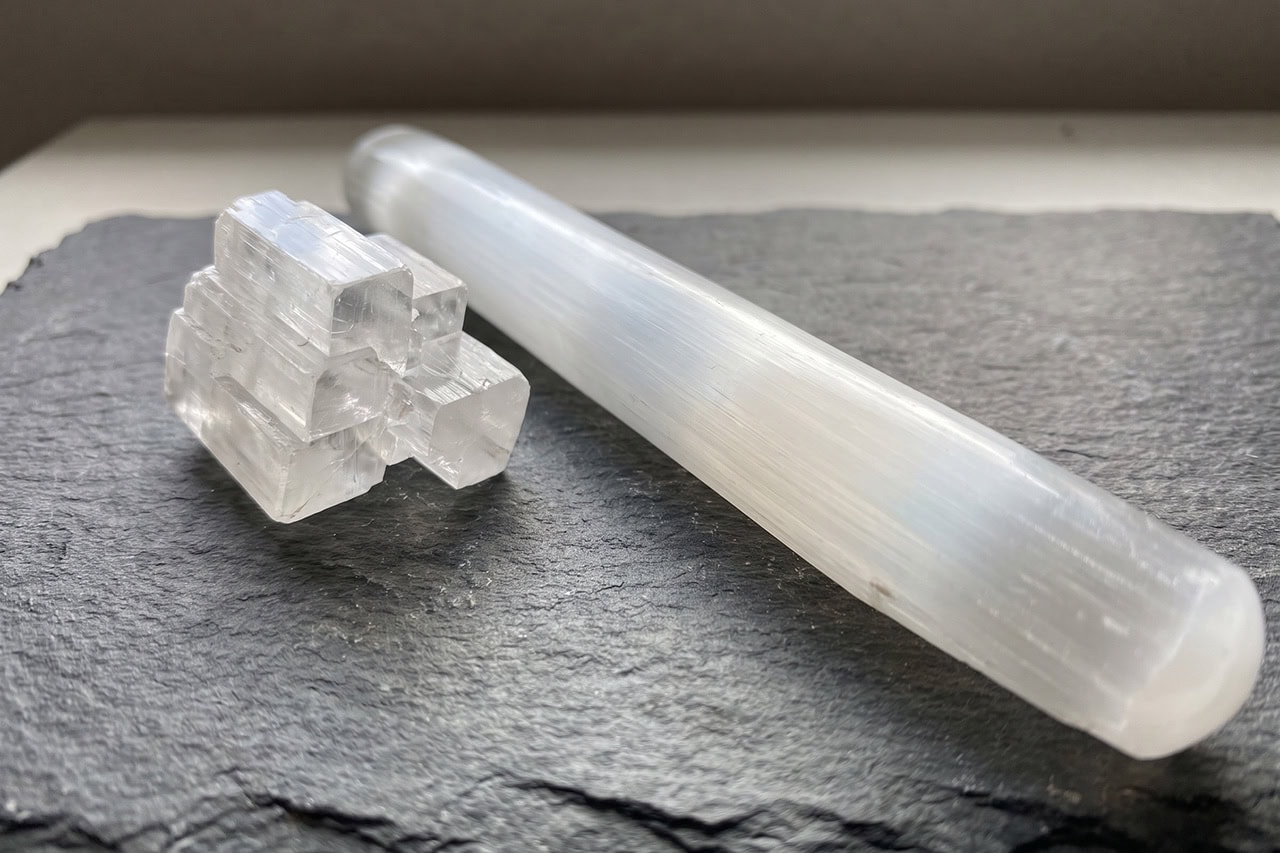
Selenite and satin spar are the same mineral, gypsum, in two different physical forms. Selenite is the transparent, glassy, well-crystallised variety. Satin spar is the fibrous, silky, pearly-white variety with a soft cat’s-eye sheen. They are chemically identical, and here is the twist most buyers never hear: the great majority of “selenite” wands, towers, and sticks sold in shops are actually satin spar.
This is one of the crystal world’s quiet open secrets. That glowing white tower on your shelf, the one you bought as selenite, is very probably satin spar, and almost nobody selling it will mention the difference. It is not usually a scam, exactly, more a piece of trade shorthand that has drifted into inaccuracy. But it is worth understanding what you own.
Let’s clear it up properly.
The Same Mineral: Gypsum
Start with the fact that dissolves most of the confusion. Selenite and satin spar are both varieties of gypsum, a soft mineral made of calcium sulphate. Their chemistry is identical; only their physical form differs.
This puts the comparison in a different light from most “X vs Y” questions. Sodalite and lapis are different substances. Carnelian and jasper differ in structure. But selenite and satin spar are the very same mineral, wearing two different habits. Asking which is “better” is a bit like asking whether an icicle or a snowflake is better water. The stuff is the same; the shape is not.
Because they are the same mineral, they share the same properties that matter most in practice. Both are soft, both dislike water, and both are treated the same way in care, which we come to below.
How They Look Different
Same mineral, but you can usually tell them apart at a glance once you know what to look for.
Selenite is the transparent, glassy variety. Proper selenite forms clear or lightly tinted crystals, sometimes in large tabular sheets, with a see-through or pearly clarity. It looks like a crystal, because it is one, well formed and glassy.
Satin spar is the fibrous variety. Instead of transparency, it has a silky, pearly, milky look, and its parallel fibres produce a soft moving band of light across the surface, a cat’s-eye sheen called chatoyancy. That glowing, satiny, almost fibre-optic quality is the giveaway. Most white “selenite” towers, with their luminous glow, are satin spar showing exactly this sheen.
What’s striking is that the very quality people love about their “selenite” tower, that soft inner glow, is really the signature of satin spar. Truly transparent selenite does not glow like that; it is clear, like glass.
Why Most “Selenite” Is Satin Spar
If the two are so tellable apart, why the near-universal mislabelling?
Part of it is abundance. Satin spar is common and forms readily in the fibrous veins that are easy to cut into wands and towers, so it is cheap and plentiful. Transparent selenite is rarer and generally more expensive. The market naturally fills with the abundant one.
Part of it is loose naming. For a long time, “selenite” has been used casually in the crystal trade as a catch-all for several gypsum varieties, satin spar included. The name stuck to the product regardless of which form it actually is, and now the shorthand is everywhere.
Consider the result. A whole category of popular crystals, the glowing white wands, sticks, and charging plates, is sold under one name while mostly being another. It is not that sellers are lying so much as that an inaccurate convention has hardened into a habit.
Gypsum’s Other Faces
Selenite and satin spar are not even the whole story. Gypsum grows in several forms, and knowing them helps put the pair in context.
Desert rose is gypsum (sometimes with sand grains included) that has crystallised into clustered, petal-like blades resembling a flower, formed in arid, sandy conditions. Gypsum flower is a related bladed form. Alabaster is the fine-grained, massive variety of gypsum, soft enough to carve, prized by sculptors for millennia precisely because it works so easily. All of these, the glassy selenite, the silky satin spar, the rosette desert rose, the carveable alabaster, are one mineral wearing different habits.
Consider how much variety a single soft, humble mineral produces. Calcium sulphate, given different conditions, becomes a transparent crystal, a fibrous wand, a stone flower, or a sculptor’s block. The “selenite versus satin spar” question is really just two entries from a longer family album.
The Giant Crystals of Naica
There is one more member worth naming, because it is spectacular. The largest natural crystals ever documented, the beams up to eleven metres long in the Cueva de los Cristales in Mexico, are also gypsum, and are properly called selenite. They are the same mineral as the little glowing wand on your shelf, grown to cathedral scale over hundreds of thousands of years.
That is a genuinely humbling thought for this comparison. The transparent selenite variety, the rarer of our two, is the same stuff that formed the most gigantic crystals on the planet. Whether it grows into a giant beam, a fibrous silky vein, a stone flower, or a carveable block comes down to conditions and time, not to any difference in the mineral itself. The soft white wand on your shelf and the eleven-metre crystals of Naica are, atom for atom, the very same thing.
Does the Difference Matter?
Here is the honest answer, and it has two parts.
For crystal-practice purposes, most people treat the two as interchangeable, and reasonably so, since they are the same mineral with the same associations of clearing, calm, and cleansing. If you bought a “selenite” tower for those qualities and it turns out to be satin spar, you have lost nothing that matters to how you use it.
Where the difference does matter is honesty and price. If you are paying a premium specifically for rare transparent selenite, you deserve to actually get transparent selenite, not satin spar sold at a markup. And if you simply like knowing what you own, which is a fair thing to want, then the distinction is worth having. Accuracy is its own small value.
So the practical takeaway is relaxed but informed: enjoy your glowing wand for what it does, but know that it is very likely satin spar, and do not overpay under the impression it is something rarer.
Caring for Either
Because they are one mineral, the care is identical, and it is important, because gypsum is genuinely delicate.
Both selenite and satin spar are very soft, only 2 on the Mohs hardness scale, soft enough to scratch with a fingernail. And crucially, both are slightly water-soluble, so water will cloud, flake, and eventually ruin them. Never soak either one, and keep them out of humid bathrooms and off damp surfaces. For the wider list, see which crystals should not be put in water, and for using the stone itself, what selenite is good for.
Common Questions
Is my selenite tower actually satin spar? Very probably. Most white “selenite” wands, towers, and charging plates are satin spar, the fibrous form of gypsum. If it has a soft glowing sheen rather than glassy transparency, it is satin spar.
Does the difference matter for cleansing or charging other stones? For practical purposes, no. Both are gypsum and are used the same way, so whichever you have will do the job people reach for “selenite” to do.
Can I put selenite or satin spar in water? No. Both are soft and slightly water-soluble, so water will cloud and eventually dissolve them. Cleanse them dry, with smoke, sound, or moonlight.
Why is transparent selenite more expensive? It is simply rarer. Fibrous satin spar forms readily and abundantly, while clear, well-crystallised selenite is less common, so it commands a higher price.
The curious thing about selenite and satin spar is that the entire debate is really about one soft, water-shy mineral that happens to grow two ways. For more on gypsum and its glowing forms, see the Crystalance Mineral Library. Call it what you like, keep it dry, and enjoy the glow, just know which glow you are looking at.