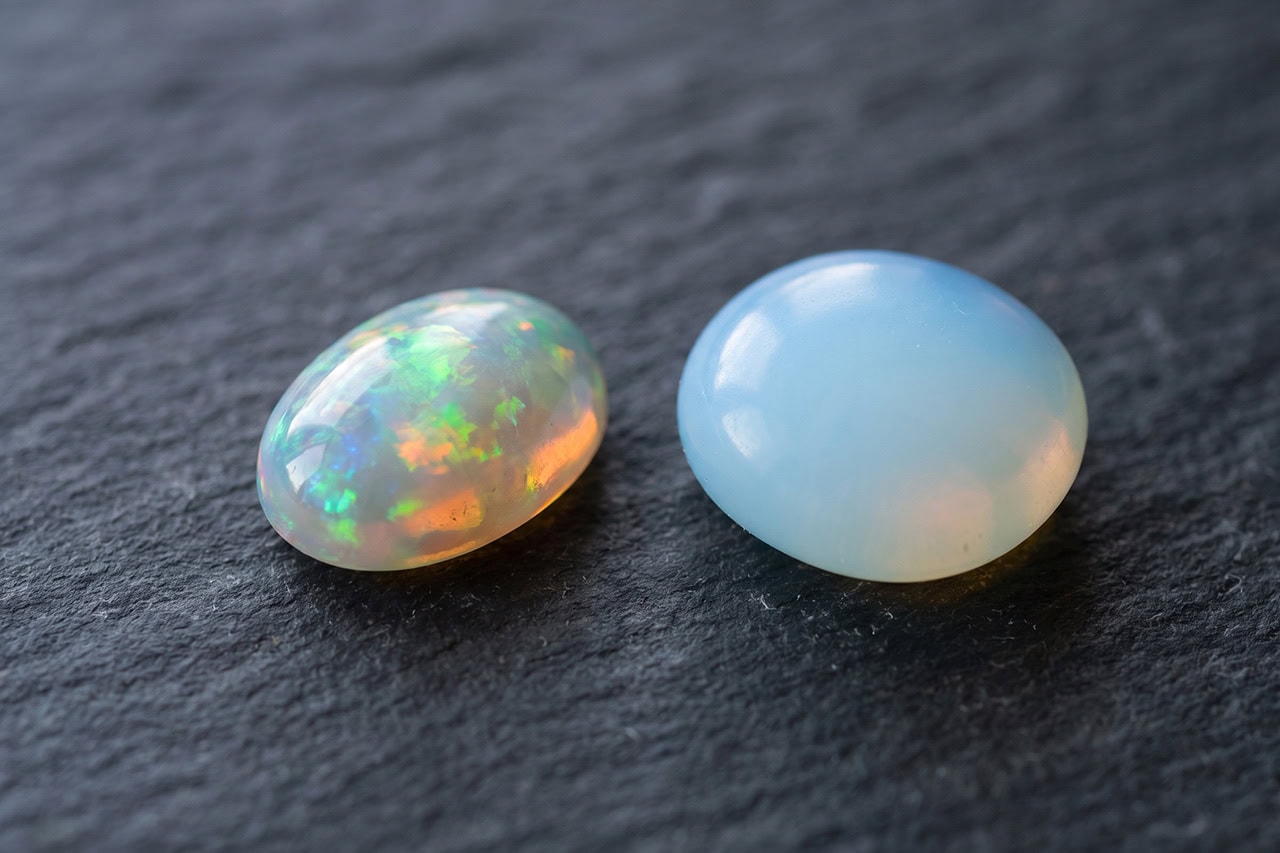
Opal and opalite sound almost the same, and that is exactly the problem. Opal is a natural gemstone, a form of hydrated silica that can flash brilliant rainbow colours. Opalite is not a gemstone at all: it is man-made glass, a milky, uniformly glowing material with no true rainbow fire. The single clearest difference is play-of-colour, the shifting internal rainbows that opal has and opalite does not.
The near-identical names do a lot of quiet work here. “Opalite” sounds like a variety of opal, a cousin, a little sister. It is not. It is manufactured glass given a name that borrows opal’s glamour, and a great many people buy it believing they have bought a natural stone. Untangling the two is worth doing, because the gap between them, in nature, rarity, and value, is enormous.
Here is the comparison.
What Each One Is
The two could hardly be further apart in origin.
Opal is a genuine mineraloid, a hydrated form of silica that contains water within its structure and forms in the earth over long spans of time. Precious opal’s glory is play-of-colour: the shifting flashes of red, green, blue, and every shade between, produced by tiny silica spheres arranged in a regular pattern that diffracts light like countless miniature prisms. Opal is the October birthstone, and fine opal can be genuinely valuable.
Opalite, despite the name, is man-made glass, an imitation, sometimes also sold under names like “sea opal” or “opalized glass.” It is mass-produced from opalescent glass (occasionally resin), designed to bend light so that it glows a soft milky blue in daylight and a warmer honey tone under artificial light. That glow is pretty, but it is not the same phenomenon as opal’s fire.
What’s striking is that these two are not variations on a theme at all. One is a natural gemstone formed underground; the other is a factory product. The shared syllable is doing all the work of making them seem related.
The Deciding Test: Play-of-Colour
If you look at one thing, look for play-of-colour, because it is the cleanest divider between the two.
Precious opal shows those darting rainbow flashes that move and change as you tilt the stone. The colours seem to come from inside, shifting across the surface, and no two opals show quite the same pattern. This is opal’s signature, and opalite cannot reproduce it.
Opalite, by contrast, has a flat, uniform, milky glow with no true rainbow fire. It may shimmer softly and shift a little between a bluish daylight tone and a warm backlit one, an effect closer to simple scattering of light than to diffraction. But hold it and turn it, and you will not see the moving spectral flashes of real opal. If the “opal” glows evenly and never throws rainbow fire, you are almost certainly holding opalite.
Consider the one honest caveat here. Not all natural opal shows strong play-of-colour either; “common opal,” or potch, is natural opal without the fire. So a lack of play-of-colour does not by itself prove a stone is opalite, but combined with the other cues below, it is telling.
More Ways to Tell Them Apart
A few further checks confirm which you have.
- Uniformity. Opalite’s milky blue is remarkably even and consistent, sometimes with the tell-tale look of glass: perfect clarity, or tiny round bubbles trapped inside. Natural opal is more variable, with internal texture and irregularity.
- The glow direction. Opalite characteristically looks bluish in normal light but glows orange or honey when light passes through it from behind. That specific two-way colour shift is a hallmark of the glass.
- Price. This one is loud. Opalite sells for a few dollars a piece, because it is cheap to manufacture in quantity. Fine natural opal can sell for hundreds or thousands per carat. A large, flawless, glowing “opal” at a bargain price is opalite.
- Bubbles. Because opalite is glass, it can contain small spherical gas bubbles, which never occur in natural opal. A loupe sometimes settles the question outright.
The Name Confusion Runs Deeper
Part of what makes this pair so slippery is that the word “opalite” is used loosely, and not always for glass.
Most often, opalite means the man-made glass described above. But the name is sometimes applied to natural common opal, or to certain milky, glowing natural stones, which muddies the water further. On top of that, glass opalite is marketed under a shifting set of names, “sea opal,” “opalized glass,” “Argenon,” and others, each sounding a little more natural than the last.
The practical upshot is that the label alone cannot be trusted, in either direction. A stone called “opalite” is usually glass, but not always; and glass is sometimes sold under names that avoid the word entirely. This is exactly why the physical tests matter more than the name on the tag. Consider the name a starting hint, then let play-of-colour, price, and a look for bubbles give you the real answer.
Durability and Care
There is a practical difference too, and it runs the same direction as everything else.
Natural opal is already a relatively soft, water-bearing gem that needs gentle care, since it can craze or crack if it dries out. Opalite, being glass, is softer still and more fragile, prone to scratching and chipping, and not well suited to hard everyday wear in rings or bracelets. So neither is a knockabout stone, but opalite is the more delicate of the two despite being the cheaper.
Is Opalite a Scam?
The fair answer is the same as for other imitations. Opalite sold honestly, as man-made glass, at a low price, is a perfectly nice decorative material. Its soft glow is genuinely attractive, and plenty of people enjoy it for exactly what it is. There is no shame in owning opalite.
The problem is only the name and the deception it enables: opalite sold as “opal,” or implied to be a natural gemstone, so that a buyer pays for nature and receives a factory. The confusion is baked into the marketing, which is why knowing the difference matters. When a seller offers “opal” that is flawless, evenly glowing, bubble-flecked, and startlingly cheap, the honest label is opalite.
Common Questions
Is opalite a real stone? No. Opalite is man-made glass (occasionally resin), not a natural gemstone. Some sellers apply the name to natural common opal too, which adds to the confusion, but the popular milky-blue “opalite” is glass.
Does opalite have play-of-colour? No. It shows a soft, even glow that shifts between bluish and warm depending on the light, but not the moving rainbow flashes of precious opal. If it throws real fire, it is not opalite.
Is opalite worth anything? As glass, very little; it sells for a few dollars a piece. Its value is decorative. Fine natural opal, by contrast, can be worth a great deal.
Is “sea opal” real opal? Usually not. “Sea opal” is one of several trade names for opalite glass. As with the green-stone trade, a fancy natural-sounding name is a reason to check what the material actually is.
Which Should You Buy?
It comes down to what you are actually after. If you want the real magic, the moving rainbow fire that has fascinated people for centuries, only natural opal delivers it, and you should expect to pay accordingly and to handle a delicate stone with care. If you simply love the soft milky-blue glow and want an affordable, pretty piece, opalite is perfectly fine, bought honestly as glass at a glass price.
The only trap is paying opal money for opalite, or believing a factory product is a natural gem. So decide first which you genuinely want, the natural stone’s fire or the glass’s gentle shimmer, and then let price and a look for play-of-colour keep everyone honest. Both can be enjoyable to own; they are just not the same thing, and they should never cost the same.
The curious thing about opal and opalite is how a single borrowed syllable turns a factory glass into the near-namesake of one of the earth’s most magical gems. For more on genuine opal and the play-of-colour that sets it apart, see the Crystalance Mineral Library. Look for the moving fire: real opal has it, and opalite, for all its pretty glow, never will.