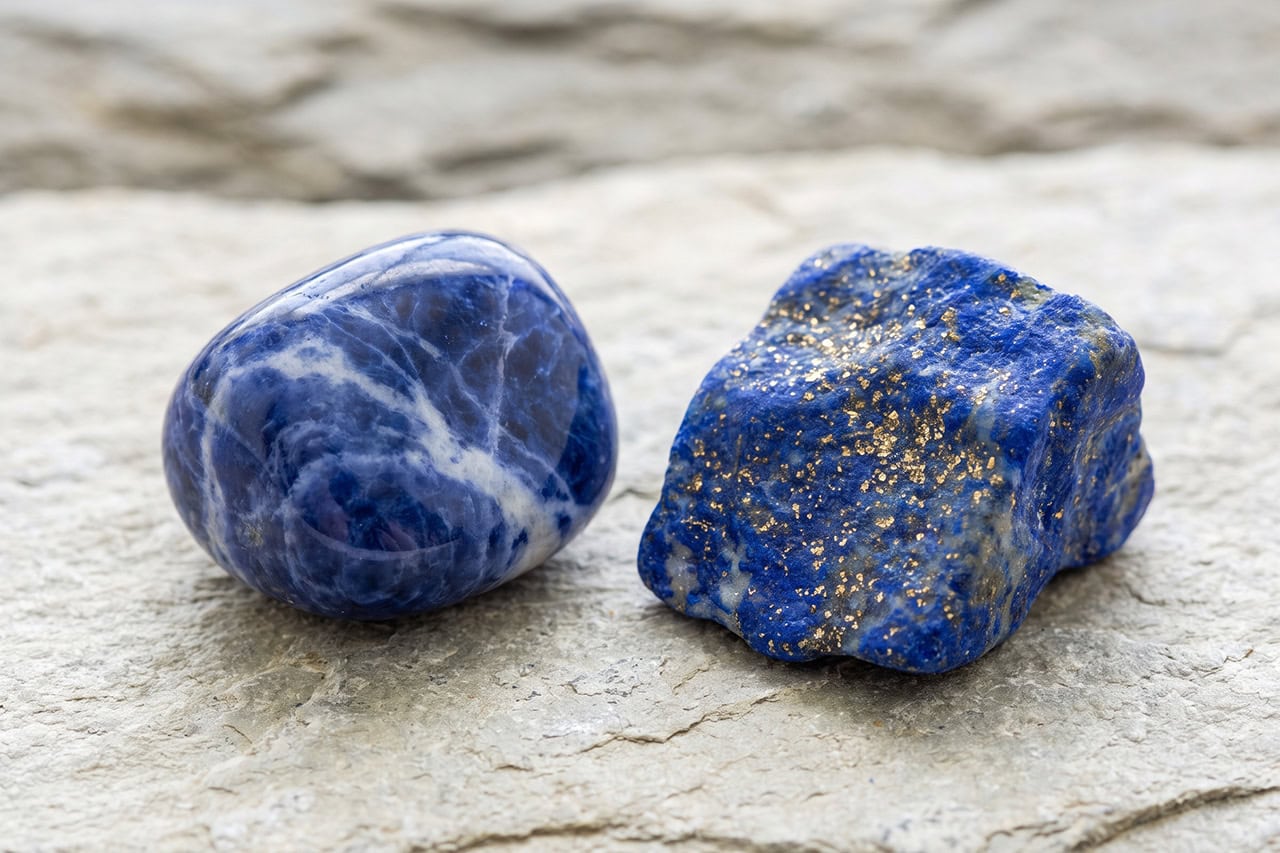
The fast tell is gold: lapis lazuli usually carries flecks of golden pyrite, and sodalite does not. Lapis tends to a deeper blue, sodalite to a softer, denim blue with white veining. They are not even the same kind of thing: sodalite is a mineral, lapis a rock.
Compare the two and the quickest way to place them is also the strangest fact about them. The gold specks that mark a piece as lapis are not lapis at all. They are pyrite, a separate mineral, scattered through the blue like currants in a loaf. You are using one mineral to recognise another, which works only because lapis is not a single mineral in the first place. It is a rock.
Sodalite is the tidy case, one mineral, a chloride-bearing sodium aluminosilicate, fairly even in colour because there is only one thing in it to be coloured. Lapis is a small committee. Its blue comes from lazurite, its white from calcite, its gold from pyrite, and a handful of other minerals turn up in the mix besides. That single difference, one mineral against a whole rock, is the root of nearly everything that separates the pair in the hand.
A mineral set against a rock
Sodalite belongs to the feldspathoid family, and more precisely to the mineral group that carries its own name, the sodalite group. Feldspathoids are a family close to the feldspars but poorer in silica, the minerals that form when there was not quite enough silica to go round as a rock cooled, which is why sodalite turns up in igneous rocks like nepheline syenite rather than in granite. It is built from sodium, aluminium, silicon and chlorine, and because it is one mineral its blue tends to read as fairly uniform, broken mainly by pale veins of calcite running through it. Lapis is a metamorphic rock, and the mineral that turns it blue is lazurite. Here is the part that makes the comparison quietly circular: lazurite sits in the same sodalite group as sodalite itself. The blue of lapis and the whole of sodalite are close mineral relatives. What sets them apart is the company each kept while it grew. Sodalite kept to itself; lazurite grew packed in among calcite and pyrite, and that crowd is what gives lapis its flecked, mottled, more complicated face. It also means no two lapis pieces are quite alike, since a rock is a mixture and the amount of white calcite and gold pyrite shifts from block to block, where one sodalite tends to resemble the next. That unevenness is the direct signature of a stone assembled from several minerals rather than grown as a single one.
What the gold and the veins give away
The practical checks follow from the chemistry. Gold flecks lean strongly toward lapis, since that is the pyrite, and sodalite only rarely shows anything metallic. White or grey veining is common in sodalite, where it is calcite threading the blue, and less organised in lapis. Colour helps once you know the range: lapis is usually the deeper, saturated ultramarine, sodalite the softer, greyer, more denim blue, though a good sodalite can be richly coloured too. Neither is hard. Sodalite sits around 5.5 to 6 on the Mohs scale and lapis between about 5 and 6 depending on how much soft calcite it carries, so both want gentle handling. A stubborn case gives itself up on unglazed porcelain, where sodalite leaves a white streak. No single clue is final, but gold in the blue settles most of them in a second, because pyrite either sparkles in the stone or it does not. Grade and identification blur together here: the best lapis is deep and even, sparked with pyrite and carrying little of the chalky calcite that both pales the colour and softens the stone, so a washed-out, calcite-heavy piece is cheaper and softer, and the easiest lapis to mistake for a plain blue sodalite. Price is the quiet last tell. Lapis costs more, so a deep-blue, gold-flecked stone offered cheaply is a reason to look closer rather than to celebrate a find.
The blue that was worth more than gold
Part of why lapis carries more weight, in price and in reputation, is how far back the human relationship with it runs. The stone has been mined at Sar-e-Sang in Badakhshan, in the northeast of modern Afghanistan, for a very long time, and GIA reckons the link between people and lapis stretches back more than six and a half thousand years. From there it travelled enormous distances in the ancient world, into Mesopotamian ornament and Egyptian burial goods. And nearly all of it came from that one Afghan valley. For most of that history the Sar-e-Sang seams were effectively the only lapis the West could get, so every blue bead in a Sumerian grave had already crossed thousands of miles of mountain and desert before anyone set it in gold. Its most famous afterlife came later, when it was ground to powder and refined into ultramarine, the costliest blue a painter could buy. Gram for gram it was once reckoned dearer than gold, and from around 1400 it was reserved for the most important passages in a picture, most often the robe of the Virgin Mary, to signal her importance in the colour itself. That reign broke only in 1828, when a French chemist worked out how to make the pigment synthetically and the price collapsed.
Sodalite has no such past, and its history is almost comically plain by comparison. It was described and named only in 1811, by the Scottish chemist Thomas Thomson, from material collected in Greenland, and it got its name from nothing grander than its high soda content. One of these stones carried the most precious colour in Europe for centuries. The other is a nineteenth-century arrival still introducing itself.
The same corner of the body, different weight
Because both are deep blue and both are read in crystal practice as throat stones, their associations overlap, which is part of why they get grouped and then confused. The traditions do pull them apart, though. Crystal practice reads sodalite as the cooler and more rational of the two, a stone of level thinking and calm, plain speech, the ground covered in what sodalite is good for. Lapis it reads as the older and heavier presence, tied to truth and to inner sight, the subject of what makes lapis lazuli so powerful. The two meanings sit close because the colour and the placement sit close, but the tradition does not treat the stones as interchangeable, and each carries a weight that its own long use, rather than its chemistry, decided.
Look for the gold, and you will rarely confuse the two again, since pyrite in the blue means a rock and its absence a single mineral. The quick test hides the real kinship. The lazurite that colours lapis and the whole of sodalite belong to one mineral family, parted mainly by the company each kept while it grew and by a few thousand years of human attention paid to one and not the other. Both keep fuller entries in the Crystalance Mineral Library.
Sources
- Sodalite as a feldspathoid, chloride-bearing sodium aluminosilicate: Britannica, sodalite.
- Sodalite formula, sodalite-group membership, Mohs 5.5 to 6, and white streak: Geologyscience, Sodalite.
- Sodalite first described and named in 1811 by Thomas Thomson from Greenland material, for its soda content: GEO143 Mineral Webpages, Sodalite.
- Lapis lazuli as a rock coloured by lazurite, with calcite and pyrite, and its Badakhshan source: Britannica, lapis lazuli.
- Lapis Mohs hardness of 5 to 6 depending on composition: GIA, Lapis Lazuli Care and Cleaning.
- The human link to lapis stretching back more than 6,500 years at the Afghan mines: GIA, Lapis Lazuli History and Lore.
- Ultramarine made from lapis, once reckoned more precious than gold, reserved from about 1400 for the Virgin Mary’s robes, and displaced by synthetic French ultramarine in 1828: Winsor and Newton, Ultramarine.