Much cheap turquoise is dyed howlite, a soft white stone that takes colour well. The tells are hardness, dye pooling in the veins, and price. But the more useful question is not fake or real. It is how a stone was treated, and whether the seller says so.
The famous swap is dyed howlite sold as turquoise, and it is a swap to learn to catch. Yet it sits at the far end of a longer scale that most buyers never hear described. A good deal of the turquoise sold honestly, as turquoise, at fair prices, has been treated too. Natural turquoise is soft and porous, so much of what reaches the shelf has been stabilised, soaked with resin to harden it and hold its colour. That is still real turquoise. The line that really matters runs not between real and fake but between disclosed and undisclosed.
Once you can see the whole scale, the howlite question falls into place as one point on it. Untreated natural turquoise sits at one end, stabilised turquoise beside it, then reconstituted turquoise, which is real turquoise ground to powder and bonded back together, and only at the far end the imitations that were never turquoise at all, chiefly dyed howlite and dyed magnesite. Telling turquoise from howlite is the skill people ask for. Reading where a stone sits on that scale, and whether the seller volunteers it, is the one that protects your money.
A ladder of treatments, not a line between real and fake
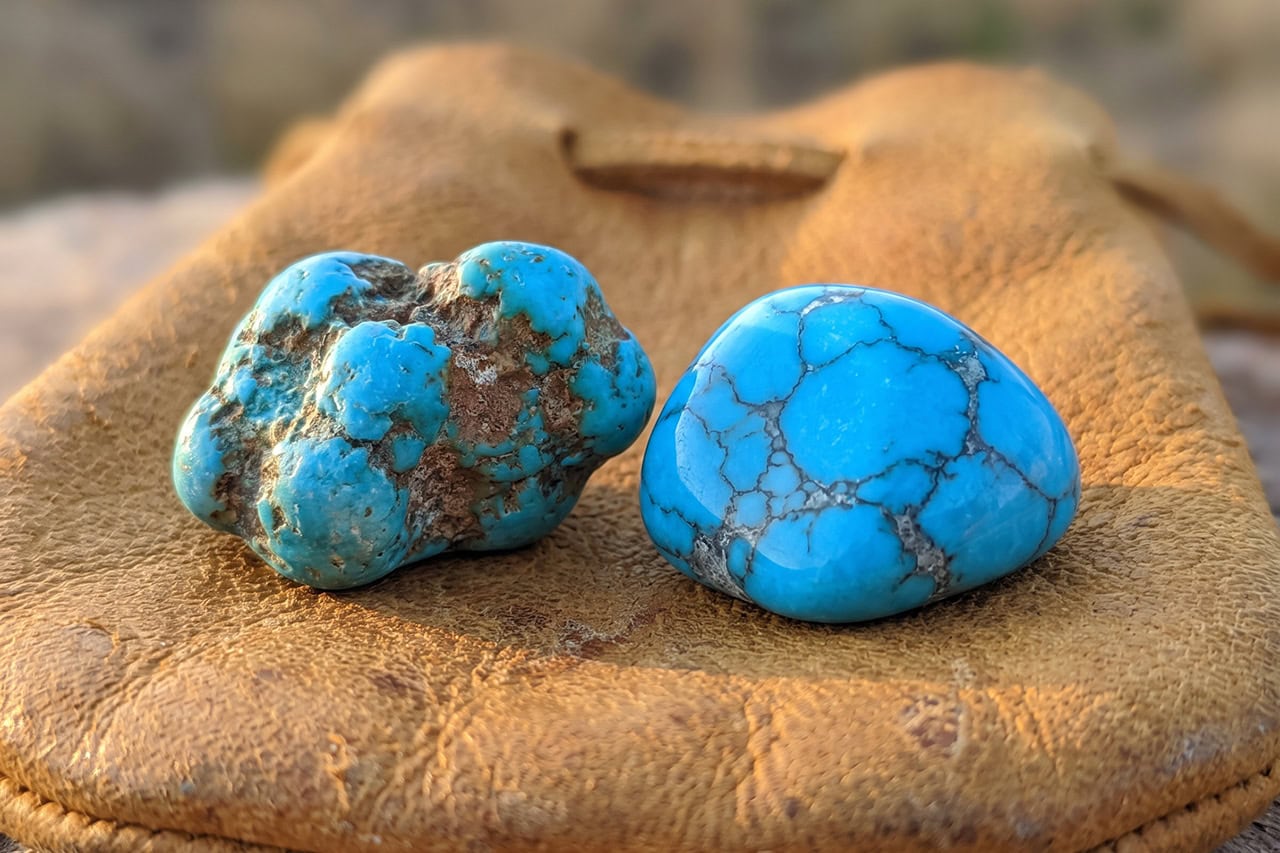
It helps to hold the four rungs in view rather than a single divide. Turquoise forms slowly in the weathered zones of copper deposits in dry country, and much of it grows porous and chalky rather than hard and even, the fact behind the whole scale. Untreated natural turquoise of good, hard, even colour is uncommon and priced accordingly. Stabilised turquoise is genuine turquoise made more durable, its porous body impregnated with resin so it holds a polish and keeps its colour, and it is entirely legitimate when sold as what it is. GIA notes that coarse, porous turquoise is usually treated to make it more marketable, so treatment here is closer to the norm than the exception. Reconstituted turquoise is a further step removed, real material in origin but rebuilt from powder and binder. Then come the imitations, dyed howlite and dyed magnesite and, further out still, dyed glass and plastic.
What every rung except the first has in common is that something was added, and this is exactly where honesty becomes a legal matter rather than a courtesy. GIA, writing on United States trade rules, records that disclosure of a treatment is required where it is not permanent, demands special care, or has a significant effect on value, and the treatments it names by title include dyeing, impregnation and the use of resins, wax, plastic and glass. Whether the United Kingdom or the European Union impose an equivalent obligation is not something we have confirmed. The buyer’s real tool, then, is a question rather than a test: what is this stone, and how was it treated?
Spotting dyed howlite
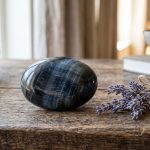
Howlite is a calcium borosilicate, naturally white to pale grey and threaded with grey or black veining, and it is porous. That porosity is the whole story. It drinks dye evenly and holds a strong, uniform blue, and once the white body is coloured, its natural veining does a fair impression of the matrix, the web of host rock, that runs through real turquoise and that collectors prize in its own right as spiderweb turquoise. The stone owes its name to Henry How, the Canadian chemist who first described it from a Nova Scotia deposit in 1868, and it took up its second career as a turquoise stand-in not long after.
Several checks separate the two, and none is foolproof alone. Turquoise runs about 5 to 6 on the Mohs scale, while howlite is much softer, usually given as around 3.5, so it scratches far more easily and a stone that marks readily is suspect. Dye tends to pool and darken in the cracks and veins of a coloured howlite, where natural turquoise carries its colour more evenly through the body. A cotton bud dipped in a little acetone will often lift blue off a dyed stone and leave the bud stained. And a large, solid, vividly even blue at a bargain price is a warning in itself, since natural turquoise of that size and evenness is not cheap. Magnesite, a magnesium carbonate, is the other common porous white stand-in and behaves much as howlite does under the same tricks. The old shortcut of telling them apart by dropping acid on them, watching for a fizz, is unreliable, because magnesite reacts only weakly with cold dilute acid and mostly when powdered. For a buyer the distinction rarely matters anyway. A cheap, evenly dyed blue stone is very often one of the two, and neither is turquoise.
What honest howlite offers on its own
None of this is howlite’s fault, and it should be said outright, because the stone gets talked about only as a counterfeit. Dyed howlite sold openly as dyed howlite is a perfectly good, affordable decorative stone, and there is nothing wrong with owning it once you know what it is. Natural white howlite is a genuinely nice material in its own right, marble-pale and calm, and it is used undyed for exactly that quiet look. Howlite is not the villain in this. An honest, rather pretty white stone was dyed and passed off, and any dishonesty in that belongs to the seller, not to the mineral.
Buying turquoise with your eyes open
If you do want the real thing, the work is less detective than conversation. A trustworthy seller will name a stone without prompting, as natural, stabilised, reconstituted or imitation, and will price it to match. There is no shame in buying stabilised turquoise for a ring or a bracelet, where an untreated porous stone would soon dull and crack; the treatment is what makes much turquoise wearable at all, and the only thing that turns it into a problem is silence about it. The warning signs are the mirror image of that, a solid, vivid, suspiciously even blue going for very little, and a seller who cannot or will not say how a stone was treated. Absence of a straight answer is itself an answer, and rarely the one the buyer wanted. The broader habit of reading a seller before reading a stone is the through-line in how to buy real crystals, and what turquoise is asked to do once you have a genuine piece is covered in what turquoise is good for.
The instinct a cheap blue stone triggers, that you are being cheated, is the wrong one to lead with. Most of the time you are looking at a stone that was treated or built rather than a swindle, and the only real fault lies with a seller who let the name do work the material could not. Ask what a stone is and how it came to look that way, and a good seller gives a straight answer. What turquoise is, under all the treatment and imitation, keeps its own entry in the Crystalance Mineral Library.
Sources
- Turquoise as a hydrated copper and aluminium phosphate, Mohs 5 to 6, porous and usually treated: GIA, Turquoise Description.
- Howlite as a calcium borosilicate, hardness from about 3.5, white to grey and porous, named for Henry How who described it in Nova Scotia in 1868, and dyed as a turquoise substitute: Geologyscience, Howlite.
- Magnesite as magnesium carbonate that effervesces in cold dilute acid only slowly and when powdered: Geology.com, Magnesite.
- The United States legal obligation to disclose gem treatments, and the named treatment list including dyeing, impregnation, resin, wax, plastic and glass: GIA, Gem Treatment Disclosure and U.S. Law, Gems and Gemology Summer 2004.