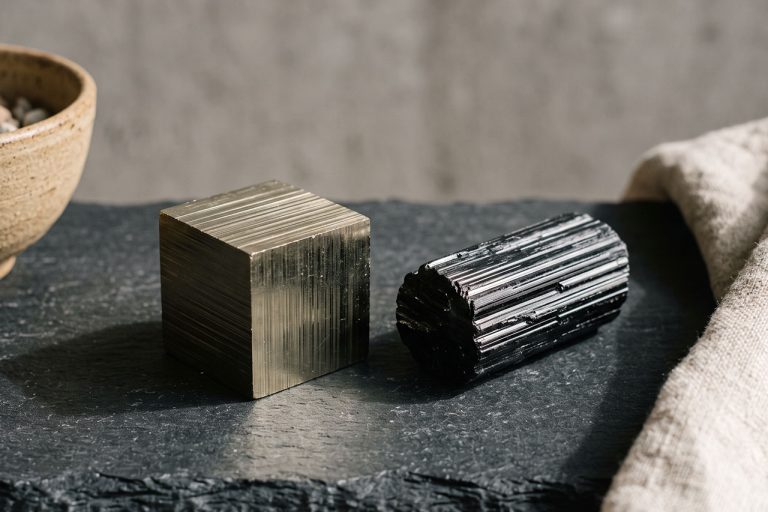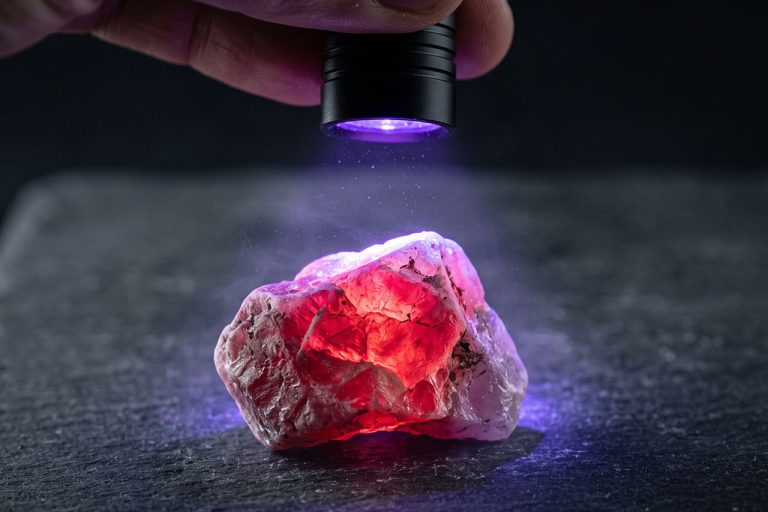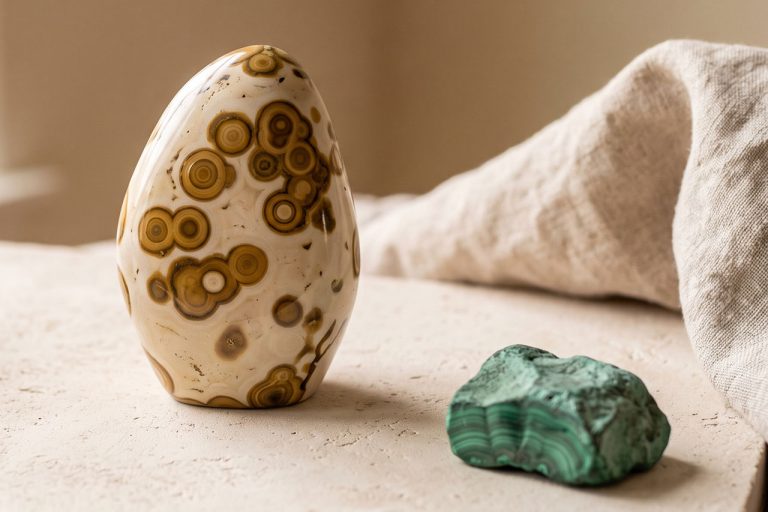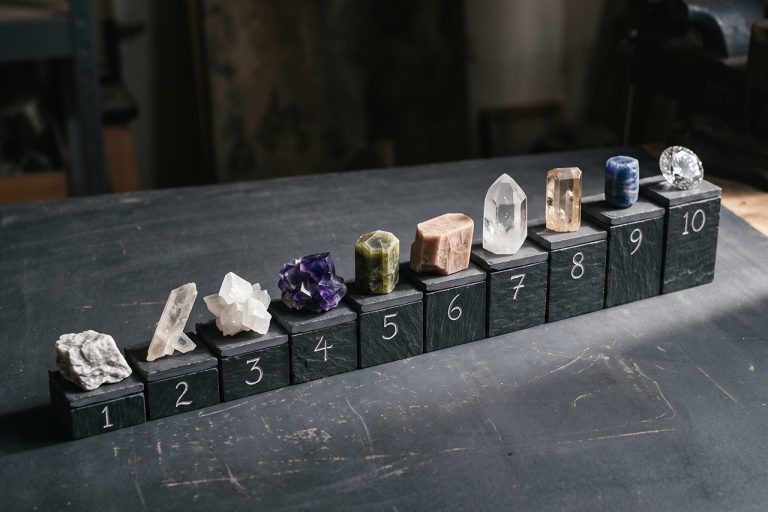
Atoms and ions in a repeating three dimensional arrangement. The chemistry varies wildly: quartz is silicon and oxygen, halite is sodium and chlorine, diamond is carbon alone. The arrangement is what makes them crystals, and the official list of what qualifies runs stranger than you would guess.
Urea is a mineral. Not in some loose or figurative sense, but as a species with its own entry in the Handbook of Mineralogy, formula CO(NH2)2, tetragonal, described from Toppin Hill near Lake Rason, about 320 kilometres northeast of Kalgoorlie, and from Wilgie Mia Cave, both in Western Australia. The Handbook gives its occurrence in a single line: derived from bat guano and urine, stable only under very arid conditions. Its name, the same entry notes, comes from the Greek for urine, in which urea was first found.
Another entry on the register is abelsonite, C31H32N4Ni, approved in 1975 and described from the Green River Formation in Utah, where the Handbook records it sitting on fracture surfaces in oil shale. It is a nickel porphyrin, which is to say a large ring-shaped organic molecule with a metal atom held at its centre.
Any answer to what crystals are made of has to be wide enough to hold both of those alongside a lump of table salt. The ingredients half of the question turns out to be the interesting half.
Normally crystalline, and never inorganic
The International Mineralogical Association’s Commission on New Minerals and Mineral Names published its working definition in 1995, in The Canadian Mineralogist, and it is short. A mineral, Ernest Nickel wrote, is in general terms “an element or chemical compound that is normally crystalline and that has been formed as a result of geological processes.”
The word inorganic is not in that sentence. It is not anywhere in the paper. Inorganic sits in the five-part definition a school textbook gives, alongside naturally occurring, solid, a definite chemical composition and an ordered internal structure, and the body that decides these cases in practice does not use it.
Then there is normally, sitting in front of crystalline where a reader expects nothing at all. The definition does not require that a mineral be crystalline. It requires that being crystalline is the usual case, which is a much weaker demand and lets in things a reader would not expect.
A 2025 restatement in the European Journal of Mineralogy, by Bosi and colleagues, is looser still: “a mineral is defined as a homogeneous, naturally occurring solid substance formed through geological processes.” That paper is a set of guidelines on how to assess whether something formed geologically, not a balloted redefinition, so it is best read as a summary of where the thinking sits. Neither crystalline nor inorganic appears in that sentence, and inorganic appears nowhere in the paper.
What both versions keep is the process. A substance qualifies because of how it came to exist. Bat guano drying out in an arid Australian cave is a geological process. The same compound in a laboratory flask is not, and the compound is identical either way.
Where the ingredients and the arrangement come apart
Opal is on the Master List, with the status code that covers species established before the IMA existed, and opal has no lattice. A 2022 paper in Minerals describes opals as naturally formed hydrated silicas that lack “the regular crystalline structure of quartz, moganite, cristobalite or tridymite”. The same paper reports that opal’s variability in water content, in trace elements and in the mixture of silanol species has led to a consensus that opal is not a true mineral. The list and the consensus disagree, both are published, and the case has not been closed.
Mercury is the cleaner example, because it is uncontested. Nickel’s paper records mercury as recognised as a mineral even though it does not occur in a crystalline state on Earth. It is liquid down to about minus 39 degrees Celsius, so it will run off a tilted surface and it is still on the register.
Both of those point the same way. The register is a record of substances, and being crystalline is a property most of those substances happen to have rather than the thing that earns them a place on it. That is a different arrangement from the one a school definition implies, where the ordered structure is the entrance requirement and everything else follows from it.
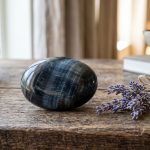
Then the reverse case, where the ingredients are right and the structure is missing. No flat face appears anywhere on a piece of raw black obsidian. Ours is a chunky mass instead of a point, it gives nothing back to the light, and every surface on it is a curved break. Chemically it is not far from a quartz point, mostly silicon and oxygen with a scatter of other elements. Structurally it is not a crystal, and it has never been on the register.
Glass is not disordered, though. Work published in Communications Materials in 2023 puts the difference as an absence of long-range structural order: unlike crystals, which show translational periodicity, amorphous materials do not have order that carries over distance. The silicon and oxygen in glass still sit in local arrangements, and plenty of writing about obsidian gets that wrong by a step. What the arrangements never do is line up and repeat.
Almost all of it is two elements
The strange edges of the register are edges. In bulk the answer is dull, and the dullness carries its own information.
Writing for the Minerals Explained series, Craig Barrie gives quartz as the second most abundant and widespread mineral in the Earth’s crust at approximately 12 per cent, with plagioclase the most abundant single mineral and the feldspars together making up nearly 60 per cent. Feldspar is an aluminosilicate; quartz is silicon dioxide. Between them they account for the large majority of the crystalline material under everyone’s feet, and both are built from the same two elements plus a few metals.
The shape of the answer, then, is a very tall middle and two odd tails. Nearly everything is silicon and oxygen with additions. A smaller group is made up of metals, sulfides, carbonates and halides. Out at the edge sit a handful of compounds that arrived through organic chemistry and stayed because the process that made them counted.
There is no threshold anybody can point to that separates the tails from the middle. The commission’s test is not about how exotic the chemistry looks. It is about whether the substance formed the way the definition says, and whether somebody measured it well enough to write down.
A collector meets this from the other end, which is to say almost never. Nothing on a shop shelf is a borderline case. Amethyst, agate, pyrite and fluorite have formulae and crystal systems behind them, established long ago and not in dispute, and the material that makes the definition work hard has stayed in museum drawers and journal pages. The boundary is real and it is a long way from anything anybody is likely to buy.
The boundary also keeps moving in the direction of stranger and not tidier. The species grandfathered in before 1958 are largely the ones people had been finding and naming for centuries. The ones approved since were characterised with instruments, and an instrument will report a formula that looks nothing like mineralogy just as readily as one that does.
Every entry in the Crystalance Mineral Library is there because somebody measured a substance and published the result, and no other route onto the register exists. The stones a shop sells sit in the middle of that distribution, and the question of what counts as a crystal at all is answered by an instrument rather than by eye. Urea got its entry from a cave floor in the Western Australian desert, and it is the same register.
Sources
- Nickel, E.H. (1995), “The definition of a mineral”, The Canadian Mineralogist 33, 689-690, for the definition quoted above, for the absence of the word inorganic, and for mercury being recognised as a mineral despite not occurring crystalline on Earth. This is a separate document from the 1998 procedures and guidelines paper by Nickel and Grice.
- Bosi, F., Hatert, F., Meisser, N., Pasero, M. and Mills, S. (2025), “IMA-CNMNC guidelines for assessing the natural geological origin of minerals”, European Journal of Mineralogy 37, 871-876, for the 2025 restatement of the definition. A guidelines paper, not a balloted redefinition.
- Handbook of Mineralogy, urea, for CO(NH2)2, the tetragonal system, the occurrence from bat guano and urine, the Western Australian type locality and the derivation of the name.
- Handbook of Mineralogy, abelsonite, for C31H32N4Ni, the nickel porphyrin identification, the occurrence on fracture surfaces in oil shale and the Green River Formation type locality.
- IMA-CNMNC Master List of Mineral Names, September 2026, for abelsonite’s approved status and 1975 IMA number, for opal’s grandfathered status, and for the status codes, in which approved covers species accepted after the IMA was established in 1958 and grandfathered covers those discovered before it.
- Curtis, N.J., Gascooke, J.R., Johnston, M.R. and Pring, A. (2022), “29Si Solid-State NMR Analysis of Opal-AG, Opal-AN and Opal-CT: Single Pulse Spectroscopy and Spin-Lattice T1 Relaxometry”, Minerals 12(3) 323, for opal as naturally formed hydrated silica lacking the regular crystalline structure of quartz, moganite, cristobalite or tridymite, and for the variability in water, trace elements and silanol species leading to a consensus that opal is not a true mineral.
- Shiga, M. et al. (2023), “Ring-originated anisotropy of local structural ordering in amorphous and crystalline silicon dioxide”, Communications Materials 4, for the absence of long-range structural order in amorphous material as against translational periodicity in crystals.
- Barrie, C., “Minerals explained I: rock forming silicate minerals I”, the Minerals Explained series for Geology Today, for quartz at approximately 12 per cent of the Earth’s crust, plagioclase as the most abundant mineral in the Earth’s crust, and the feldspars together at nearly 60 per cent.