Black obsidian is volcanic glass, cooled too fast for any crystal to form. Black tourmaline, properly schorl, is a true crystal, an ordered borosilicate that builds an electric charge when warmed. That split, glass against crystal, drives every difference in how they look, break and wear.
Warm one of these two stones gently and it will, faintly, begin to draw ash and dust toward its ends. Warm the other as much as you like and it does nothing, ever. Only a true crystal can carry that charge, and one of these two black stones is not a crystal at all, which is the whole story of how they differ.
One is a crystal, one is frozen lava
Obsidian is not a mineral in the strict sense, because a mineral needs an ordered internal structure and obsidian has none. It is volcanic glass. When certain lavas cool fast enough, at the chilled edge of a flow rather than in the slow set of a deep magma, the atoms are locked in place before they can arrange into a repeating lattice, so they set in the disordered jumble they held while molten, the way toffee pulled off the heat freezes mid-swirl. The consequences are physical, not mystical. Glass with no crystal grain has no preferred direction to break along, so it fractures in smooth curved shells, and it can be worked to an edge finer than surgical steel. That is why obsidian was one of the first tools, knapped into blades and scrapers across the ancient world and polished into some of the earliest mirrors. A raw piece can still carry fracture edges sharp enough to open skin if it is grabbed without care. Being glass rather than crystal puts obsidian in an odd category with manufactured goldstone: both get sold as crystals, and neither owns a crystal lattice, the only difference being that obsidian is nature’s glass and goldstone the workshop’s.
Schorl is the opposite kind of thing. It is a complex borosilicate whose atoms sit in a strict repeating order, and that order shows on the outside as long prisms scored with deep grooves, or striations, running the length of the crystal. Schorl grows slowly in granite pegmatites and metamorphic rock, and that unhurried growth is part of why the lattice comes out so exact. The same order runs right through its behaviour. Because the lattice has a built-in electrical asymmetry, heating or squeezing a tourmaline crystal drives a charge to its ends, positive at one, negative at the other. Mineralogists call the two effects pyroelectricity and piezoelectricity, and they are exactly what a Dutch lapidary stumbled on in 1703, when a parcel of stones the Sinhalese called turmali was found to pull ash and straw toward itself in the sun. The Dutch named it asschentrekker, ash-puller, for the way a warmed crystal would draw the ashes from a pipe. A stone has to be a crystal to do this. Obsidian, having no lattice, never can, which is the cleanest possible demonstration that these are not two versions of one black stone but two different states of matter that happen to share a colour.
Telling them apart
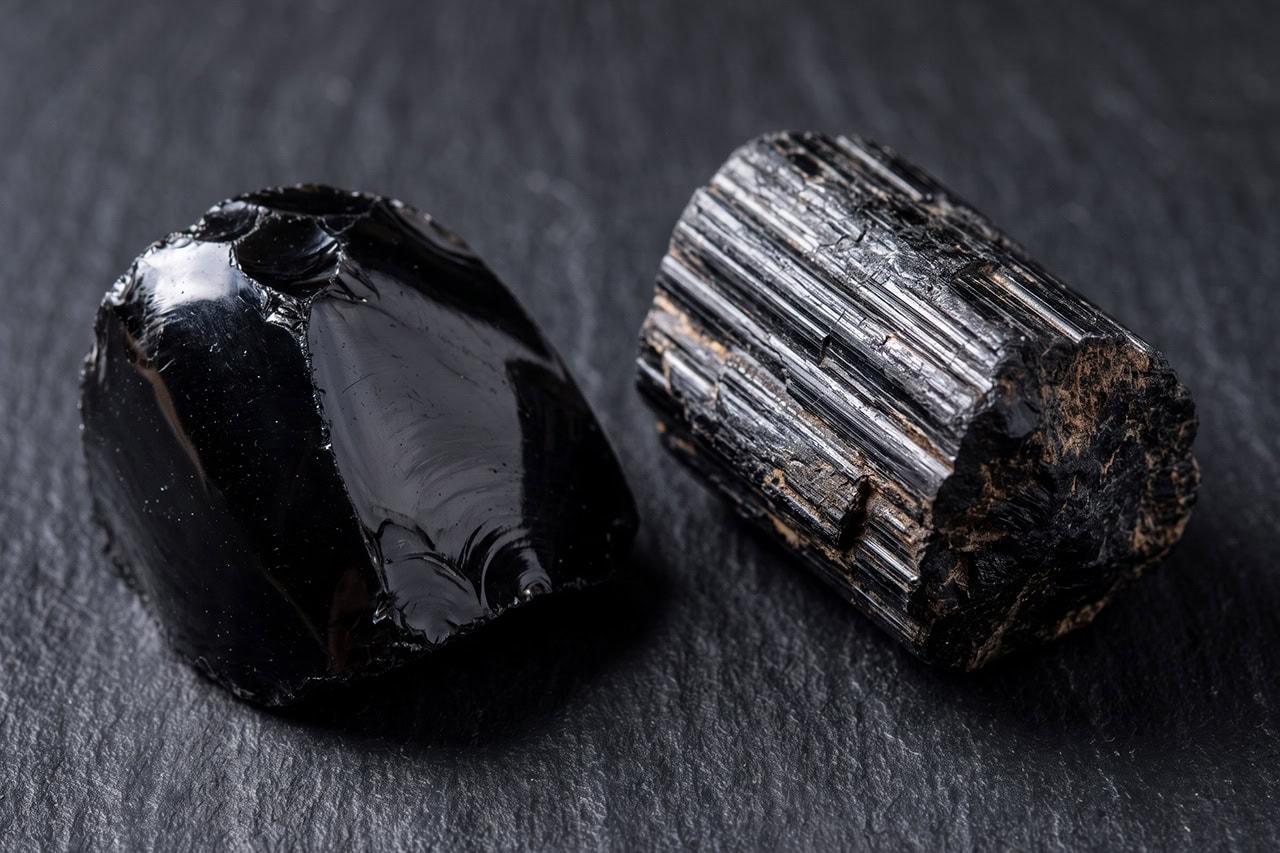
Set an unlabelled black stone in the light and it declares itself quickly. Obsidian has a wet, glassy shine, and a broken face shows the smooth curved fracture of glass, sometimes with a faint brown translucency glowing at a thin edge. Tourmaline looks like a mineral rather than a lozenge of glass, its rough faces carrying those lengthwise grooves that obsidian never has. Held to a bright light, a thin obsidian edge can glow a smoky brown, a last trace of its glassy nature, while tourmaline stays flatly opaque however thin the edge.
Hardness settles any remaining doubt, because the gap is wide and easy to test. Schorl sits at 7 on the Mohs hardness scale; obsidian at about 5.5. Tourmaline will scratch obsidian and obsidian will not touch tourmaline, so a discreet scratch on an inconspicuous spot ends the argument. Weight is a quieter confirmation of the same thing. Schorl is a dense mineral, measured between 3.18 and 3.22, while obsidian is a light glass, so a tourmaline sits noticeably heavier in the hand than an obsidian piece of the same size. The striations do most of the work anyway. Deep parallel grooves down the length mean tourmaline; a smooth, groove-free glassy surface means obsidian.
Why the durability question is not simple
Ask which stone survives daily life better and the obvious answer turns out to be wrong. Schorl is harder, so by the scratch test it wins, but hardness measures resistance to scratching and says nothing about whether a chunk holds together. Most raw black tourmaline sold by the handful is not a single clean crystal. It is a bundle of parallel columns grown side by side, and what gives way when it is knocked is the join between neighbouring columns rather than the crystal itself. A columnar piece can shed a fragment along its length while every fragment stays a hardness-7 mineral. A single well-formed prism is genuinely tough; a columnar aggregate is less so, and the aggregate is what most people are in fact holding.
Obsidian fails differently. It does not scratch easily against soft things but it chips, and a chip on glass tends to be sharp. The practical upshot is that neither is a carefree pocket stone. Tourmaline asks you not to knock it along the grain, obsidian asks you not to knock it at all, and both prefer to be cleansed dry and kept from harder stones that would mark them. Water is not the enemy here that it is for softer minerals; a knock is.
What people reach for each one to do
Beneath the shared black, crystal practice gives the two quite different jobs, and it does so with striking consistency across sources. Practice treats black tourmaline as the deflector, the everyday shield set by a door or carried against draining or chaotic energy, and its reputation for grounding is set out in what black tourmaline is good for. Obsidian it treats as the revealer, a stone of confronting what is already there rather than blocking what comes at you, explored in what obsidian is good for. One tradition-role keeps things out; the other shows you something. It is the reason practice puts tourmaline by a front door or near a desk of humming electronics, where a steady, deflecting stone earns its keep, and reserves a piece of obsidian for meditation or emotional work, where a stone that surfaces things is the point.
There is a curiosity worth sitting with here, and it is only that, a curiosity. The associations were assigned long after anyone measured a stone, yet they landed close to the physics. The electrically active crystal became the deflecting, grounding one; the glass that takes the sharpest edge became the cutting, revealing one. Whether people half-sensed the materials’ natures or simply told a good story that happened to fit, the fit is real, and it is a nicer coincidence than the trade’s habit of treating these two as interchangeable rivals would suggest. For where each sits among the darker stones, see the Crystalance Mineral Library.
Sources
- Geology.com, Obsidian, for obsidian as volcanic glass of hardness about 5.5 with conchoidal fracture and an edge finer than surgical steel: https://geology.com/rocks/obsidian.shtml
- Handbook of Mineralogy, Schorl, for hardness 7, very poor cleavage, brittle tenacity and density 3.18 to 3.22: https://handbookofmineralogy.org/pdfs/schorl.pdf
- Geology Science, Tourmaline, for tourmaline as a complex borosilicate that is pyroelectric and piezoelectric, developing a charge when heated or stressed: https://geologyscience.com/minerals/tourmaline/
- Lang Antiques, Antique Jewelry University, Tourmaline, for the 1703 Dutch account and the name asschentrekker, ash-puller: https://www.langantiques.com/university/tourmaline-2/