Azurite
Carbonate
Azure blue, Berlin blue, very dark to pale blue
Vitreous to subadamantine in crystals; dull or earthy in massive pieces
3.5 - 4
3.77
Monoclinic
Namibia (Tsumeb), Morocco (Touissit), Mexico (Milpillas, Sonora), USA (Bisbee and Morenci, Arizona), France (Chessy), Australia, China
Common as crusts and nodules in copper deposits; sharp, deep blue crystals are collector material
Cu₃(CO₃)₂(OH)₂ (Copper carbonate hydroxide)
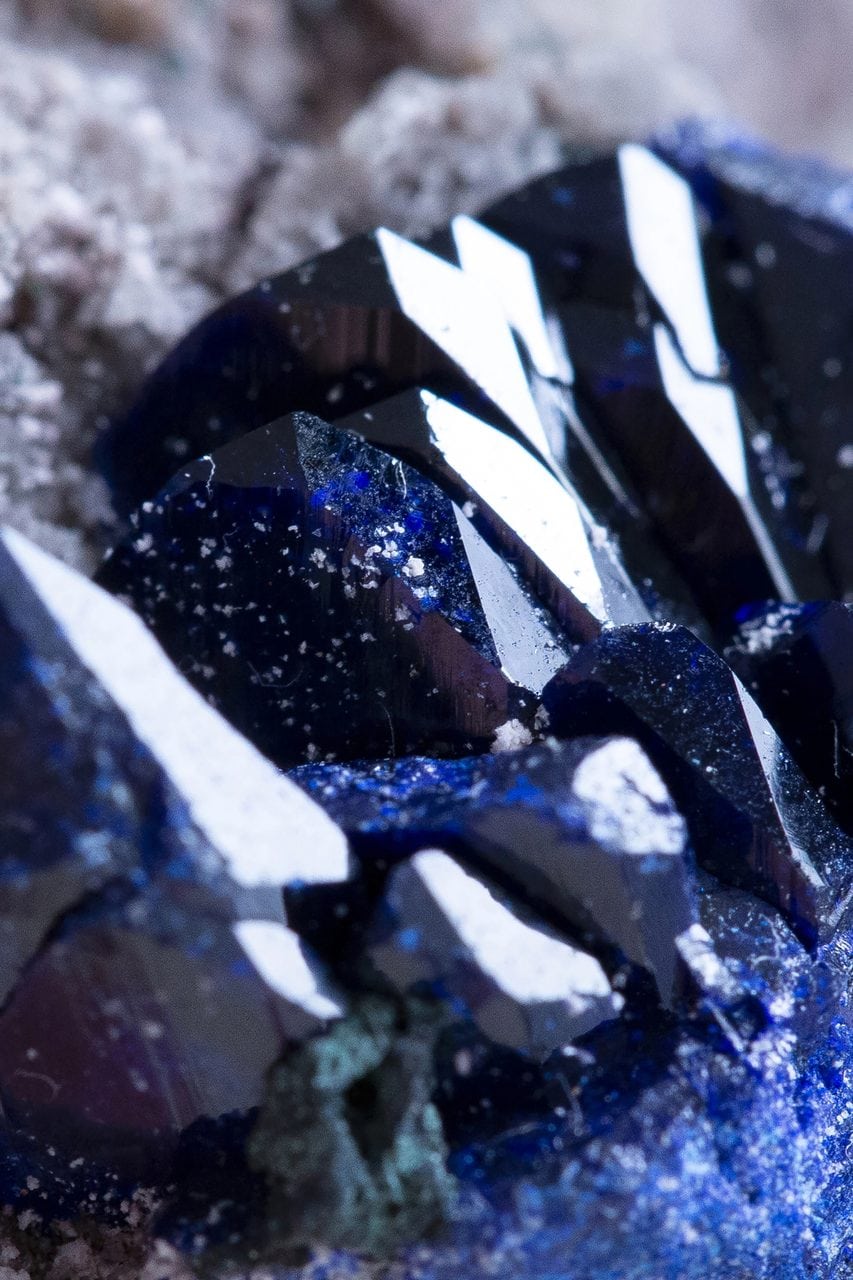
Azurite is a copper carbonate, one of the minerals that forms when water and air work their way down into a copper deposit and alter the ore near the surface. Copper is part of its formula, and copper is what makes it blue. The Handbook of Mineralogy gives its colour as azure blue and Berlin blue, from very dark to pale, and the name says the same thing: it comes from the Persian lazhward, for blue, the root that also gave English the word azure.
It grows side by side with malachite, the green copper carbonate, and the two are close relatives. Under the right conditions azurite turns into malachite while keeping its shape, so a crystal that grew blue can end up green, and the two colours sharing one specimen are a familiar sight. Material from Chessy, near Lyon in France, gave azurite its old name of chessylite. Tsumeb in Namibia, Bisbee and Morenci in Arizona, Touissit in Morocco and the Milpillas mines of Sonora in Mexico have produced some of its best crystals, and the Smithsonian ranks Milpillas azurite alongside the classic pieces from Bisbee and Tsumeb.
Painters wanted azurite long before collectors did. Ground and washed, it was used in European painting from the fifteenth to the middle of the seventeenth century, according to Britannica, as a cheaper blue than the ultramarine made from lapis lazuli, and painters used the two side by side. Pliny knew it as Armenian stone.
At 3.5 to 4 on the Mohs scale it is soft, and it is a stone for a shelf or a careful setting rather than daily rough wear. Crystal practitioners place it at the third eye and use it for insight, a reputation that runs back to the Edgar Cayce readings of the 1930s.
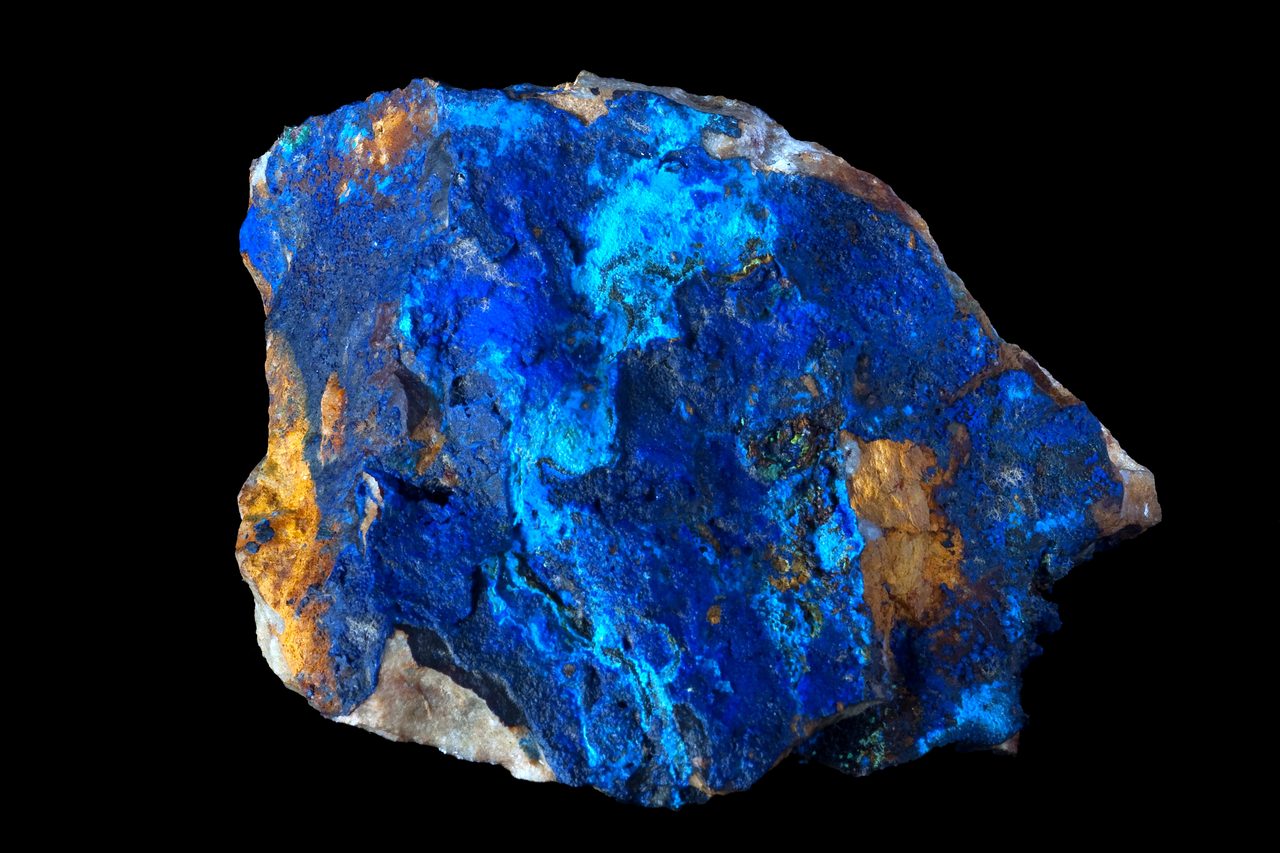
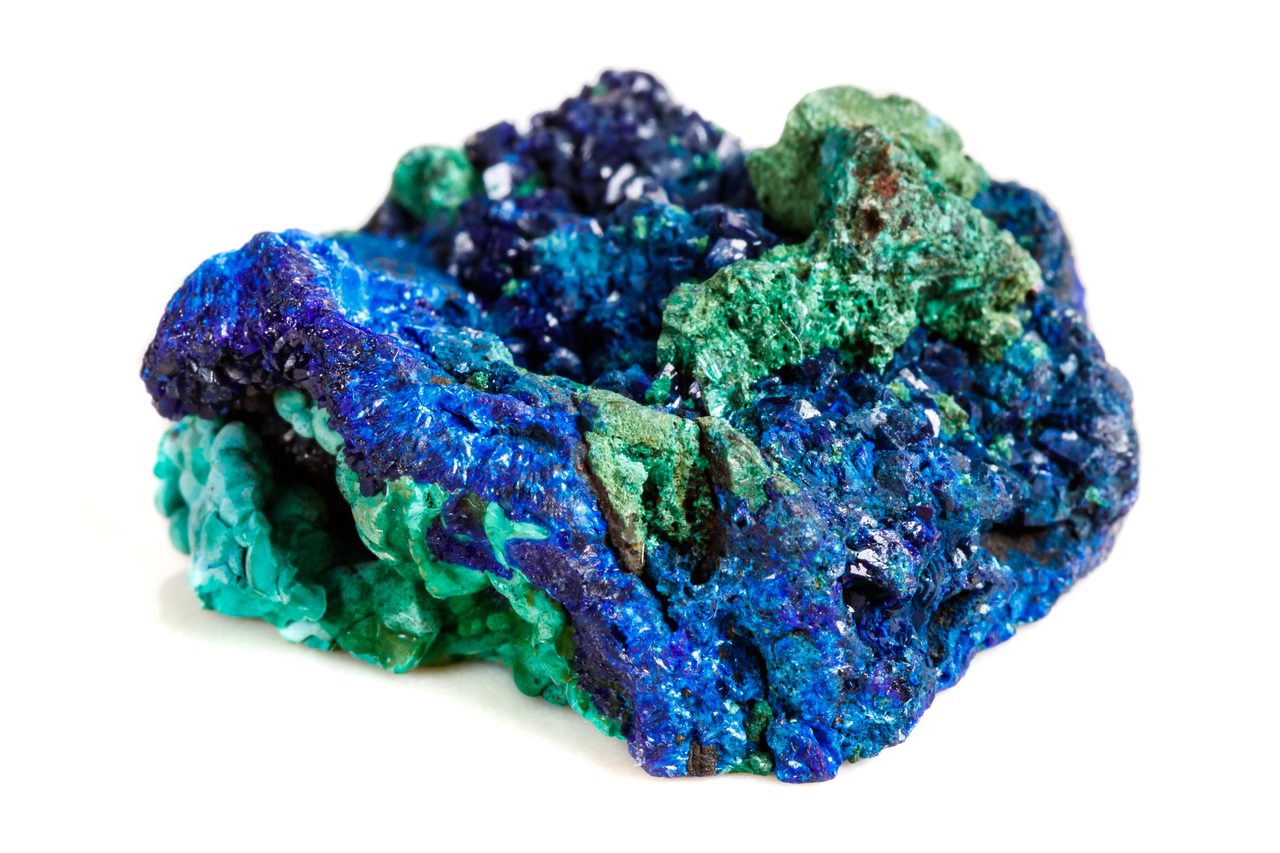
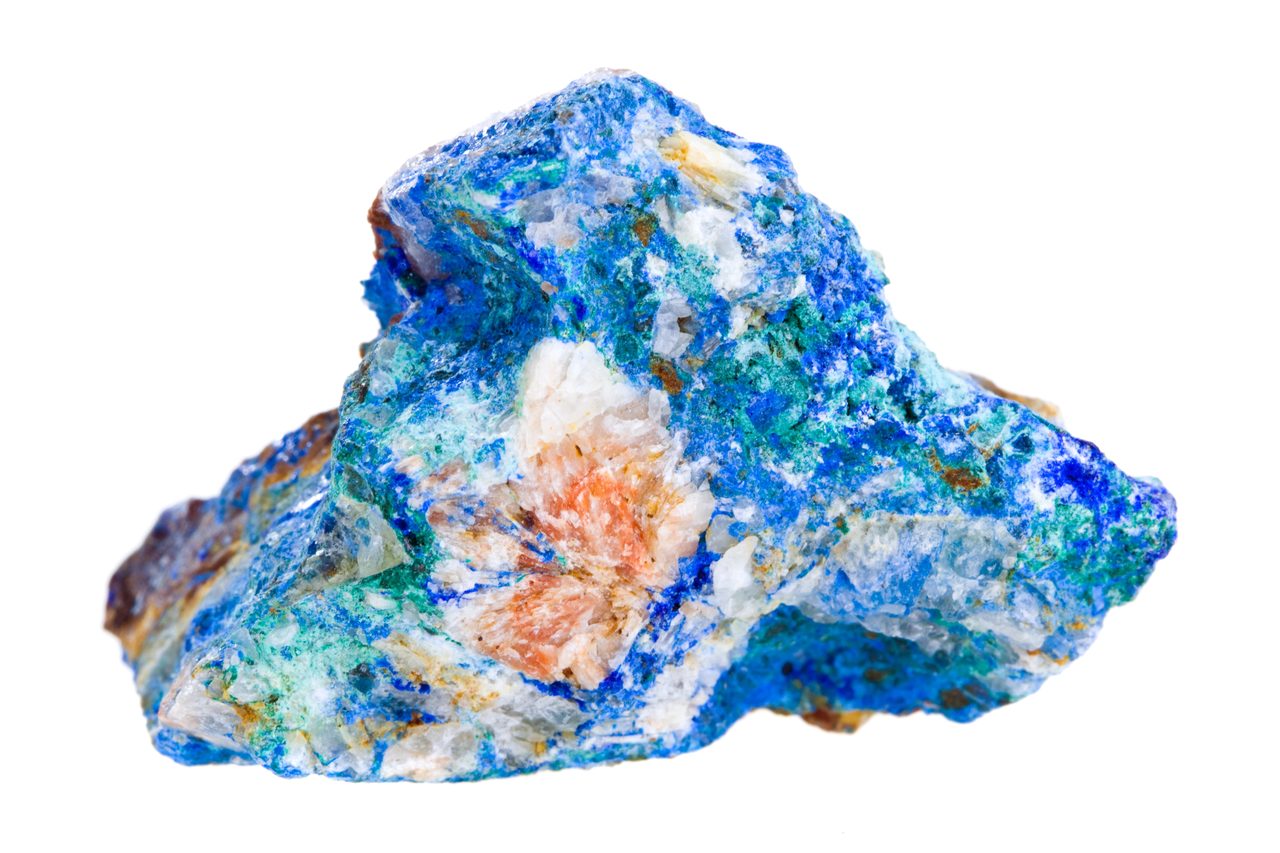
TABLE OF CONTENTS
Properties & Qualities
Physical Properties
Copper carbonate. Azurite's formula is Cu₃(CO₃)₂(OH)₂, and copper makes up more than half its weight. The colour comes from the copper the mineral is made of, so the shade shifts with thickness and crystal size while the hue stays blue. Our article on why crystals are different colours explains the difference between a mineral that is coloured by its own chemistry and one coloured by a trace.
Where it forms. Azurite forms in the oxidised upper part of copper deposits, especially where carbonate rocks such as limestone are present. Its usual neighbours in the Handbook's list are malachite, chrysocolla, brochantite, cuprite, cerussite, smithsonite, calcite and dolomite. Where there is enough of it, it can be mined as an ore of copper.
Crystals and habit. The Handbook records over a hundred crystal forms for azurite, which can make its crystals complex. They range from flat tablets to short prisms, and the mineral also grows as rosettes, radiating balls, rounded botryoidal crusts, fine drusy coatings, and earthy or massive nodules. Transparent azurite is small, because larger crystals are too dark to see through, and the International Gem Society notes that cut stones rarely exceed one carat.
Azurite into malachite. In a strongly oxidising setting azurite can alter to malachite over geological time, and a Gems & Gemology abstract gives that as the reason malachite is the more abundant of the two. When the replacement is complete and the crystal shape survives, the result is a pseudomorph: a green malachite crystal in the outline of a blue azurite one. Barbara Muntyan's survey of Arizona pseudomorphs lists azurite to malachite and azurite to chrysocolla among the commonest in the state. Our article on whether azurite is a crystal covers this pairing in more depth.
Hardness, cleavage and weight. At 3.5 to 4, azurite is softer than a steel blade and can be scratched by harder stones in a bag. It has one perfect cleavage and is brittle, so a knock can split or chip it. It is also heavy for its size, with a specific gravity around 3.77, noticeably denser than lapis lazuli or sodalite.
Azurmalachite and other mixtures. Azurite grown together with malachite is sold as azurmalachite or azurite malachite, and cut into cabochons, beads and small carvings. The International Gem Society notes that natural azurite generally receives no treatment, but reconstructed azurmalachite, made from compressed material impregnated with plastic, has been on the market since at least 1989.
Pigment. Azurite was ground, washed and sieved to make blue paint. ColourLex lists it in Raphael's Procession to Calvary for Christ's robe and in the sky of Titian's Madonna Aldobrandini, with the more costly ultramarine used elsewhere in the same paintings. An artificial copper carbonate made for the same purpose is called blue verditer. ColourLex describes azurite pigment as lightfast and stable in air, but notes that it can turn green where it changes to malachite. The International Gem Society is less reassuring about cut stones, which it says gradually lose their blue when exposed to air, heat and light.
Metaphysical properties
In crystal practice azurite is the stone of insight. It is placed at the third eye, the point between the brows that practice treats as the seat of intuition, and is used for clear thinking, study and seeing a situation as it really is. Its deep blue is read as the colour of concentration. Some practitioners also set it at the throat, so that what has been understood can be put into words. They describe its effect as quiet and searching, better suited to reflection than to raising energy.
The reputation can be traced. In the Edgar Cayce readings of the 1930s, a blue copper stone called lapis linguis was recommended to people interested in psychic matters, and the Association for Research and Enlightenment, which holds the readings, identifies that stone as azurite. Our article on what azurite is good for traces how that identification was made.
Practitioners also treat azurite as a stone of change because of what happens to it in the ground. Its slow conversion into malachite is read as insight turning into action, and azurmalachite is used where both are wanted at once.
Meaning & Symbolism
Physical meaning
Azurite's blue comes from the copper in its own formula rather than from a trace of something else, and practitioners read that as a stone for being plainly what you are. Its weight is read in a similar way. Azurite is heavy for its size, and practitioners take that density as the mark of an idea with substance behind it, something to hold and turn over before acting on it.
It is soft, it chips, and given the right conditions it turns into malachite. In practice those traits make it a stone of clarity that has to be looked after, since a clear view of a situation scuffs easily too.
Azurite grows near the surface of a copper deposit, where water and air reach the ore, and practice treats it as a stone of things coming to light. Its larger crystals are too dark to see through, which some practitioners connect with understanding that arrives slowly and in layers.
Spiritual meaning
Spiritually, azurite stands for insight and for the inner sight associated with the third eye. Practitioners describe it as helping a person notice what they already know and bringing ideas up where they can be looked at.
Painters ground azurite for robes and skies in devotional pictures, and practice carries that history over into a reading of it as a stone of the contemplative imagination. The same mineral is used now to steady attention in meditation and prayer, and some give a piece a permanent place on a home altar for that reason.
Azurite shares its root with the word azure, and in practice its colour is linked with open sky and with taking a wider view of a life or a question. Practitioners turn to it when they want to step back from detail and see the outline of things.
When azurite becomes malachite and keeps its crystal outline, the change works from within while the form holds, and that is read as inner growth that leaves a person recognisably themselves.
Healing Benefits
Physical healing
Healing practices with azurite belong to crystal tradition and energy work, and they are not a substitute for medical care.
Through its third eye placement, practitioners connect it with the head, with tension behind the eyes and with the tiredness that follows long concentration. Some rest a piece at the brow after a long stretch of reading or screen work and treat those few minutes, eyes closed, as a quiet pause. These are symbolic associations, and a doctor is the right person for any physical symptom.
Emotional healing
Emotionally, azurite is used to look at a feeling clearly rather than be swept along by it. Practitioners describe it as helpful for old patterns, worries that go round in circles, and reactions that seem bigger than the moment that set them off.
In practice it suits slow, reflective work. Some people hold a piece while writing in a journal about a reaction that keeps coming back, asking where it began and what it guards. Others keep it close before a conversation they have been putting off, for the steadiness to say what they see. It is also used after a decision has been made, when the mind keeps going back over it, as an aid to settling on what was chosen.
It is paired with malachite when insight alone is not enough and something has to change. For the stones practice uses alongside malachite, see what crystals go well with malachite.
Spiritual healing
In spiritual healing, azurite is used in meditation focused on the third eye, held to the brow or placed on it while lying down. Practitioners use it for intuition and dream work, and for quiet, deliberate attention in place of a busy mind.
The Cayce readings suggested wearing the stone or keeping it close, and one recommended sitting beside a large quantity of it in a museum and listening. Some practitioners keep a version of the second idea and simply sit near a piece for a while without asking anything of it.
A simple practice is to set the stone at eye level, look at its colour for a minute or two, then close the eyes and keep the blue in mind. Some practitioners end a session by noting any image or phrase that surfaced, without trying to interpret it straight away. A piece with a patch of malachite can close the session, moving attention from the blue to the green as a sign of returning to ordinary life.
Use & Care
How to use
- At the brow: Rest a small piece between the brows for a few minutes while lying down, then take it away and note what comes to mind.
- On a desk: A specimen or nodule on a study or work desk suits concentration and clear thinking.
- By the bed: Keep a piece on the bedside table for dream work, and write down what you remember on waking.
- With malachite: Use an azurmalachite piece or a pair of stones when insight needs to become a decision.
- In a protected setting: As jewellery, azurite is best in a pendant or earrings rather than a ring, where it is less likely to be knocked.
- Apart from harder stones: Keep it out of pockets and pouches shared with quartz or keys, which will scratch it.
- Before study: Hold it for a minute before opening your books.
- On a journal page: Let it weigh down the page as you write through a question you keep circling.
- Behind glass: A drusy crust displays well in a closed cabinet, clear of dust and fingers.
- In a body layout: Place it just above the crown or at the brow while lying still.
- Cupped in the hand: Hold a polished piece loosely in a cupped palm, since rubbing wears soft stone.
How to cleanse
- Smoke: A stick of incense moved slowly around it cleanses without wetting or handling it.
- Sound: Ring a bowl or chime close by. Nothing touches the stone, which suits a soft, fragile mineral.
- On selenite or in a quartz cluster: Set it beside the other stone rather than pressing it in, to avoid scratches.
- Moonlight: Set it on a sill overnight and move it before the morning sun arrives.
- Skip soaking and salt: Azurite is soft and splits along its cleavage, and some azurmalachite is resin-filled, so it is not a stone to leave in water, salt water or gem waters. Our guide to which crystals should not be put in water covers the reasons for soft stones.
- Dry dusting: A soft brush or cloth is enough for dust on a crystal specimen.
- Even blue: Cup it in both hands and picture its blue settling into a clean, even shade.
- Over a folded towel: Do any handling above something soft, so a slip does not chip it.
- Drusy pieces: Fine drusy coatings snag on cloth, so smoke or sound alone suits them best.
How to charge
- Moonlight: Leave it out overnight where moonlight reaches it, which suits a stone that dislikes heat.
- Beside clear quartz: Practitioners keep it next to a quartz point or cluster to amplify it.
- With intention: Hold it at the brow and say what you want to understand more clearly.
- Out of strong heat: Charge it away from radiators, hot windowsills and long hours of direct sun, since the International Gem Society describes azurite as very sensitive to heat.
- In meditation: Some practitioners count regular third eye meditation with the stone as charging in itself.
- Indigo light: Hold it and picture a deep indigo glow around it, the colour practice gives the third eye.
- In an amethyst geode: Set it down gently in the hollow overnight.
- Beside malachite: Rest it next to a malachite piece, its partner from the same deposits.
- A dark rest: After heavy use, some put it away in a drawer for a few days.
Combining with other stones
- Malachite: Its green partner and natural companion, for turning insight into change. See Malachite.
- Lapis lazuli: Another deep blue stone of the third eye and throat, for wisdom and speaking honestly.
- Sodalite: A calmer blue for logic and steady thought. See Sodalite.
- Kyanite: For alignment and communication alongside azurite's insight. See Kyanite.
- Amethyst: For calm and intuition during meditation. See Amethyst.
- Clear quartz: Paired with azurite to amplify it. See Quartz (Clear).
- Chrysocolla: A copper neighbour from the same deposits, used for gentle, patient communication.
- Fluorite: Brings order to study sessions alongside azurite's focus. See Fluorite.
- Iolite: Another stone of inner vision for third eye work. See Iolite.
- Celestine: A soft pale blue for calm and dream work. See Celestine.
Identification
Can be mistaken for
- Lapis lazuli: A rock of lazurite with calcite and pyrite. Gold flecks of pyrite point to lapis, and azurite is softer and heavier. Our comparison of sodalite and lapis lazuli explains how lapis is built.
- Sodalite: Royal blue with white veins, harder than azurite and lighter in the hand. See Sodalite.
- Dyed white stones: Howlite and magnesite take blue dye well. The colour gathers in cracks and pores, and both are much lighter in the hand than azurite.
- Chrysocolla: A copper mineral from the same deposits, greener than azurite and found as smooth crusts and masses rather than crystals. See Chrysocolla.
- Dumortierite and blue kyanite: Other deep blue stones, both harder than azurite. See Kyanite.
- Reconstructed azurmalachite: Compressed and stabilised blue and green material that imitates natural azurmalachite.
- Linarite: A lead copper mineral whose small, bright blue crystals can pass for azurite on a specimen.
- Shattuckite: A blue copper silicate sold as tumbled stones and beads that can resemble polished azurite.
How to spot a fake
- Check where the colour sits: Colour that is deepest along cracks, pits and grain boundaries points to a dyed stone, because that is where dye collects.
- Check the weight: Azurite is heavy for its size. A blue stone that feels light in the hand is more likely howlite, magnesite or a resin composite.
- Watch for uniform beads: Strings of identical, bright blue beads at a low price are more likely dyed material than azurite.
- Ask about reconstruction: Reconstructed azurmalachite is compressed and stabilised with plastic, and the International Gem Society reports some with artificial copper veins. A good seller will say which you are buying.
- Be wary of trade names: The International Gem Society notes that azurite has been sold as "copper lapis" and "Arctic opal", names that misrepresent it.
- Look for green: Natural nodules can show malachite patches blending into the blue, where a dyed stone tends to be one flat colour.
- Bubbles under a loupe: Round air bubbles inside a blue bead point to glass or resin.
- Ask for the locality: A dealer in specimen azurite can name the mine or at least the region it came from.
- Leave the hard tests to a lab: Separating natural, stabilised and reconstructed material reliably takes a gem lab's instruments. The labels sellers use for treated material are explained in what "natural" means when buying crystals.
Sources: Handbook of Mineralogy, Azurite; Britannica, Azurite; International Gem Society, Azurite value, price and jewelry information; Smithsonian National Museum of Natural History, Azurite from the Milpillas mines (NMNH 177311); ColourLex, Azurite; Muntyan, B.L. (2018), Arizona pseudomorphs, New Mexico Mineral Symposium; GIA, Gems & Gemology abstract, Azurite through the ages; Association for Research and Enlightenment, Gemstones and the Edgar Cayce Readings.