Chrysocolla
Silicate
Blue, blue-green and green; brown to black when impure
Vitreous, porcelaneous or earthy
2 - 4 (harder where it is intergrown with quartz)
1.93 - 2.4
Orthorhombic (uncertain); visible crystals are rare
USA (Arizona), Chile, Peru, Mexico (Sonora), Democratic Republic of the Congo, Israel (Timna), Russia (Ural Mountains), Slovakia, Australia
Common in the oxidised zones of copper deposits; translucent gem silica is scarce
(Cu,Al)₂H₂Si₂O₅(OH)₄·nH₂O (Hydrated copper silicate)
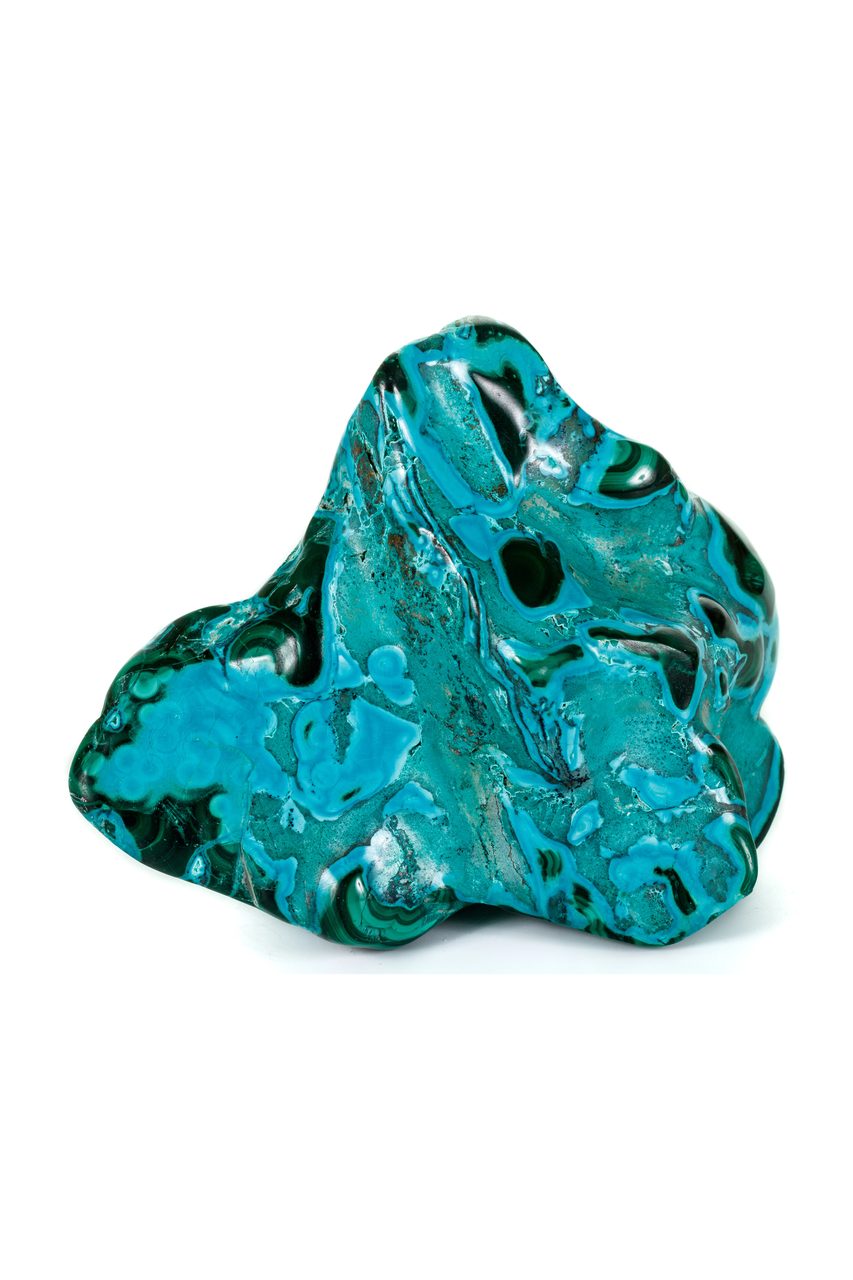
Chrysocolla is a blue-green copper mineral that grows where copper ore has weathered. It forms near the surface of copper deposits, where water carrying dissolved copper meets silica, and it sets as crusts, veins, rounded masses and enamel-like coatings rather than as crystals you can see. The Handbook of Mineralogy gives its colour as blue, blue-green or green, turning brown to black where it is impure.
It is an approved mineral, but an unusually hard one to pin down. Its formula carries a variable amount of water, its crystal system is printed in the Handbook as orthorhombic with a question mark, and samples put under X-ray have come back with no clear pattern at all. Researchers are still arguing about what it is at the scale of atoms.
The Handbook traces the name to the Greek for gold and glue, after a substance used to solder gold, and notes that the word was once applied to other blue and green minerals as well.
Shops sell it in several guises. The soft massive material goes into beads and cabochons, commonly stabilised with resin first. Where chrysocolla is trapped in chalcedony the result is gem silica, which GIA calls the most valuable variety of chalcedony, and a blend of it with malachite, azurite and turquoise from the Timna valley in Israel is sold as Eilat stone. Crystal practitioners use it for calm and gentle speech, and place it at the throat and the heart.
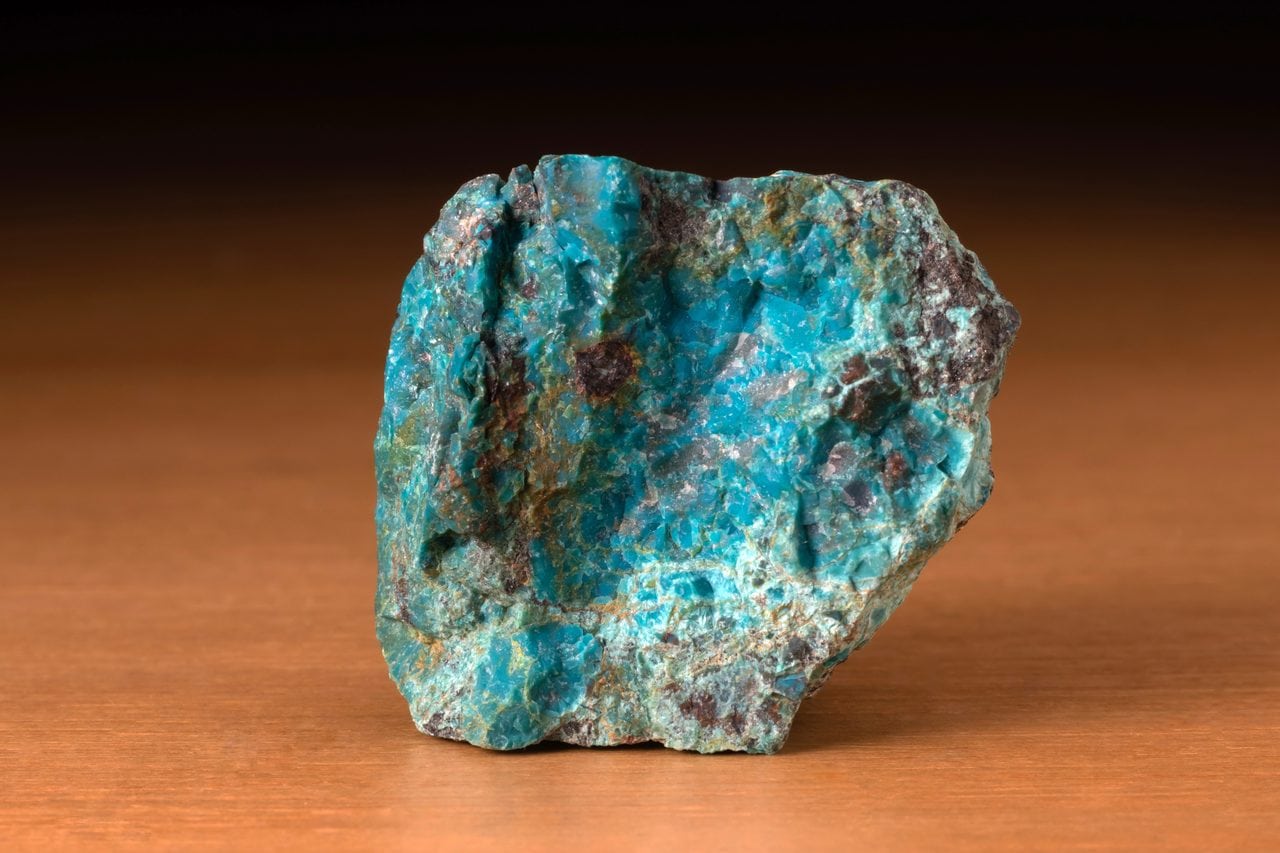
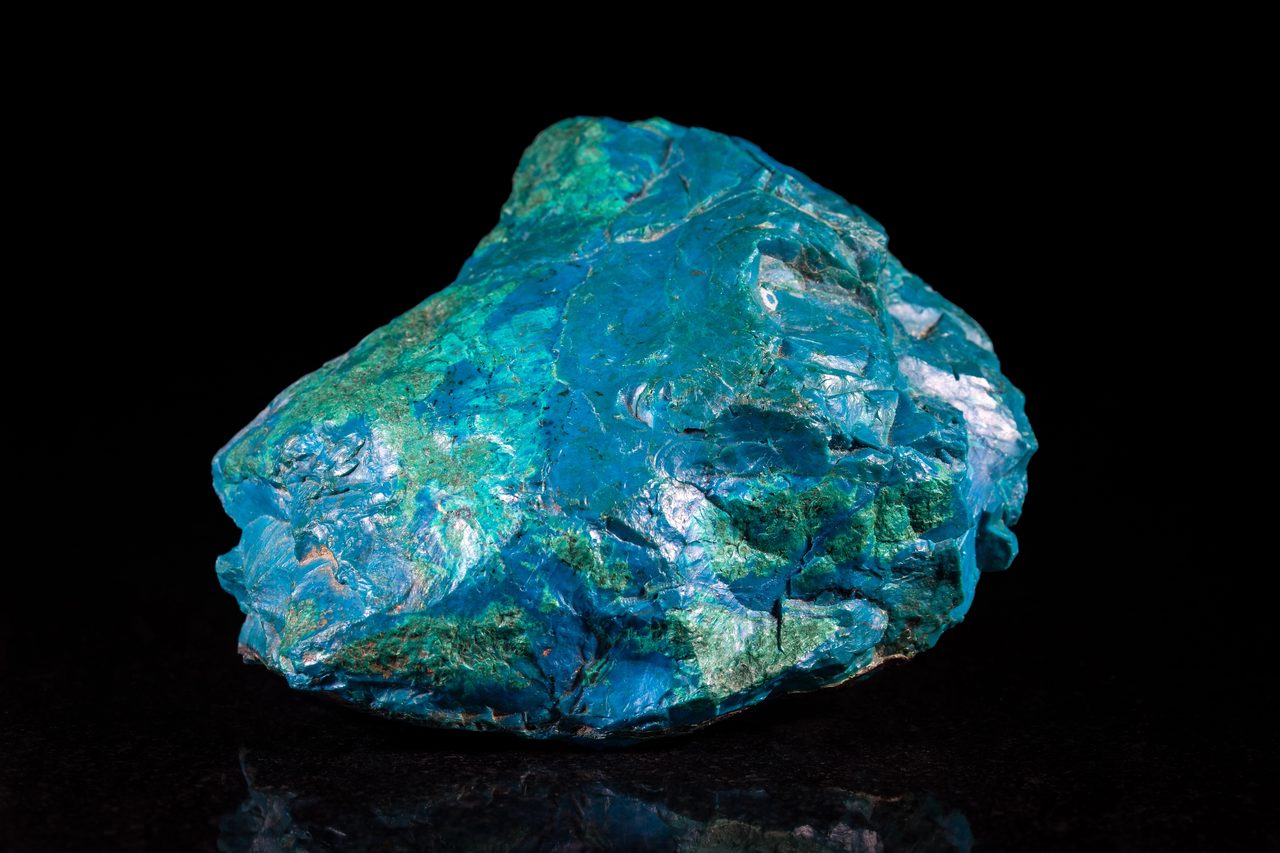
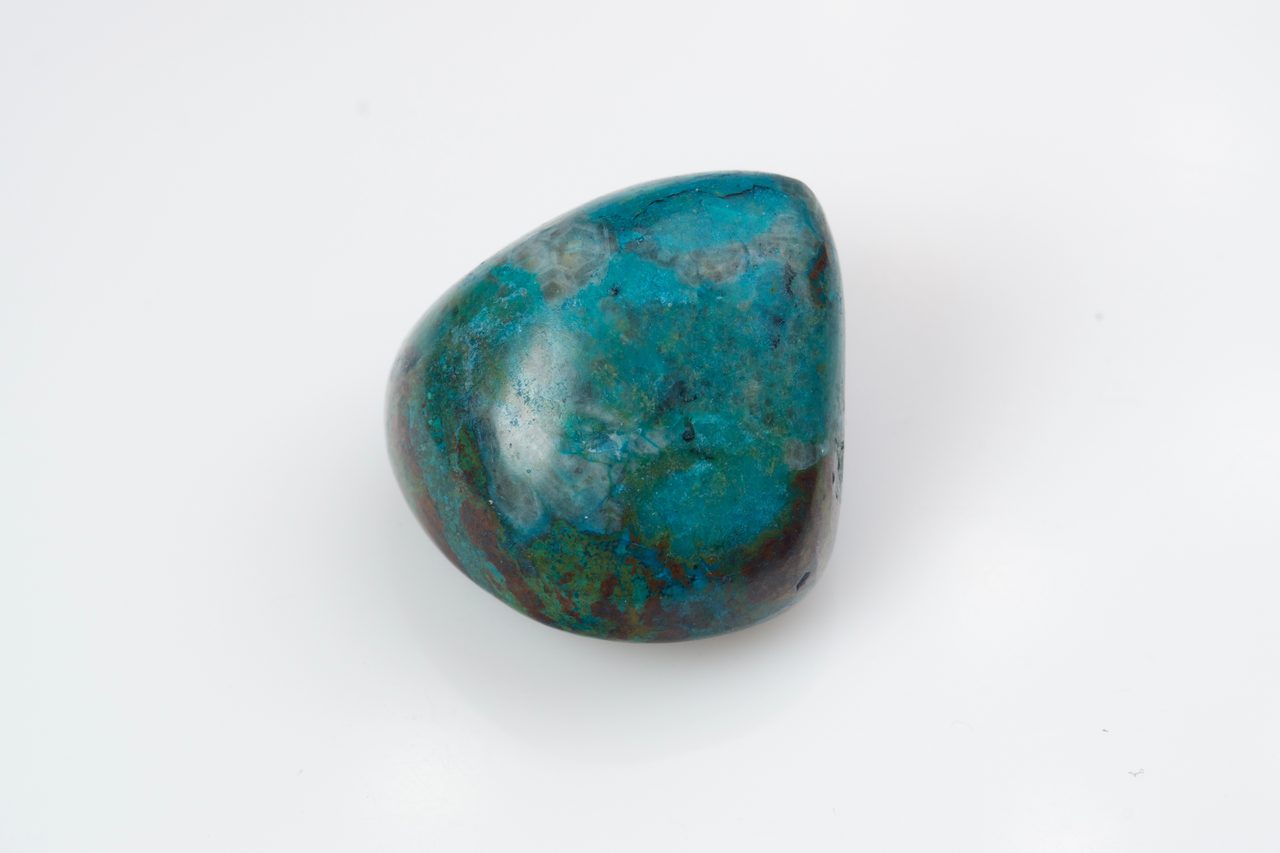
TABLE OF CONTENTS
Properties & Qualities
Physical Properties
A copper silicate with variable water. The Handbook gives chrysocolla's formula as (Cu,Al)₂H₂Si₂O₅(OH)₄·nH₂O. Copper is the colouring element and part of the mineral itself, aluminium can stand in for some of it, and the n on the water shows that the amount varies from piece to piece.
Structure still being worked out. In 2012, Frost, Xi and Wood put chrysocolla from Arizona, the Congo and Nevada under powder X-ray and found the samples non-diffracting. A 2007 study by Farges, Benzerara and Brown, using X-ray absorption on samples from Peru, the USA and the Congo, proposed that chrysocolla is a fine mixture of the copper hydroxide spertiniite, water and amorphous silica. In 2026 a team writing in American Mineralogist looked at material from Elba and Pennsylvania under the electron microscope and found it was mainly a tangled network of nanotubes, which did not fit the earlier picture of copper particles held in silica. Our article on whether chrysocolla is a crystal follows that question further.
Habit. Visible crystals are rare: the Handbook records tiny needles up to 5 mm in radiating clusters. Chrysocolla is far more familiar as fine fibres, rounded botryoidal crusts, earthy masses, and smooth opal-like or enamel-like coatings and veins.
Soft, light and porous. Pure chrysocolla rates about 2 to 4 on the Mohs scale, with a measured specific gravity of 1.93 to 2.4, light for a copper mineral and lighter than quartz. It is brittle to somewhat sectile, shows no cleavage and breaks with a conchoidal fracture. Massive material is porous, and dealers commonly stabilise it with resin to protect the surface.
Gem silica. Where chrysocolla forms together with silica, the result can be chalcedony coloured blue-green by tiny inclusions of chrysocolla. GIA describes this gem silica, also sold as chrysocolla chalcedony, as the most valuable chalcedony variety. It takes on the hardness of chalcedony, so it can be cut and worn in a way soft chrysocolla cannot.
Where it forms. Chrysocolla forms in the oxidised portions of copper deposits, and the Handbook lists malachite, tenorite, halloysite and nontronite among its companions. Azurite can also alter into it, according to Barbara Muntyan's survey of Arizona pseudomorphs. The 2026 American Mineralogist study ties its stability to oxidising conditions, plenty of dissolved silica, and low, near-ambient temperatures. Arizona's Globe-Miami, Morenci and Ray districts, the Chilean copper mines, the Katanga region of the Congo and the Timna mine in Israel all appear in the Handbook's list of localities.
Metaphysical properties
Crystal practice treats chrysocolla as a calm, soft-spoken stone. Its blue-green places it at two centres, the throat for communication and the heart for feeling, and practitioners combine the two into a stone for saying what you mean kindly. Our article on amazonite's chakra explains why blue-green stones tend to collect both placements.
Practitioners also read it as a stone of water and patience, from its colour and from the way it forms out of copper and silica carried in water. It is used when a feeling needs time to settle before anyone acts on it.
Copper gives chrysocolla its colour, and some practitioners group it with malachite and azurite as the copper stones. Within that family it is the one used for easing tension, letting energy move between the heart and the throat. It is classed as a receptive stone, suited to listening and taking in, and it is chosen for slow, steady work more than for a quick lift. Gem silica carries the same associations in practice, and some prefer it simply because it is durable enough to wear close to the throat.
Meaning & Symbolism
Physical meaning
Chrysocolla grows out of copper ore that has broken down at the surface, and practitioners read it as a stone of renewal because of that origin.
Physically it is soft and easily marked, while the same mineral sealed inside chalcedony becomes hard enough to cut and wear. Practitioners take that as a picture of gentleness that needs a little protection to last.
Its formula carries a variable amount of water, so the share differs from one piece to the next. In practice that is read as adaptability, a stone that takes its make-up from the conditions it formed in and still stays recognisably chrysocolla. It also forms as crusts, coatings and veins laid over other rock, and practitioners see a soothing, covering quality in that habit, like a layer of calm settling over something rough. The light weight of a piece, unexpected in a copper mineral, is read the same way, as a stone that is easy to keep about you.
Spiritual meaning
Spiritually, chrysocolla stands for quiet expression, the kind of speech that is meant to be understood more than to persuade. Practice describes it as a stone for teachers, carers and anyone whose work is listening as much as talking.
Its name comes from the Greek for gold and glue, after a substance once used to solder gold. Practitioners draw on that history and treat it as a joining stone, used when the aim is to mend a tie within a family or a group, or to bring words and feelings back into line with each other.
Researchers have not settled what chrysocolla is at the scale of atoms, and in practice that is taken as permission to stay unfinished for a while. It is kept by people who are still working out what they believe or where they belong, as a stone that holds a place for the question without hurrying an answer. Some keep a piece close through a change of faith or a move into a new community, while that question is still open.
Healing Benefits
Physical healing
Healing practices with chrysocolla belong to crystal tradition and energy work, and they are not a substitute for medical care.
Practitioners associate it with the throat through its chakra placement, and with tension carried in the chest and shoulders through the heart. These connections are symbolic.
In practice a smooth piece is laid just below the larynx once the voice has been used hard for hours, or held in the hand while the jaw and shoulders loosen before sleep. Anything physical, in the throat or elsewhere, belongs with a doctor.
Emotional healing
Emotionally, chrysocolla is used for calm. Practitioners reach for it in anxious, overstretched periods and when a person is holding back something they need to say. Our article on crystals for anxiety and calm covers the wider group of stones used this way.
It is also used for softening a hard conversation before it happens, held while thinking through what to say and how.
After an argument, some hold it while they cool down and before they reply, so that the answer is kinder than the first impulse. It is used for heartache, and for guilt or anger that has gone quiet and still lingers. Some write a letter they do not intend to send, with the stone resting on the page, and read it back once the first strong feeling has passed. Others keep a piece by the phone for messages they find hard to answer, and pick it up before typing a word.
Spiritual healing
In spiritual healing, chrysocolla is placed on the throat or over the heart during meditation, and used in quiet practice aimed at patience and acceptance.
A simple layout pairs a piece resting below the chin with a second over the breastbone, the person lying down and breathing slowly between the two. Some follow the breath upward from the heart stone to the throat stone and pause there, letting words come or stay unspoken. The session ends by sitting up slowly and noting anything that surfaced.
Practitioners use it with others too, for example in group work, circles and teaching, where the aim is that each voice is heard. In a circle a single piece can be passed from hand to hand as a talking stone, so only the person holding it speaks while the rest listen. Afterwards the stone is cleansed and left to rest in its pouch before its next use.
Use & Care
How to use
- At the throat: Before a conversation that matters, lie back for a few minutes with a small smooth piece resting in the hollow of your throat.
- Over the heart: Hold a palm stone against the chest while breathing slowly at the end of a difficult day.
- Before speaking: Keep a piece in your hand while you plan what to say, then put it down when you are ready.
- As jewellery: Pendants and earrings suit soft or stabilised chrysocolla best. Gem silica is hard enough for a ring.
- On a teaching or counselling desk: Keep a piece where you listen to people for a living, as a reminder to let them finish.
- Kept separately: Store it in its own pouch, away from quartz and metal that will scratch it.
- For a hard phone call: Slip a pouched chrysocolla tumble into your pocket beforehand.
- At the bedside: A small piece by the bed is used to wind down after a talkative day.
- On the kitchen table: Some place a specimen where a household sits and talks together.
- While rehearsing: Hold it as you practise a talk or presentation out loud.
How to cleanse
- Smoke: Pass it through incense or herb smoke, which leaves a porous stone dry.
- Sound: Strike a tuning fork or singing bowl a short way off and let the sound reach it.
- Moonlight: Set it in moonlight overnight.
- Keep it out of water: Massive chrysocolla is porous and sensitive to liquids, so it is not a stone for soaking, salt or gem waters. Our guide to which crystals should not be put in water explains why porous stones are on that list.
- Wipe after wearing: A soft dry cloth removes skin oils, perfume and lotion, which can mark a porous or resin-treated surface.
- No ultrasonic cleaner: The gem trade advises against ultrasonic cleaning and any immersion for chrysocolla jewellery.
- Selenite plate: Leave it on a dry selenite plate through an afternoon.
- Breath: Hold it in cupped hands and breathe gently across it a few times.
- Dust on crusts: A soft make-up brush lifts dust from botryoidal and crusted surfaces without wetting them.
How to charge
- Moonlight: Put it out on a clear night, somewhere the moon reaches.
- With intention: Hold it to the throat and say plainly what you want to be able to say.
- Away from heat: Keep it off radiators and hot sills. Chrysocolla is described in the gem trade as extremely heat-sensitive.
- Beside clear quartz: Practitioners set a quartz point near it to amplify it, leaving a gap so the harder stone cannot scratch it.
- Humming: Hold it just under the chin and hum softly for a minute or two.
- Reading aloud: Read out a note or poem you care about with the stone beside you.
- Grid with its companions: Circle it with amazonite and chalcedony tumbles, keeping chrysocolla in the middle.
- Colour visualisation: Hold it in both palms and picture blue-green light gathering in it.
- Indoors and dry: For a long charge, choose a shelf well away from bathroom and kitchen steam.
Combining with other stones
- Malachite: The green mineral it grows beside in copper deposits, for heart work and change. See Malachite.
- Azurite: The deep blue copper mineral it forms beside and sometimes replaces, for insight alongside chrysocolla's calm.
- Turquoise: Another blue-green copper stone of the throat, for honest speech and protection.
- Amazonite: A blue-green feldspar for calm communication. See Amazonite.
- Chalcedony: Chrysocolla's host in gem silica, for gentleness and steady speech. See Chalcedony.
- Rose quartz: For the heart side of its reading. See Quartz (Rose).
- Sodalite: A blue throat stone linked with clear thinking, paired with chrysocolla's softer tone. See Sodalite.
- Amethyst: Set beside it in calming meditation layouts. See Amethyst.
- Lepidolite: A lilac mica that practitioners reach for in anxious periods and combine with chrysocolla for calm. See Lepidolite.
Identification
Can be mistaken for
- Turquoise: Similar blue-green and also a copper mineral, but harder and heavier than pure chrysocolla. Our comparison of turquoise and howlite explains how turquoise is told apart from dyed howlite.
- Malachite: Banded in strong greens and found alongside chrysocolla in copper deposits. See Malachite.
- Azurite: Deeper blue, much heavier, and more ready to form visible crystals. See Azurite.
- Amazonite: A blue-green feldspar, much harder than chrysocolla. See Amazonite.
- Dyed chalcedony: GIA has reported chalcedony dyed with copper salts and sold as natural blue chalcedony in a market where gem silica is the prize.
- Glass: GIA has also reported greenish blue glass cabochons imitating gem silica.
- Eilat stone: Partly chrysocolla, but a mixture of several copper minerals rather than chrysocolla alone.
- Shattuckite: A deeper blue copper silicate, sometimes cut together with chrysocolla in the same stone.
How to spot a fake
- Expect stabilisation: Bead and cabochon chrysocolla is commonly resin-treated to make it hard enough to use. That is standard practice, and a seller should tell you about it.
- Be wary of very even colour: Chrysocolla grows mixed with matrix and other copper minerals, so its colour varies across a piece. A strand of identical, uniform beads is more likely dyed or reconstituted.
- Ask what "gem silica" means: Real gem silica is chalcedony coloured by chrysocolla inclusions. Dyed chalcedony and glass have both been sold in its place, and only testing can tell them apart with certainty.
- Check "Eilat stone" claims: Mindat's gem database notes that much of the Eilat stone sold to visitors in Israel is imported material, not stone from the original Timna deposit.
- Notice the weight: Pure chrysocolla is light in the hand. A heavier blue-green stone may be a different mineral or a composite.
- Leave the hard tests to a lab: GIA separated the dyed chalcedony with Raman spectroscopy and chemical mapping, the kind of testing a gem lab does. The words sellers use for treated stones are covered in what "natural" means when buying crystals.
- Look for host rock: Natural pieces commonly show brown or black patches, or other copper minerals, at the edges of the blue-green.
- Use a loupe on cracks: Dye gathers in fractures and pits, so colour that darkens along the cracks points to treatment.
- Weigh price against clarity: Translucent gem silica is scarce, and a large clear piece offered cheaply deserves questions.
Sources: Handbook of Mineralogy, Chrysocolla; Frost, R.L., Xi, Y. and Wood, B.J. (2012), Thermogravimetric analysis, PXRD, EDX and XPS study of chrysocolla, Thermochimica Acta; Farges, F., Benzerara, K. and Brown, G.E. Jr. (2007), Chrysocolla redefined as spertiniite, AIP Conference Proceedings; Monico, S. et al. (2026), Revealing the true nature of chrysocolla, American Mineralogist; GIA, Gems & Gemology, Greenish blue glass imitating gem silica; GIA, Gems & Gemology, Dyed chalcedony imitation of chrysocolla-in-chalcedony; Gemdat, Eilat Stone; Muntyan, B.L. (2018), Arizona pseudomorphs, New Mexico Mineral Symposium; Edelsteine.at, Chrysocolla.