Quartz (Smoky)
Silicate (Tectosilicate)
Pale greyish brown, smoky brown and yellowish brown to near black
Vitreous
7
2.65
Trigonal
Brazil, Madagascar, Switzerland (Alps), USA (New Hampshire, Colorado), Scotland (Cairngorm Mountains)
Common; large, clean, evenly coloured crystals are less so
SiO₂ (Silicon dioxide)
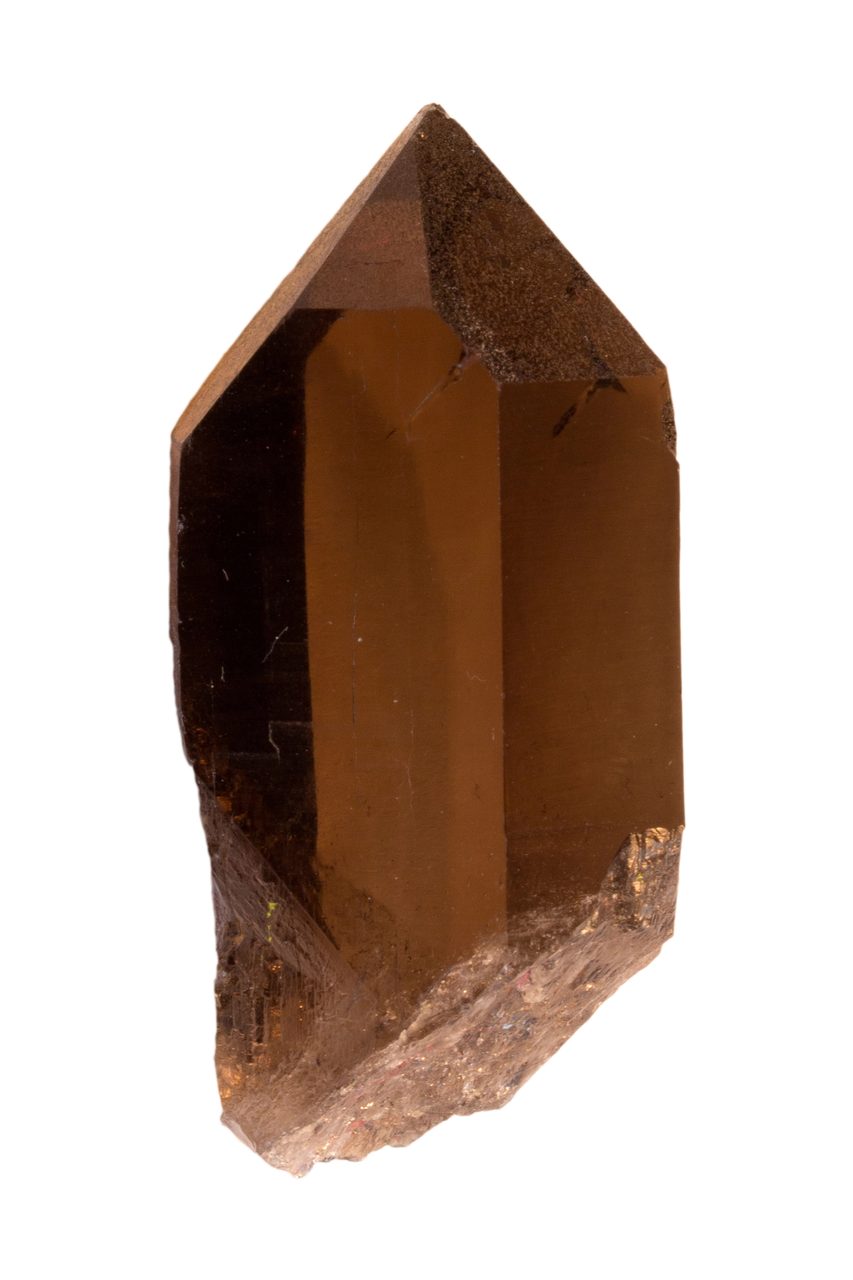
Smoky quartz is ordinary quartz that has been exposed to radiation. The crystal itself is silicon dioxide, the same as clear quartz, and Britannica notes that there is no distinct boundary between the two. A little aluminium sits in the lattice where silicon should be, and natural radiation from the surrounding rock, over a very long time, turns those sites into colour centres that absorb light. The result runs from a faint grey-brown haze to nearly black.
The darkest material is called morion. Smoky quartz from the Cairngorm Mountains of Scotland is called cairngorm, and Britannica describes it as a favourite ornamental stone there, worn in brooches with Highland costume. Aberdeen's museum collections record its use on kilt pins and on the handles of the sgian-dubh, the small knife worn in the stocking, and note that the largest known cairngorm crystal, a 23.6 kg specimen, is kept at Braemar Castle.
New Hampshire made smoky quartz its state gem in 1985, the same year it adopted granite as its state rock, which is apt, since smoky quartz grows in granites and in granite pegmatites, the coarse rocks that carry the trace radioactivity responsible for the colour. Brazil, Madagascar and the Swiss Alps are among its well-known sources.
Radiation can also be applied on purpose. A good deal of commercial smoky quartz started out colourless and was irradiated, and heat works the other way, bleaching the smoke out. Crystal practice treats it as the earthy member of the quartz family, works it at the root chakra, and hands it to people at the end of something.
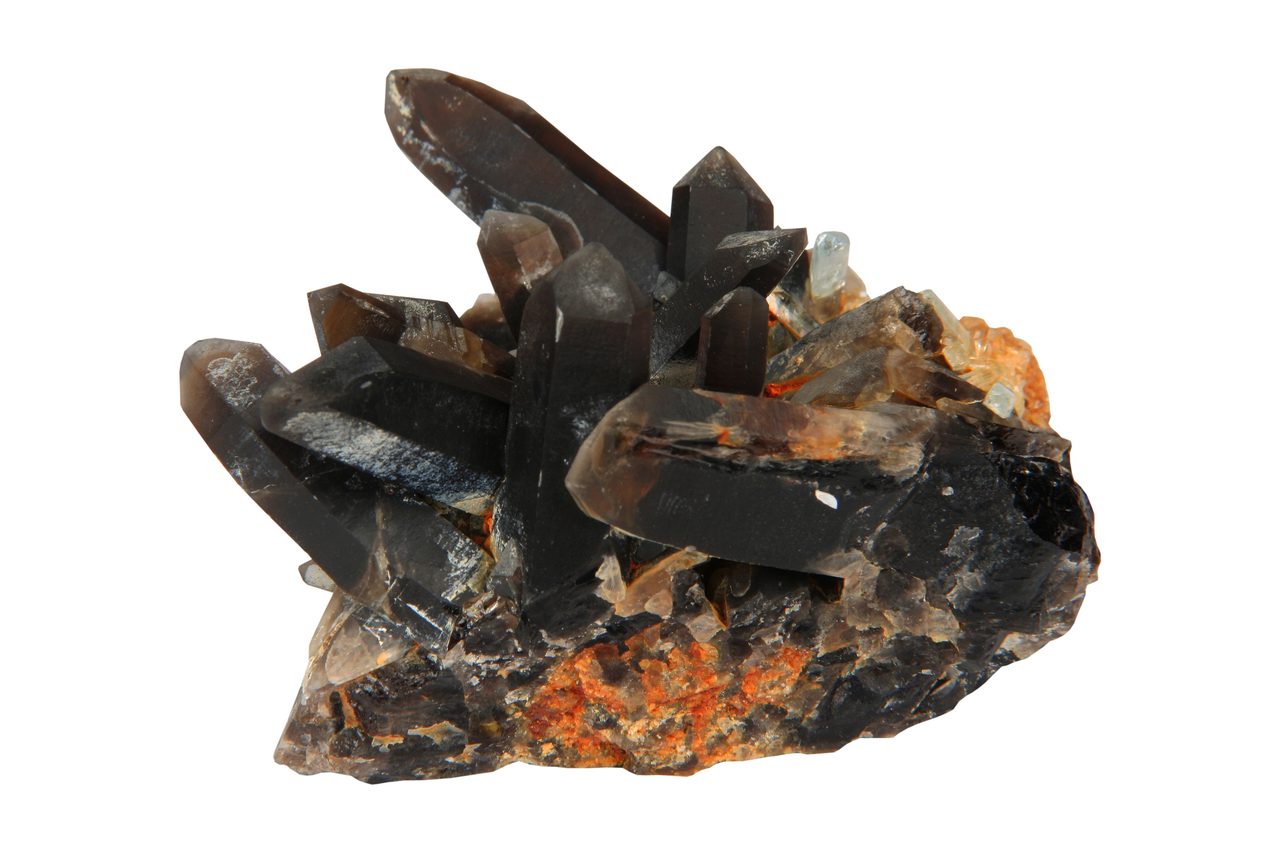
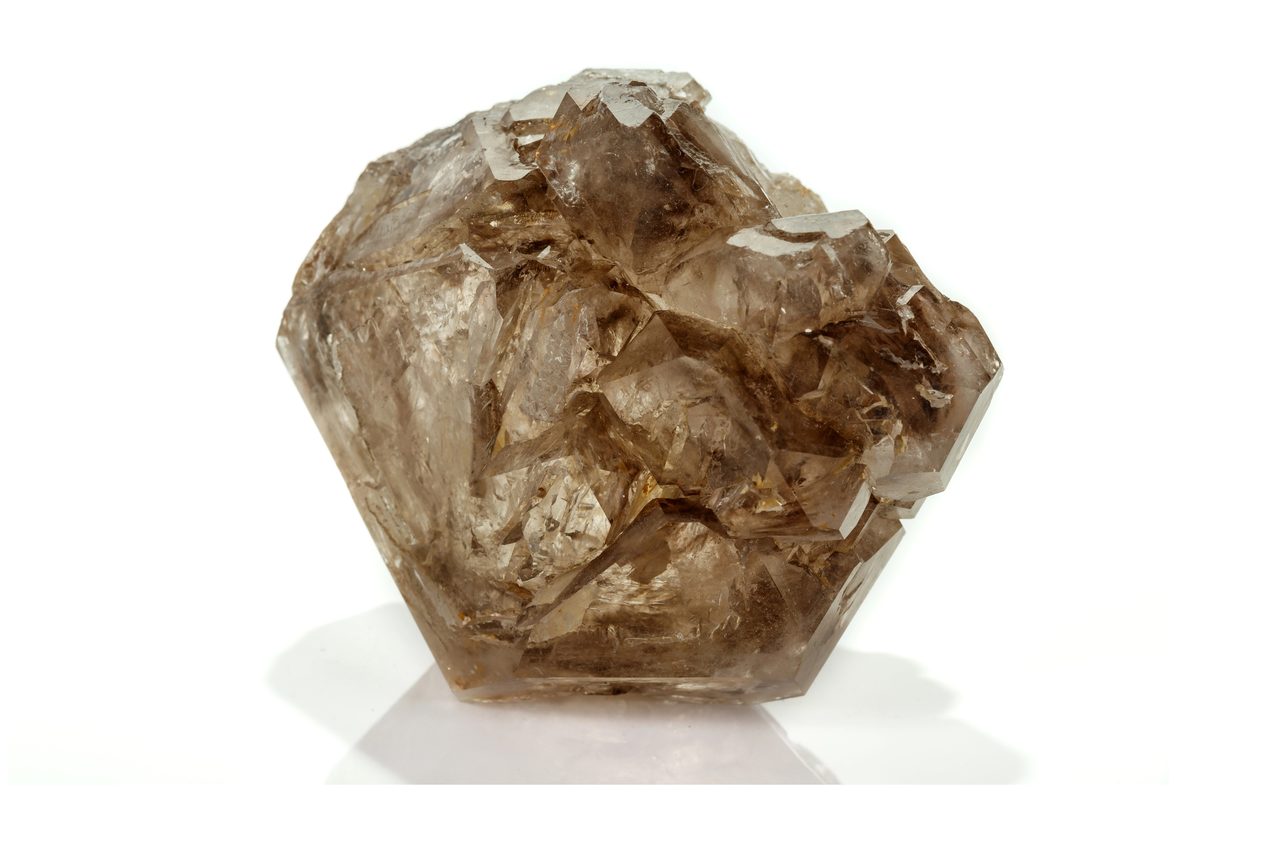
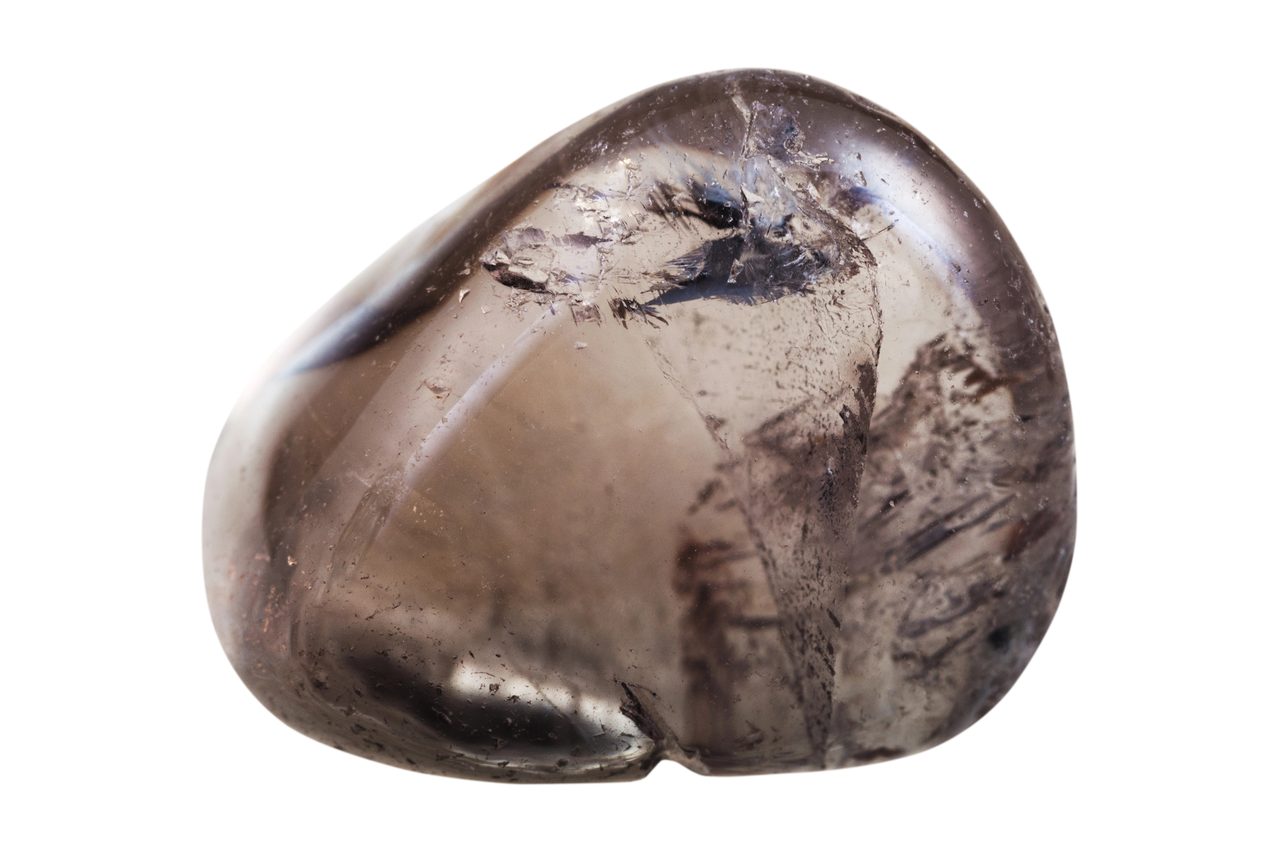
TABLE OF CONTENTS
Properties & Qualities
Physical Properties
Quartz first. Smoky quartz has every physical property of quartz: silicon dioxide, trigonal, hardness 7, specific gravity about 2.65, a vitreous lustre and no cleavage worth speaking of. It grows in the familiar six-sided prisms ending in a point, and it is a hard, forgiving stone to own.
Where the smoke comes from. Aluminium can take the place of silicon in the quartz lattice, with a small alkali ion nearby to balance the charge. On its own that does nothing visible. Exposure to ionising radiation, from uranium, thorium and potassium in the surrounding granite, knocks electrons out of place and leaves colour centres at the aluminium sites. More aluminium, or a larger dose over geological time, gives a darker stone. A crystal can be zoned, smoky in some layers and nearly clear in others, depending on how its chemistry and its radiation changed as it grew.
Morion and cairngorm. These are names for shades, not different minerals. Morion is the very dark brown to black end of the range, often opaque in thick pieces. Cairngorm traditionally means the warmer yellowish to greyish brown material from the Scottish Highlands. Much of what is sold under the cairngorm name today is smoky quartz from elsewhere.
Heat and irradiation. Heating removes the smoky colour, and depending on the stone, heated smoky quartz can pass through greenish or yellow shades on the way. Gem-A describes lemon quartz as heat-treated smoky quartz, and the American Gem Society credits the discovery that amethyst and smoky quartz could be heated to yellow and honey tones with a boost in citrine's popularity. In the other direction, colourless quartz is routinely irradiated and then heated to produce smoky material for the jewellery trade. The Health Physics Society states that there is no radiation hazard associated with irradiated smoky quartz.
Colour stability. Naturally coloured smoky quartz is generally described as stable. Some artificially irradiated material has been reported to fade under strong ultraviolet light, so a piece of unknown origin is better kept off a sunny windowsill for long periods.
Crystal forms. Smoky quartz occurs in single points, clusters and large crystals, and in the stepped, terraced skeletal growth sold as elestial quartz. Our piece on smoky elestials explains what that surface actually records. Some smoky crystals carry needles of rutile or other inclusions inside.
Metaphysical properties
In crystal practice smoky quartz is the grounding member of the quartz family. Its brown to black colour is read as earthy, and it is placed at the root chakra, at the base of the spine, alongside black tourmaline, hematite and red jasper. Practice treats it as the gentler of those, grounding with a note of letting go.
Release is the second strand, and the one that sets it apart. Practitioners describe difficult feelings or tension moving out of a person and into the stone, where the dark colour is read as absorbing or transmuting them. For that reason it is the stone people reach for at endings: the last day of a job, a move, the close of a relationship. Our guide to how to use smoky quartz sets out the practice in steps.
Practice also counts it as protective, a quieter partner to black tourmaline, and as a stone for coming back into the body after a tense or scattered day. Some practitioners add a practical side, using it for concentration and for sorting a long list of tasks into an order when a person feels swamped.
Meaning & Symbolism
Physical meaning
Smoky quartz is clear quartz that has been marked by its surroundings. The colour is a record of the radiation it sat in for a very long time, and in practice that gives it a reading as a stone of lived experience: something that took on the weight of where it was without losing its structure.
The second reading comes from its toughness. A stone meant to be gripped hard at difficult moments needs to stand up to that, and quartz at hardness 7 does, which makes it reliable in the plainest physical sense.
Smoky quartz grows in granite and granite pegmatites, and practitioners connect that origin with stability, weight and a body that feels settled. Zoned crystals, smoky in some layers and nearly clear in others, are read as a picture of a life in which hard stretches and easier ones sit side by side within one sound structure.
Spiritual meaning
Spiritually, smoky quartz stands for grounding and release together, and practice describes a stone that keeps a person's feet on the floor while they let something go. It is associated with endings handled with some dignity, and with clearing space so something new can start.
Another reading makes it a bridge between the earth and the clear light associated with quartz in general. Practice treats it as the version of quartz for people who find the brighter stones too airy, a way into spiritual work that does not lose contact with ordinary life.
The darkest material, morion, is kept for deeper protective work and for long, slow endings, while paler, honey-toned pieces go to people who want a lighter touch. Because heat can bleach the smoke away, some practitioners read the darkness as something the crystal carries for a time and can lose, which suits its place at endings. The cairngorm story, a stone worn with Highland dress, adds a sense of belonging to a place and its people.
Healing Benefits
Physical healing
Healing practices with smoky quartz belong to crystal tradition and energy work, and they are not a substitute for medical care.
Practitioners link it with tension in the body, with the lower back and legs through its root placement, and with sleep after a stressful day. Some keep a piece in a pocket through long hours on their feet, or hold one while stretching at the end of the day, as a cue for the body to settle. Those links are symbolic, and physical symptoms are a matter for a doctor.
Emotional healing
Emotionally, smoky quartz is the stone for letting go. Practitioners use it for grief, for the end of a job or a relationship, and for the small daily residue of a hard day, named and put down at bedtime. Our article on crystals for letting go covers the other stones practice uses for slower endings.
It is also used for nervous, scattered moments that pull attention out of the body, as something solid to hold while breathing slows down.
Practitioners also turn to it for stress that builds up at work. A small piece kept under the desk can be held through a difficult phone call and set down when the call ends. For resentment that lingers after an argument, some write a few lines about what happened, rest the stone on the page overnight, and throw the page away in the morning. People in a low, heavy stretch sometimes keep one close as quiet company.
Spiritual healing
In spiritual healing, smoky quartz is used to steady a person during and after meditation, especially work that leaves them feeling light-headed or untethered. It is commonly paired with lighter, more expansive stones so that one reaches and the other holds.
A simple practice uses two pieces, one at the feet and one at the base of the spine, with attention moved slowly downward on each out-breath. Some practitioners lay smoky quartz points facing away from the body at the close of a session, a layout described as drawing heavy energy out and away from the person lying there.
Practitioners also use it to mark transitions, holding a piece through a ritual of closing one chapter, then cleansing it or giving it away once the chapter is done. In space clearing, a piece is set in each corner of a room after a move or a hard period in the household.
Use & Care
How to use
- At the bedside: Keep a tumbled piece by the bed, hold it for a minute at night, and name the things from the day you are finished with.
- For an ending: Choose a palm stone in advance, carry it on the day, hold it at the moment itself, then decide deliberately what to do with it afterwards.
- At the root chakra: Lie down with a piece resting low on the abdomen or at the base of the spine during meditation.
- By the door: A piece near the entrance suits people who use their home to wind down after the day.
- In a pocket: Quartz shrugs off keys and coins, so it travels well loose.
- With a cluster or point: Larger pieces suit a desk or a shelf where you want a steadying presence.
- In the car: Tuck one in the door pocket if commuting leaves you tense.
- With a journal: Keep it on the page as you list the things you are ready to close.
- As jewellery: A ring or pendant keeps it on the body through the day, and at hardness 7 it copes with daily wear.
- Point downward: After meditation, hold a point tip down towards the floor for a minute before getting up.
- For slow breathing: Hold it in the non-dominant hand for a few minutes of long out-breaths.
How to cleanse
- Running water: Quartz is unharmed by water, so a rinse under the tap is the simplest method.
- Earth: Some practitioners bury it in a pot of soil overnight, in keeping with its grounding reading.
- Smoke: Incense or herbs, passed around the stone.
- Sound: A bowl or bell rung near it.
- Moonlight: Overnight on a sill, for those who prefer it.
- After an ending: A piece held through a specific ending is commonly cleansed before it goes back into ordinary use.
- Salt water: Quartz tolerates a soak in salted water; rinse it in plain water afterwards.
- Soap and a soft brush: Warm soapy water lifts dust out of the crevices of a cluster.
- Thinning smoke: Hold it and picture the haze inside it thinning out.
How to charge
- Moonlight: A night under the moon, the gentle option.
- On the ground: Set it directly on soil, grass or stone outdoors for a few hours.
- With hematite or black tourmaline: Practice keeps it beside other grounding stones to reinforce that reading.
- With intention: Hold it and say what you want it to help you put down.
- Little direct sun: Keep sun exposure brief, especially for pieces that may have been artificially irradiated.
- On a clear quartz cluster: A night resting on its colourless relative.
- With a drum: Some practitioners beat a hand drum slowly beside it, a low sound to match its earthy reading.
- In a small grid: Set it at the centre of a ring of clear quartz points for a day.
- Outdoors in shade: A spell on a shaded step or garden wall gives it fresh air without strong sun.
Combining with other stones
- Black tourmaline: The standard pairing for grounding and protection. Our article on what works with black tourmaline explains why. See Tourmaline (Black).
- Hematite: A heavier grounding partner. See Hematite.
- Clear quartz: Its own colourless form, paired for balance between grounding and clarity. See Quartz (Clear).
- Citrine: A warm, bright counterweight to smoky quartz's heavier reading. See Citrine.
- Amethyst: For calm and for grounding during spiritual work. See Amethyst.
- Moonstone: Black moonstone in particular sits well beside it, for rest and turning inward.
- Red jasper: Another root chakra stone, added for stamina and steady effort. See Jasper.
- Rose quartz: A soft companion during grief, bringing comfort alongside release. See Quartz (Rose).
- Selenite: Practitioners pair the two so one clears the space above while the other anchors below. See Selenite.
Identification
Can be mistaken for
- Irradiated quartz: Clear quartz irradiated in a lab to look smoky. It is still genuine quartz, but the colour was not formed in the ground, and in a shop it can be impossible to tell apart.
- Smoky glass: Moulded rather than grown, so it lacks natural crystal faces, and it can show bubbles under a loupe.
- "Smoky topaz": An old trade name for smoky quartz. Topaz is a different mineral.
- Brown tourmaline (dravite): Tourmaline crystals have a rounded triangular cross-section with grooves running along their length, while quartz prisms are six-sided with fine lines across them. See Dravite.
- Obsidian: Black volcanic glass, which does not form the six-sided points of quartz. See Obsidian.
- Citrine: Some smoky quartz heats to yellow, and some yellowish smoky quartz is sold as citrine. See Citrine.
- Black tourmaline (schorl): Dark morion can pass for schorl at a glance, but schorl shows the same lengthwise grooves as dravite. See Tourmaline (Black).
- Black onyx: Tumbled morion resembles it, though onyx stays evenly opaque while thin morion edges show brown against a strong light. See Onyx.
How to spot a fake
- Do not rely on colour: By eye, naturally coloured and artificially irradiated smoky quartz look alike, whatever the shade.
- Check for glass: A loupe shows glass for what it is, with round bubbles and flow lines, and a moulded point can look too perfectly regular to have grown.
- Ask about treatment: Ask whether pieces were irradiated, which an honest seller will know. The treatment is safe and legal, but it should be disclosed.
- Be careful with "cairngorm": The name implies Scottish origin. Genuine Scottish material is uncommon in the trade, and stones sold under the name commonly come from elsewhere.
- Be careful with "smoky topaz": It is smoky quartz under a misleading name.
- Weigh price against size: Large, clean, evenly coloured crystals are less common, so a big flawless piece sold cheaply deserves a question.
- Ask where it was mined: A seller with a genuine source can say which country, and ideally which region, the crystal came from.
- Leave the hard tests to a lab: Separating natural from irradiated smoky quartz reliably takes laboratory equipment. For how sellers describe treated stones, see what "natural" means when buying crystals.
Sources: Britannica, Smoky quartz; Aberdeen Art Gallery and Museums, cairngorm, or smoky quartz (P12051); New Hampshire Revised Statutes, 3:15 State Gem; National Museums Scotland, The history and science of Cairngorm quartz; "The optical absorption of gamma irradiated and heat-treated natural quartz", Materials Research; Minerals.net, Quartz; Health Physics Society, Ask the Experts, irradiated smoky quartz; Gem-A, Understanding and Testing for Rare Natural Citrine; American Gem Society, The history of citrine.