Rhodochrosite
Carbonate; calcite group
Pink, rose red to cherry red; also yellowish grey, brown or white; massive material banded in pink and white
Vitreous; pearly in aggregates
3.5 - 4
3.4 - 3.7
Trigonal
Argentina (Capillitas, Catamarca), USA (Colorado, Montana), Peru, South Africa, Mexico, Romania, Germany, China, Japan
Banded massive material is common and affordable; transparent red crystals are rare and expensive
MnCO₃ (manganese carbonate), usually with some iron, calcium or magnesium in place of manganese
Rhodochrosite is manganese carbonate, a soft pink to red mineral from the same family as calcite. The German mineralogist Johann Friedrich Ludwig Hausmann named it in 1813, from Greek words for "rose" and "colouring", and the colour comes from the manganese itself.
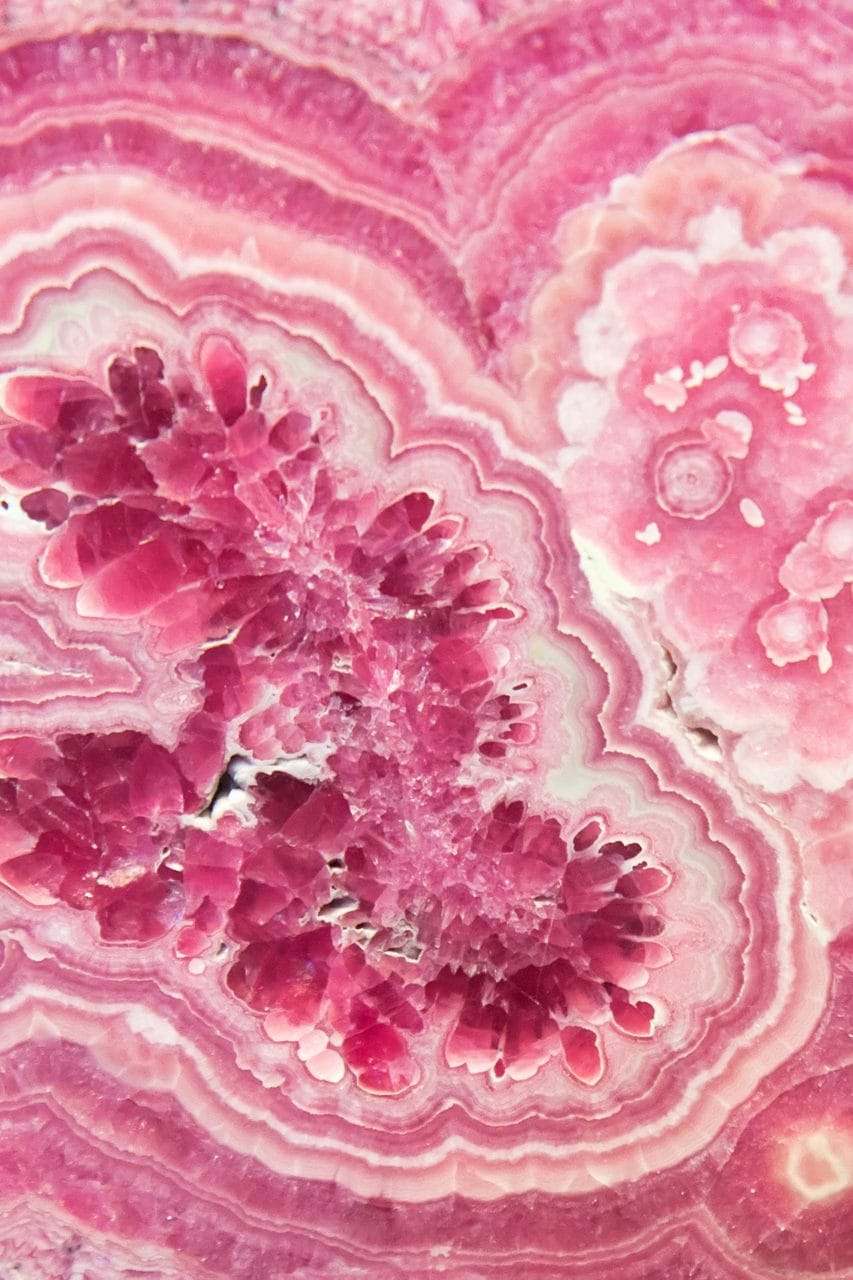
Two forms of it reach the market, and they look nothing alike. The familiar one is opaque and banded, rings of raspberry red and pale pink cut into slices, beads and cabochons. Its best-known source is the Capillitas mining district in Catamarca, Argentina. The other is the transparent red crystal, shaped like a slanted cube. It is rare, and collectors want it far more than jewellers do. The finest crystals came from the Sweet Home mine near Alma, Colorado, and in 2002 Colorado made rhodochrosite its official state mineral.
In shops the banded stone goes by "Inca rose". The name sounds ancient, but the mineral writer Steve Voynick, in Rock and Gem magazine, traces it to jewellers in Buenos Aires, who coined it once Capillitas rhodochrosite caught on there in the twentieth century. Argentines widely call it their national stone, although no law has made it one yet. In September 2026 two committees of the Chamber of Deputies backed a bill to do exactly that.
Crystal practice places rhodochrosite at the heart, and asks it for self-compassion and for emotional repair after a hard stretch.
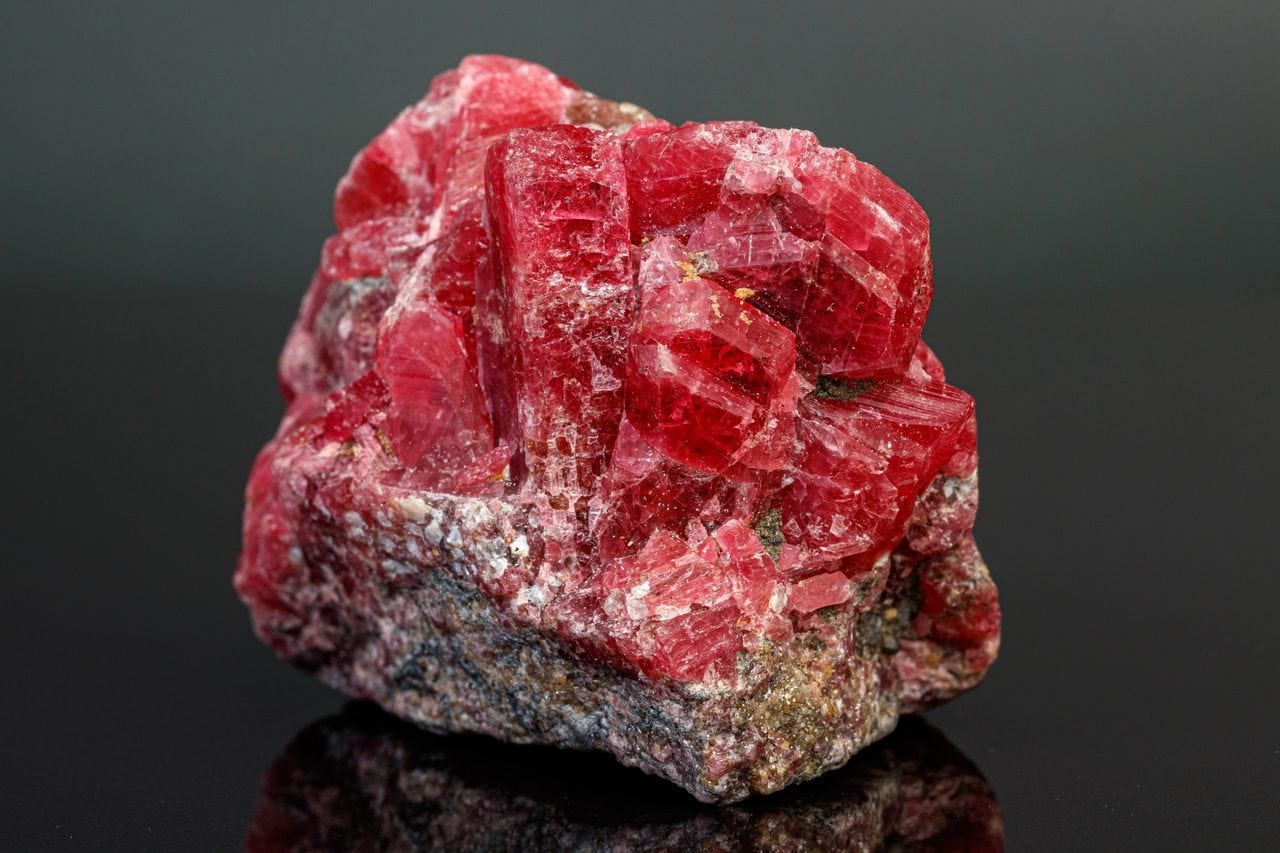
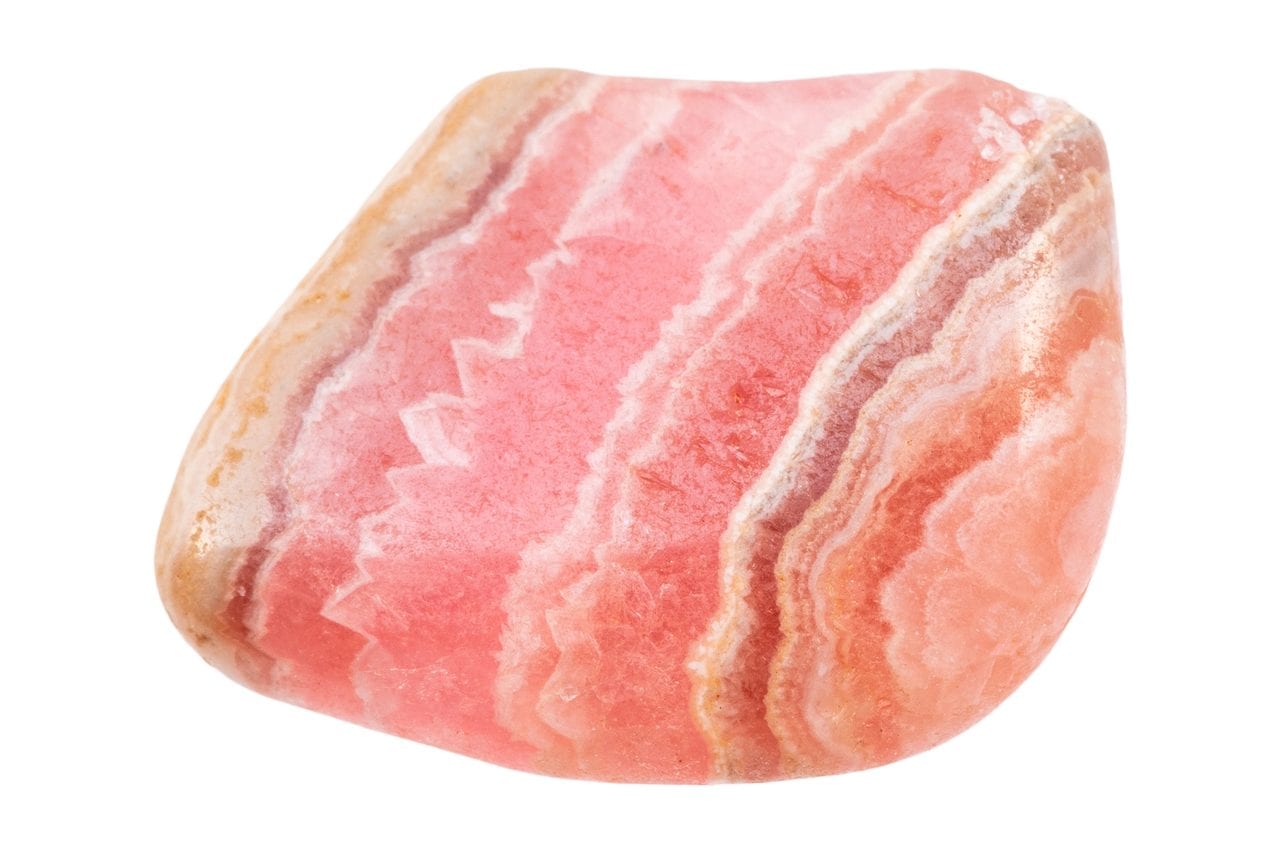
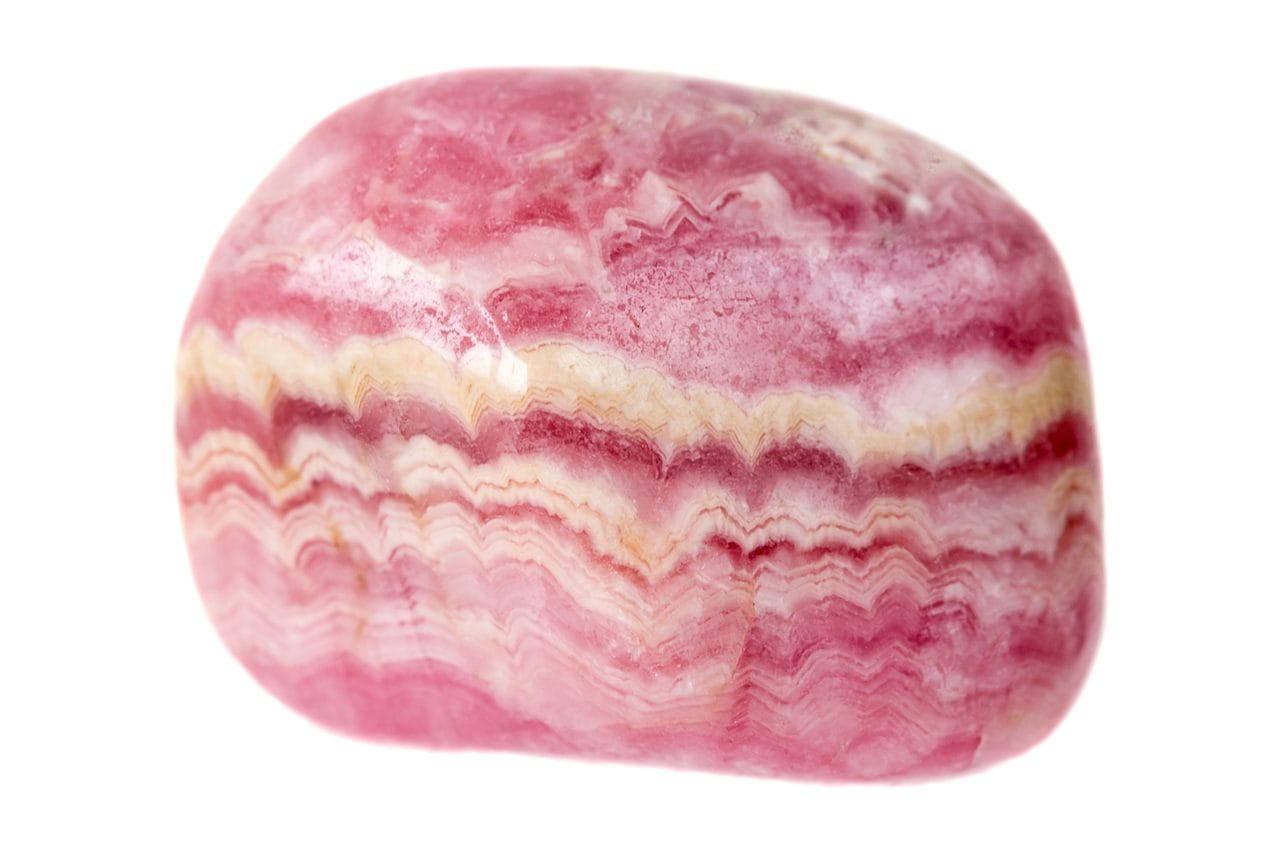
TABLE OF CONTENTS
Properties & Qualities
Physical Properties
A carbonate of the calcite family. Rhodochrosite is manganese carbonate, MnCO₃, and a member of the calcite group, named after calcite. The Handbook of Mineralogy records two solid-solution series, one with calcite and one with siderite, the iron carbonate. Natural pieces usually carry some calcium, iron or magnesium in place of part of the manganese, which Geology.com says shifts the colour, hardness and specific gravity.
Where the colours come from. The pink is manganese, and Mindat notes that the reddest shades occur where iron is minimal. A study of the Capillitas deposit published by Argentina's geological survey, SEGEMAR, found that its bands differ in chemistry as well as colour. The pale bands are richer in calcium, the raspberry bands are almost pure manganese carbonate, and a brown variety the miners call capillitita holds more iron and zinc.
Soft, with perfect cleavage. It rates 3.5 to 4 on the Mohs scale and cleaves perfectly in three directions, along the faces of the rhombohedron its crystals grow as. The International Gem Society calls it a challenging stone to cut and wear, because of that cleavage, its softness and its sensitivity to heat. Geology.com rules it out for rings. Clear crystals also have very strong double refraction, enough that the International Gem Society describes a pronounced doubling effect inside a cut stone.
How it forms. It grows mainly in low- to moderate-temperature hydrothermal veins, according to the Handbook of Mineralogy, with quartz, fluorite, pyrite and sphalerite for company, and Geology.com adds that it is often found with silver. The banding is a record of repeated pulses of mineral-rich water, each leaving a layer of slightly different pink on the wall of a fracture. Where the water drips into an open cavity it builds stalactites instead, and a slice across one shows rings like a target.
Capillitas, Argentina. Rock & Gem calls the district, more than 3,000 metres up in the Andean foothills, the world's largest rhodochrosite deposit, though it was worked mainly for copper from the 1700s until 1997. In 1986 miners broke into caverns hung with rhodochrosite stalactites more than a metre long. Polished slabs of them caused a stir at gem shows the next year.
Sweet Home, Colorado. The Sweet Home mine opened for silver in 1872, at about 3,300 metres in the Rockies, GIA records. Its rhodochrosite was a nuisance to the silver miners for decades, and from 1991 the mine was worked for crystals alone. In 1992 it gave up the Alma King, a deep cherry-red rhombohedron of about 14 by 16.5 centimetres that GIA calls the world's largest known fine rhodochrosite crystal. It belongs to the Denver Museum of Nature and Science. Other notable sources in the Handbook of Mineralogy include South Africa's Hotazel and N'Chwaning mines, Peru, Mexico, Romania and Montana.
Metaphysical properties
Crystal practice treats rhodochrosite as a heart stone with one particular job, self-compassion. Practitioners who are patient with everyone else and merciless with themselves are the people it is usually handed to. We follow that work in more detail in what rhodochrosite is good for.
Its place is the heart chakra, the centre practice links with love and feeling. A few practitioners add the solar plexus, the centre tied to confidence and self-worth, since the stone's work turns so often on how a person judges themselves. In descriptions of it the vocabulary is warm rather than calm: repair, tenderness, spirits lifting again after a long low spell.
It is also treated as a stone for people whose kindness runs one way, such as carers and parents. Practitioners suggest they keep a piece for themselves instead of passing it on, as a reminder that the care is meant to reach them too.
Rose quartz is the stone for comfort and rest. Rhodochrosite is reached for later, when someone is ready to open up again after a loss or a long guarded period. For rose quartz's own pairings, see our guide to what goes well with rose quartz.
Meaning & Symbolism
Physical meaning
Practitioners read rhodochrosite's physical meaning from its layers. A banded slice is built from many thin bands, each laid down by a separate pulse of mineral water on the wall of a crack. None of it happened at once, and practice takes the stone as a picture of recovery that arrives slowly and in small deposits.
The stalactites carry the same idea further. They grew drop by drop in the dark, and a slice across one shows rings around a centre, which practitioners read as care that starts at the core and works outward.
It is also a soft stone that splits cleanly along its cleavage, so it has to be handled with care, and practice makes that part of the meaning. Rhodochrosite is read as tenderness, something that does better when it is protected and not knocked about. The deep red Colorado crystals, rare and fragile and hard to bring out of the ground in one piece, are read as the heart at its most open.
Spiritual meaning
Spiritually, rhodochrosite is a stone of forgiveness, and in practice the first person forgiven is usually the one holding it. It is kept by people trying to let go of an old mistake, a harsh verdict on themselves, or the habit of apologising for taking up room.
Its trade name carries a story. A popular account, given without a source, says the Incas treasured the stone as the blood of their ancestors turned to rock. Rock & Gem reports that the Incas worked Capillitas for gold, and that "Inca rose" was coined by Buenos Aires jewellers centuries later. A practitioner can still find the legend moving. It is a modern one, that is all.
The older symbol sits in the name itself. Rhodochrosite means rose-coloured, the rose has stood for love in many traditions, and practice points that love inward, at the self.
Some keep a piece through a period of reconciliation, with another person or with their own past, and put it away once the work feels finished.
Healing Benefits
Physical healing
Healing practices with rhodochrosite belong to crystal tradition and energy work, and they are not a substitute for medical care.
Practitioners associate it with the heart and chest, with circulation, and with the tension that settles in the upper body during a hard period. These connections are symbolic, drawn from its colour and its place at the heart.
In practice a piece is held over the breastbone during rest or slow breathing. Because it is soft and attacked by acids, it is kept out of soaks and drinks. Chest pain, heart symptoms and anything else physical belong with a doctor.
Emotional healing
Emotionally, rhodochrosite is used against self-criticism. Practitioners reach for it when the inner voice has turned harsh, after a failure, a rejection or a long stretch of feeling not good enough, and when someone needs to speak to themselves the way they would speak to a friend.
It is also kept for old hurt that has gone quiet without going away. Practice treats it as a stone for revisiting a painful memory gently and in small steps, rather than forcing a breakthrough. Some hold it while writing in a journal, or while reading back something they once wrote about themselves.
Practitioners are clear that it warms rather than numbs. Feelings worked with alongside it can surface for a while before they settle.
Some carry a tumble through the weeks after a breakup or a falling-out, as a reminder to be patient with themselves while it heals.
Spiritual healing
In spiritual healing, rhodochrosite goes on the centre of the chest during meditation, for practice aimed at opening the heart without forcing it.
One layout uses a slice or palm stone over the heart with a piece of rose quartz just beneath, and the person lies still and breathes slowly for several minutes. Some picture warm pink light gathering under the stone and spreading a little further with each breath, ring by ring, the way the bands spread in a slice. Others prefer words. They repeat one short, kind sentence to themselves, under their breath, until it stops sounding strange.
Forgiveness work uses it as well. The stone is held while the person thinks of someone they are trying to forgive, themselves included, and set down when they have had enough for one sitting. Because it scratches easily, it is wiped with a dry cloth afterwards and stored on its own, away from harder stones.
Use & Care
How to use
- Over the heart: Hold a palm stone against the chest for a few minutes of slow breathing.
- In a pocket: Carry a smooth tumble on a day when you expect to be hard on yourself. Keep it away from keys and coins, which scratch it.
- As a pendant: Geology.com suggests pendants, earrings and pins rather than rings, which take more knocks.
- On a bedside table: Set a polished slice where you see it last thing at night and first thing in the morning.
- While journalling: Keep a piece beside the notebook when you write about old hurt or self-doubt.
- By a mirror: Some place a piece near the mirror as a prompt to speak kindly to the person in it.
- After a breakup: Carry it through the first weeks as a token of patience with yourself.
- In a window: Stand a thin slice upright where light can pass through its bands.
- As a gift: Give a slice to someone going through a hard time, as a sign of care.
- With rose quartz: Keep the two in a small lined dish as a gentle heart pairing.
- As a display piece: Keep a crystal specimen in a closed cabinet or under a dome, safe from knocks and dust.
How to cleanse
- Damp cloth: A soft, slightly damp cloth is the safest everyday method for this soft stone.
- Warm soapy water: The International Gem Society recommends only a soft brush, mild detergent and warm water. Rinse briefly and dry it straight away rather than soaking it. Our guide to which crystals should not be put in water explains why soft stones stay out of soaks.
- No acids: The Society also warns against acidic cleaners. Vinegar and lemon juice attack carbonates and will dull the polish.
- No ultrasonic or steam: Lang Antiques' gem care guide lists both as unsafe for rhodochrosite.
- Smoke: Pass it through incense or herb smoke a few times.
- Sound: Ring a bell or singing bowl near it and let the sound fade out.
- Moonlight: Leave it on a windowsill overnight under the moon.
- Selenite plate: Rest it on a selenite plate for a few hours, setting it down rather than sliding it.
- Dry salt: Set it in a small glass dish nested in a bowl of salt, so the stone does not touch the salt itself.
- Breath: Hold it in cupped hands and breathe across it slowly a few times.
How to charge
- Morning light: Give it a short spell of morning sun on a windowsill. Our article on charging crystals through a window covers whether the glass matters.
- Away from heat: Keep it off radiators and hot sills, since the International Gem Society lists heat sensitivity among its weaknesses.
- Moonlight: Charge it under a full moon on a sill or a table by the window.
- With intention: Hold it over the heart and name what you want to be gentler about.
- Beside a cluster: Rest it next to a clear quartz cluster for a few hours, not on top, where the harder points could scratch it.
- Kind words: Some speak a few kind sentences aloud while holding it.
- Grid: Place it in the centre of a ring of rose quartz and rhodonite tumbles.
- Sound: Play a singing bowl softly near it for a few minutes.
- Visualisation: Hold it in both palms and picture pink light gathering in rings, like the bands of a slice.
Combining with other stones
- Rose quartz: The classic heart pairing, comfort beside rhodochrosite's warmth. See Quartz (Rose).
- Rhodonite: Another pink manganese mineral, used for steady, practical self-care. See Rhodonite.
- Clear quartz: Sweet Home rhodochrosite grew alongside quartz, and practice adds it to amplify. See Quartz (Clear).
- Fluorite: A vein companion at Sweet Home, added for a clear head during emotional work. See Fluorite.
- Kunzite: Pink and gentle, chosen when tenderness is the point. See Kunzite.
- Lepidolite: Brings calm to rhodochrosite's warmth. See Lepidolite.
- Malachite: Green, and used at the heart for emotional honesty. See Malachite.
- Moonstone: Pairs gentle feeling with rhodochrosite's warmth. See Moonstone.
- Calcite: Pink manganoan calcite sits in the same mineral series and adds a softer note. See Calcite.
- Pyrite: Another Sweet Home companion, paired when self-worth needs a confident push. See Pyrite.
Identification
Can be mistaken for
- Rhodonite: The International Gem Society names it as the main look-alike. Rhodonite is a manganese silicate, harder, and usually veined with black, where rhodochrosite is banded in pink and white. See Rhodonite.
- Manganoan calcite: Calcite carrying some manganese is pink too, since the two minerals form a series. It tends to be paler, without the strong raspberry bands. See Calcite.
- Dyed calcite: The International Gem Society lists dyed calcite beads among the common imitations.
- Talc-calcite aggregates: The same source names these as another imitation that a gemmologist can usually tell apart.
- Reconstituted material: Geology.com describes imitations of powdered mineral bound in resin and layered to copy the banding. Their specific gravity is about 1.99, so they feel light in the hand.
- Rose quartz: Paler, evenly pink without bands, and much harder. See Quartz (Rose).
- Dyed banded agate: Pink-dyed agate can copy the stripes, but it is harder, glassier and often translucent at the edges.
- Rhodolite garnet: It shares the Greek root for rose, but it is a transparent purplish-red garnet, usually faceted and with no banding.
How to spot a fake
- Feel the weight: Rhodochrosite is dense. A piece that feels light for its size may be resin-bound reconstituted material.
- Look at the bands: Natural bands curve, pinch and vary in width and shade. Perfectly even stripes deserve a closer look.
- Use a loupe: Geology.com notes that resin imitations show sugary internal reflections and bubble-like pits.
- Check the cracks: Dye gathers in fractures and around drill holes, where it looks darker than the stone around it.
- Be wary of neon pink: Natural colour runs from pale pink to raspberry red. An even, fluorescent pink points to dye.
- Ask about stabilisation: The International Gem Society notes that opaque material may be impregnated with wax or plastic, and that should be on the label. The words sellers use are covered in what "natural" means when buying crystals.
- Weigh price against origin: The same source describes Argentinian material as much less costly, and clean red stones from Colorado or South Africa as scarce and expensive. A cheap "Colorado" crystal deserves questions.
- Know the trade name: "Inca rose" is a name for banded Argentinian rhodochrosite, not a separate stone, and it should still be the real mineral.
- Leave proof to a lab: A gem lab can confirm it from its refractive index and very high birefringence, which the International Gem Society gives as about 0.20 to 0.22.
Sources: Mindat, Rhodochrosite; Handbook of Mineralogy, Rhodochrosite; Geology.com, Rhodochrosite; International Gem Society, Rhodochrosite value, price and jewelry information; Márquez-Zavalía, M.F. (2008), La rodocrosita de Mina Capillitas. Rosa del Inca, piedra nacional argentina, SEGEMAR, Sitios de Interés Geológico de la República Argentina; Voynick, S., Argentina's Inca rose, Rock & Gem, March 2024; GIA, Gems & Gemology Spring 2023, Sweet Home mine rhodochrosite; Kucera, K., The Sweet Home Mine: silver "failure" to rhodochrosite bonanza (1872-2022), Colorado School of Mines Museum of Earth Science, 2022; Colorado Geological Survey, State mineral; Colorado General Assembly, Act concerning the designation of rhodochrosite as the state mineral, 2002; Honorable Cámara de Diputados de la Nación, committee opinion on the Rosa del Inca as national stone, 29 September 2026; Lang Antiques, Rhodochrosite gemstone guide.