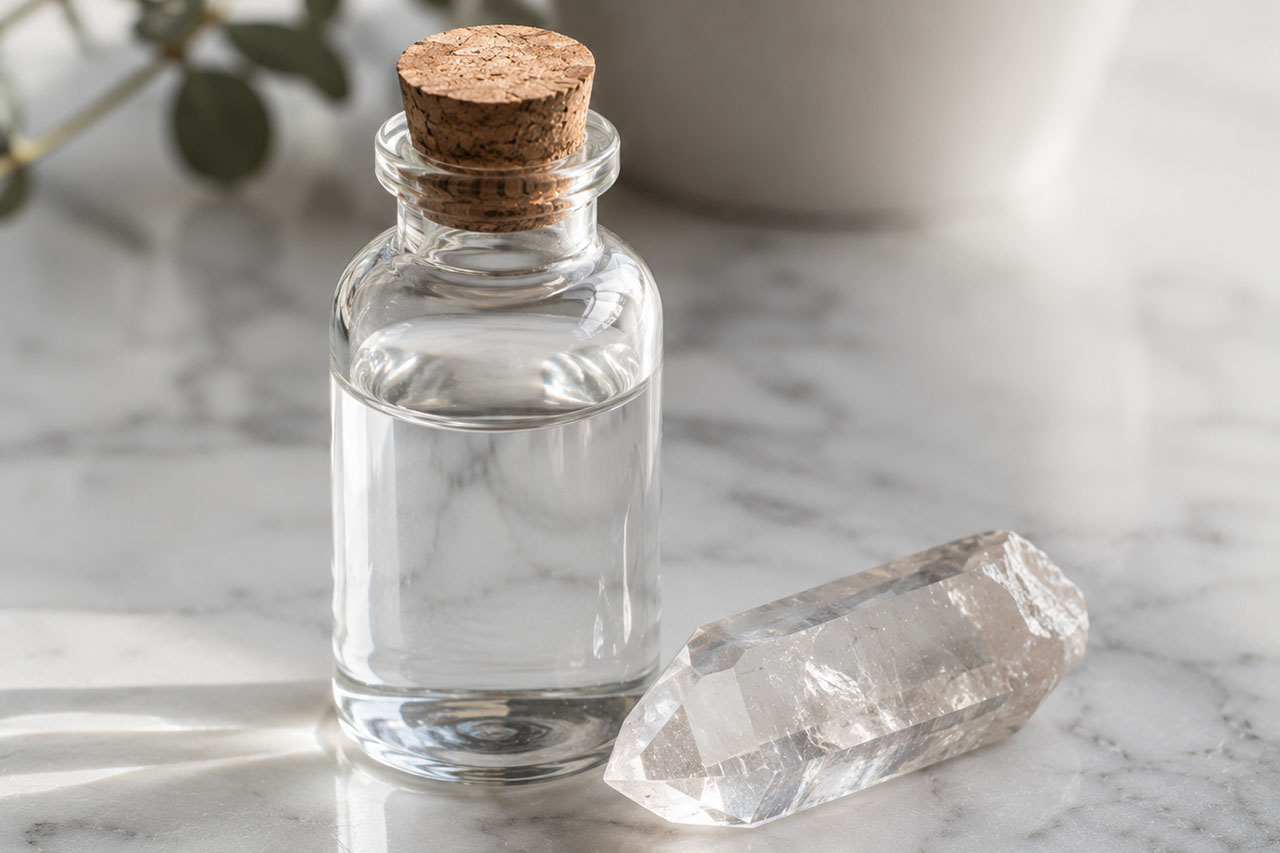
Gem essence is water a crystal has been left in or beside, then bottled, and some recipes add a little alcohol to keep it. The practice calls the two preparations the direct and indirect methods, and in both the crystal is out of the way before the bottle is filled.
A book printed in England in 1481 sets out what a healing stone can do and how to use it. If any man be sick in his body of venom, or ill meat in his stomach, of colic or canker or any other sickness, save only death itself, lay this stone in a little water and let him drink it, and he shall forthwith be whole and quit of his sicknesses. The book is William Caxton’s printing of Reynard the Fox, and the stone is set in a ring a fox has found, so the passage is a marvel inside a story and not a prescription.
Nichola Harris, whose Rutgers dissertation traces ideas about the healing virtues of stones from their Western origins in classical Greek and Roman texts into the manuscript culture of medieval Europe and on through early modern England, quotes the fox for a narrower reason. It shows that popular audiences were in some way familiar with the idea of stones that heal and with the procedures linked to using them. Her own gloss on the passage is that the stone was laid on the affected body parts or soaked in water which would then be drunk, presumably just as any other medicine.
The record behind that familiarity is large, and one poem sits near the front of it.
Stones on the apothecary’s shelf
Harris dates the tradition of the verse lapidary to the late eleventh-century poem De lapidibus, by Marbode, Bishop of Rennes. It is one of six forms of lapidary text she counts as having been produced in Europe since the eleventh century. Harvard’s Countway Library, which holds two leaves of a thirteenth-century copy, describes it as a treatise on the medicinal, therapeutic and magical properties of sixty different jewels, calls it one of the most popular works of scientific and medical lore current in the Middle Ages, and counts more than 125 surviving Latin manuscripts. Harris reports Leopold Pannier’s judgement that the poem’s impact rested on its translations into the vernacular languages of Western Europe, French, Italian, Spanish, English, Irish and Danish, and that it acted as the classic pharmaceutical text of Europe until the end of the sixteenth century. She adds that Pannier worked almost exclusively on verse lapidaries and held the prose ones to be of no literary value at all, and that limitation travels with his judgement.
For what any of that came to on a counter, Harris has counted one shop. Working from the inventories of a sixteenth-century London apothecary, she gives the average composition of the medicines as 74 per cent plant-based, 8 per cent animal-based, 5 per cent metal or metalloid, 5 per cent lapidary, and 8 per cent other chemical or mineral substances. In that shop stones were a real category and a small one, sitting level with the metals and well behind the herbs.
The recipes that put the stone inside you
Harris marks a turn in the sixteenth and seventeenth centuries. In an age of printed texts working as personal manuals of healing, lapidaries increasingly advocated cures designed to be taken internally, and gemstones, minerals, and the plant and animal materials classified as stones were to be ground, mixed, dissolved and at times distilled, using the techniques of physick as well as the budding science of chymistry.
What that looks like on the page is a shopping list. Culpeper’s directory for midwives, published in 1662 and attributed to the herbalist and healer Nicholas Culpeper, carries a preparation for stemming abundant bleeding from a woman’s womb. It calls for powder of amber, dragon’s blood, bloodstone, red coral and lettuce seed, a dram of each, with balaust and bole armoniack, given in three ounces of plantain water and asses’ milk heated with steel. A separate mixture of white henbane seed, red coral and white camphor is dosed alongside it, half a dram at a time.
The bloodstone in that list is in the glass. It has been reduced to powder and stirred into the liquid, and the patient swallows the mineral itself. Whatever anyone believed was doing the work, the material was present to do it.
What is in the bottle now
Nothing of the sort is present in a gem essence, and the method is built to make sure of it. In the version where the crystal goes into the water, it sits for some hours or days and is then lifted out or strained off before anything is bottled. In the version where it does not, the crystal stands in a separate glass vessel inside or beside the water and never touches it. Practitioners call these the direct and indirect methods, and the second is treated within the practice as the safer default for anything unfamiliar, which is a convention the practice maintains for itself rather than a standard anybody outside it has published. Recipes vary on how long the crystal stays and whether it stands under sunlight or moonlight, and practitioners hold those choices to matter.
Neither method leaves the stone in the bottle. In one it is lifted out. In the other it was never in. What gets sold or drunk is the water, and the mineral that gave the bottle its name goes back on a shelf.
Whether a given mineral would dissolve, and how fast, bears only on the direct method, and there the question worth asking is what a stone is made of and what has been done to it since. That question has real answers, and the guide to what crystals are good for water bottles works through them stone by stone.
There is a raw rose quartz in this house heavy enough that moving it is a decision, an unpolished pink mass rising to a rough point from a broad base. A preparation that ends by lifting the stone out wants a stone that can be lifted out, and that quietly settles which pieces in a collection ever take part.
The practice describes what the water then carries as something of the crystal’s quality, taken on through contact or proximity, and holds that drinking it carries that quality further into the day than holding the stone would. Particular essences get matched to particular intentions, rose quartz to emotional softness, amethyst to calm, citrine to confidence, in the pairings the practice uses everywhere else. What is being claimed there is a transfer, and not a composition.
What has been measured is the stone rather than the water. In 2025 a randomised controlled study in CNS Spectrums put 138 adults through a standardised fourteen-day protocol with rose quartz against a visually matched placebo, sorting participants beforehand into believers and non-believers. The crystals did not produce anxiety reduction beyond the placebo. Reductions appeared only among believers, and among believers they appeared regardless of which stone anyone had been given. What that study assigned people was a crystal, not a preparation to drink.
A published position on the wider practice comes from an advertising regulator. The UK’s Advertising Standards Authority states that it and CAP have not seen evidence that crystal therapy can be used to treat medical conditions, and that such claims are not likely to be acceptable without a body of robust clinical trial evidence, a position applied in rulings going back at least to 2005. That is a rule about what a seller may print, which is a different thing from a finding about what a practice does.
Harris offers a tentative reason for how little of this history gets studied. The exclusion of this kind of healing from modern scholarly concepts of medicine, she suggests, is perhaps due to lapidary healing no longer being part of recognised ideas of orthodox medicine. The minerals, and what each one is made of, are set out in the Crystalance Mineral Library for anyone who wants to start at that end. The 1662 recipe expected the bloodstone to be swallowed. A bottle filled today expects it back on the shelf before the lid goes on.
Sources
- Harris, N.E. (2009), The Idea of Lapidary Medicine: Its Circulation and Practical Applications in Medieval and Early Modern England: 1000-1750, doctoral dissertation, Rutgers, The State University of New Jersey, for the dissertation tracing ideas about the healing virtues of stones from their Western origins in classical Greek and Roman texts to the manuscript culture of medieval Europe; for the passage from Caxton’s 1481 printing of Reynard the Fox and its framing as the story of a fox who finds a ring set with an unusually coloured stone; for the reading that popular audiences were in some way familiar with healing stones and with the procedures linked to the practical application of the theory; for the gloss that the stone was laid on the affected body parts or soaked in water which would then be drunk, presumably just as any other medicine; for the tradition of the verse lapidary originating with Marbode’s late eleventh-century De lapidibus; for Leopold Pannier’s reported judgement that the poem’s impact rested on its translations into the vernacular languages of Western Europe, French, Italian, Spanish, English, Irish and Danish, and that it acted as the classic pharmaceutical text of Europe until the end of the sixteenth century, together with Harris’s note that Pannier’s investigations were almost exclusively confined to verse versions of lapidaries; for the six forms of lapidary produced in Europe since the eleventh century; for the inventories of a sixteenth-century London apothecary shop averaging 74 per cent plant-based, 8 per cent animal-based, 5 per cent metal or metalloid, 5 per cent lapidary and 8 per cent other chemical or mineral substances; for lapidaries increasingly advocating cures designed to be taken internally during the sixteenth and seventeenth centuries, with stones ground, mixed, dissolved and at times distilled using the techniques of physick and chymistry; for the 1662 Culpeper’s directory for midwives, attributed to Nicholas Culpeper, and its preparation to stem abundant bleeding from a woman’s womb, with the ingredients and the dosing described above; and for the observation that lapidary healing is no longer part of recognised ideas of orthodox medicine.
- Countway Library of Medicine, Center for the History of Medicine, Harvard, De Lapidibus, for Marbode of Rennes as a poet, teacher and scholar of the late eleventh century, for the work as a treatise describing the medicinal, therapeutic and magical properties of sixty different jewels, for it being one of the most popular works of scientific and medical lore current in the Middle Ages, and for over 125 surviving Latin manuscripts. The item held there is two leaves of an early thirteenth-century copy.
- Escolà-Gascón, A. et al. (2025), “Placebo effects in alternative medical treatments for anxiety: false hope or healing potential?”, CNS Spectrums 30(1), e70, for 138 adults classified as believers or non-believers and assigned to rose quartz or a visually matched placebo, for the standardised 14-day protocol, for healing crystals not demonstrating anxiolytic effects beyond those of the placebo, and for anxiety reductions occurring only among believers regardless of crystal assignment.
- Advertising Standards Authority and CAP, Health: Crystal Therapy, for the statement that the ASA and CAP have not seen evidence that crystal therapy can be used to treat medical conditions and that such claims are not likely to be acceptable without a body of robust clinical trial evidence, and for the rulings cited there including Octopus Publishing Group of 19 October 2005 and Spirit Walker Crystals of 17 April 2013.