Put an extra word in front of “jade” and you are usually not looking at jade any more. “New jade,” “olive jade,” “Korean jade,” “Suzhou jade”: these are trade names for serpentine, a softer and cheaper stone that happens to arrive in a similar green. Real jade is sold as jade, or more exactly as jadeite or nephrite, and sellers of the real thing rarely decorate either word.
So the swap happens in the label as much as in the stone. Serpentine is not disguised physically so much as verbally, wrapped in a name that borrows jade’s prestige. If you bought “jade” cheaply and the name had a modifier attached, that is the likely explanation, and it is one of the most common substitutions in the green-stone market.
The names to watch for
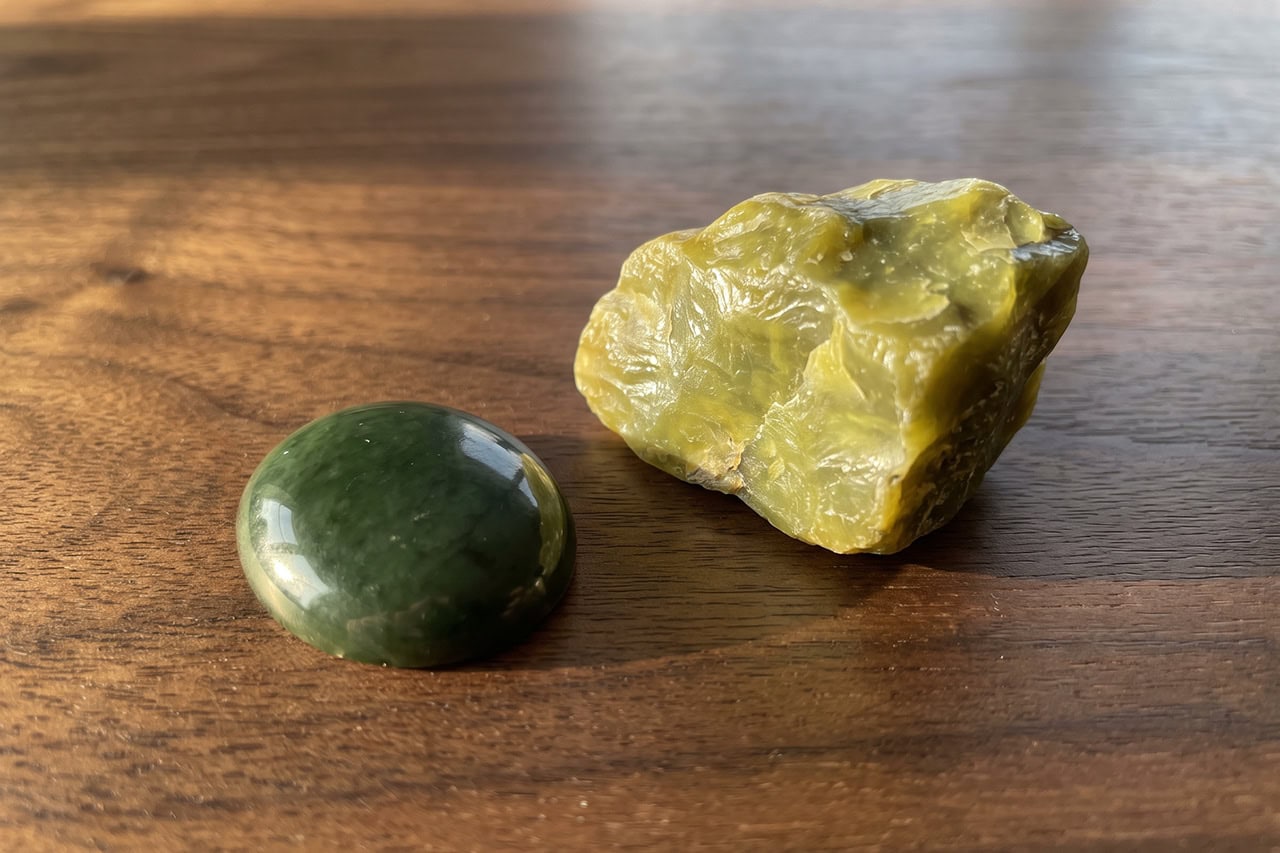
Serpentine is not one mineral but a group, and several of its varieties are marketed to evoke jade. It is commonly sold as “new jade,” “Korean jade,” “Suzhou jade,” and “olive jade,” among others. Bowenite is the awkward one. It is the serpentine usually sitting behind “new jade,” harder and more translucent than the rest of the group, and close enough to nephrite to fool a casual buyer.
A qualifier in front of “jade” is not proof of anything on its own. It is just common enough that it should make you look closer.
What each stone is
Jade is two minerals rather than one. Jadeite and nephrite are both hard and both remarkably tough, which is why jade has been carved into tools and treasures for thousands of years. There is more on its background in is jade a healing crystal.
Serpentine is a group of softer green minerals, usually with a smooth, waxy, slightly greasy lustre, and its own uses in crystal practice are covered in what serpentine is good for. Nothing about it is fake. It is a real, natural stone, and it only becomes a problem when someone passes it off as the more valuable and more storied material.
How to tell them apart
Hardness does most of the work. Jadeite sits around 6.5 to 7 and nephrite around 6 to 6.5 on the Mohs scale, while most serpentine falls between 2.5 and 4. A steel knife will mark it, and so will a coin. Jade resists both. The exception is bowenite again, which reaches about 5.5 and can pass a casual scratch test, so hardness alone will not always settle it.
Then heft. Jade is dense, jadeite especially, and feels heavier than a stone that size has any right to. Serpentine comes up light. Plenty of experienced buyers sort the two on weight alone.
Surface says something too. Serpentine takes a smoother, greasier, more waxy polish, while jade has a subtler and tougher character, and nephrite in particular can show a slightly fibrous, felted structure.
Price is the last check and often the loudest. Real jade, fine jadeite above all, commands real money. A large, richly green “jade” carving going cheap is a strong candidate for serpentine.
Use two or three of these together rather than trusting one. Hardness, heft and a sensible look at the asking price will catch most serpentine sold as jade. For anything expensive, ask for a gem report.
Jade is already two stones
Even genuine jade is not a single mineral. Jadeite is the rarer, harder, more valuable one. Nephrite is the common one, slightly softer, and no less real. Both have been carved and treasured for millennia.
Which means a green stone in your hand raises two questions in sequence rather than one. Is it jade at all, and if it is, which jade. The price gap between top-grade jadeite and serpentine wearing a jade-like name is vast, and the more names a category carries, the easier it is to slide a cheaper stone in under a grander one.
Buying serpentine on purpose
There is nothing wrong with owning serpentine. It is affordable and it carves well, and the “new jade” look is attractive on its own merits. If you like it, buy it, at serpentine prices, sold as what it is.
The trouble is only ever the swap, serpentine sold as jade, at jade prices, to a buyer who cannot tell the difference. That is where a trade name shades from marketing into misdirection. Jade’s standing in East Asia, built over centuries, is exactly what makes the swap worth attempting, and the more a material is revered, the harder its look-alikes lean on its name.
Ask the seller directly whether a stone is jadeite, nephrite or serpentine, and buy from whoever answers plainly. There is more on both in the Crystalance Mineral Library.