Colour comes from the way a crystal’s electrons meet light, and the mechanism differs from mineral to mineral. Ask first whether the colouring element is part of the mineral or a guest inside it, because that decides whether the colour tells you anything.
Malachite has never been any colour but green and it never will be. The copper in it is not an impurity that happened to be around while the crystal grew. Copper is written into the formula, and a green-free malachite would be a different mineral with a different name.
Quartz sits at the opposite pole. It is silicon and oxygen, and pure silicon dioxide is colourless. Every purple, yellow, pink, brown and grey quartz on a shop shelf owes its colour to something outside the formula: a stray atom, or a defect left behind by radiation.
Mineralogy has a pair of words for that difference. An editorial introducing a 2022 special issue of Minerals on colour puts it in one sentence: the colour-bearing elements “can be essential to the mineral composition (idiochromatic minerals) or they can just play an occasional role as impurities (allochromatic minerals).”
Essential colour and accidental colour
Idiochromatic means self-coloured. The element responsible is part of what the mineral is, so the colour is as fixed as the formula. Malachite is green, azurite is blue, and neither is negotiable.
Allochromatic means other-coloured. The host mineral would be colourless on its own, and whatever colours it arrived as a passenger. Quartz, corundum, beryl, fluorite and calcite all sit in this group, which is why each of them turns up under half a dozen trade names in half a dozen colours.
For an idiochromatic mineral, colour comes close to being diagnostic. For an allochromatic one it is nearly worthless as identification, and a good deal of confusion in the crystal trade comes from carrying one case’s habits over to the other.
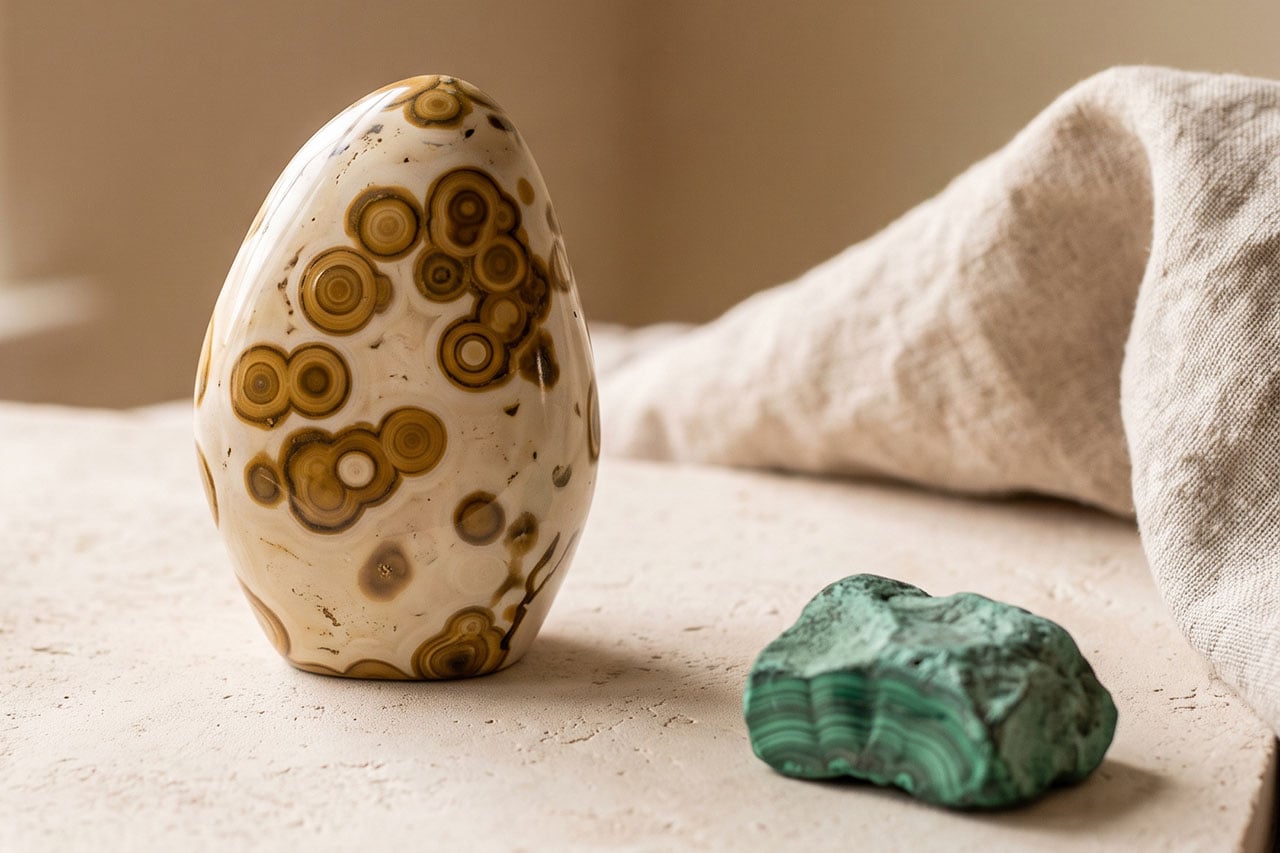
Orbicular jasper makes the allochromatic case as a single object. A polished freeform of it, creamy pale and scattered with dark golden-brown circles, came here from an online dealer some years ago, and the pale ground and the circles are the same silica. What differs between them is only what is dispersed through the material at that spot, so two colours sit a millimetre apart in a stone with one formula.
Perkins and colleagues, in an open mineralogy textbook, put the general position bluntly. Colour is one of the most misunderstood mineral properties, and quartz alone may be colourless, rosy, yellow, purple, milky, smoky or black.
What it takes to make a sapphire blue
Corundum is the standard demonstration of allochromatic colour. Pure corundum is aluminium oxide and colourless. Add chromium and it is ruby; add iron and titanium and it is blue sapphire.
The two halves of that are not the same kind of event. GIA’s 2020 review of corundum chromophores gives ruby the simpler mechanism: trivalent chromium is the trace element primarily responsible for colouring ruby red, absorbing light through transitions within a single isolated ion. Blue sapphire needs something more particular. The chromophore is a pair, Fe2+ and Ti4+, and the two ions have to sit on adjacent aluminium sites, where an electron moves from one to the other when light is absorbed.
It takes two ions on neighbouring sites and an electron moving between them, and it works at concentrations measured in parts per million. A crystal can hold plenty of iron and plenty of titanium and stay pale, if the two never end up next to each other.
The same distinction, between a lone ion and a cooperating pair, separates several quartz varieties that get treated as one kind of thing.
Colour with nothing added
The reference scheme for causes of colour is Nassau’s, and M. Darby Dyar reproduces it for the Mineralogical Society of America under the caption “Examples of the fifteen causes of color (adapted from Nassau, 1987)”. Fifteen entries, covering crystal field transitions where the chromophore is a major element and where it is a trace one, charge transfer between ions, colour centres, scattering, interference and diffraction.
Entry nine is energy bands in semiconductors, and the mineral the table gives as an example is galena. In a semiconductor the electrons available for absorbing light are not attached to one ion or shared between two. They sit in a band, and the size of the gap between that band and the next sets which wavelengths get absorbed. Where the gap is wide the material stays colourless, and where it is narrow the material comes out opaque and metallic-looking, which is galena. In between the mineral is coloured, with nothing added and no impurity anywhere in the account.
Entry ten is the doped version of the same mechanism, and the table’s examples are blue boron-bearing diamond and yellow nitrogen-bearing diamond.
A mineral can therefore be strongly coloured while being chemically dull, and nothing about the stone itself will show you which case you are looking at. A grey galena and a colourless quartz look as though they differ by pigment. What separates them is the energy it takes to shift an electron across a gap.
Radiation makes the defect, and the defect makes the colour
Radiation knocks an electron out of position in the lattice and leaves a defect behind, and the defect is what absorbs light. Heat the same crystal and it loses the defect, and the colour goes with it. That is why irradiated colours are the unstable ones, and it is why heat treatment works at all.
Amethyst is the case everybody wants explained and the one where the literature is least settled. What can be said is that the purple comes from an iron-related colour centre produced by irradiation. What cannot be said flatly is which iron species is involved. Fritsch and Rossman’s 1988 review points at Fe4+, with transitions from oxygen to iron absorbing in the middle of the visible range; Cheng and Guo, in 2020, attribute the relevant 545 nanometre band to a charge transfer between Fe3+ and oxygen instead. Neither account has displaced the other, and anyone printing a single oxidation state without naming whose account it is has quietly picked a side.
Where the explanations run out
Two of the prettiest effects in the quartz family have no accepted mechanism, and saying so is more useful than a guess.
Ametrine is a single crystal with amethyst purple in some sectors and citrine yellow in others. Vasconcelos, Wenk and Rossman confirmed in 1994 that the combination at Anahí is natural and not the result of laboratory treatment, Their own summary hedges in both directions at once. The unusual colour patterns probably result from the uncommon geologic conditions under which the crystals formed, they write, although the crystal chemical properties controlling the sector colour zoning still elude explanation.
Agate banding is the larger open question. A 2020 review in Minerals by Götze, Möckel and Pan describes the account in which waves of silica-bearing water arrive one after another as an early theory, and favours self-organisation within the growing material instead. The same review notes that banding and colour distribution in agates are not always identical, that the origin of agate remains incompletely understood, and that agates have never been successfully synthesised in a laboratory.
Nobody has grown an agate. A material that turns up in ordinary shops, in slices, on every price tier, has not been reproduced under controlled conditions, and until it is, the pattern on a cut face is a record nobody can check their reading of.
A stone’s colour becomes a sensible question only after its species is settled, and settling the species is what the Crystalance Mineral Library is for. Fluorite makes the sequence obvious, since green and purple fluorite turn out to be one mineral wearing two defects, and the colour question only becomes answerable once that is established. Malachite never reaches that question. Copper carbonate hydroxide is green by composition, and there is no second version of it to compare.
Sources
- Casas, L. and Di Febo, R. (2022), “Editorial for Special Issue ‘Colours in Minerals and Rocks'”, Minerals 12(4) 473, for the definitions of idiochromatic and allochromatic minerals quoted above. This is the editorial introducing the issue, not a research paper.
- Dyar, M.D., “Color in Minerals”, Mineralogical Society of America, for Table 1, “Examples of the fifteen causes of color (adapted from Nassau, 1987)”, for energy bands in semiconductors as cause nine with galena among its examples, and for doped semiconductors as cause ten with boron-blue and nitrogen-yellow diamond.
- “Chromophores in Corundum”, Gems & Gemology Spring 2020, for Cr3+ as the trace element primarily responsible for colouring ruby red, and for Fe2+ and Ti4+ pairs on adjacent Al3+ sites as the primary chromophore of blue sapphire.
- Fritsch, E. and Rossman, G.R. (1988), “An Update on Color in Gems, Part 2”, Gems & Gemology, for O2- to Fe4+ transitions absorbing in the middle of the visible region and giving amethyst its purple.
- Cheng, R. and Guo, Y. (2020), “Study on the effect of heat treatment on amethyst color and the cause of coloration”, Scientific Reports 10, 14927, for the alternative attribution of the 545 nm band to a charge transfer between Fe3+ and O2-.
- Vasconcelos, P.M., Wenk, H.-R. and Rossman, G.R. (1994), “The Anahí ametrine mine, Bolivia”, Gems & Gemology 30(1), 4-23, abstract page, for the natural origin of the amethyst-citrine combination, for the uncommon geologic conditions, and for the crystal chemical properties controlling the sector colour zoning still eluding explanation.
- Götze, J., Möckel, R. and Pan, Y. (2020), “Mineralogy, Geochemistry and Genesis of Agate: A Review”, Minerals 10(11) 1037, for the rhythmic-supply account as an early theory, for self-organisation, for banding and colour distribution not always being identical, for the origin of agate remaining incompletely understood, and for agates never having been successfully synthesised.
- Perkins, D. et al., “Mineralogy: Color”, LibreTexts open textbook, for colour as one of the most misunderstood mineral properties and for the colour range of quartz.