Aragonite
Carbonate; aragonite group
Colourless or white; also grey, yellow, orange to reddish brown, pink, pale blue, green and violet
Vitreous; resinous on fracture surfaces
3.5 - 4
2.93 - 2.95
Orthorhombic, pseudohexagonal through twinning
Spain (Molina de Aragón, Guadalajara), Morocco (Tazouta, Sefrou), Austria (Styrian Erzberg), Italy (Sicily), Czech Republic (Bílina), Slovakia, Namibia (Tsumeb), England (Cumbria), Greece (Lavrion), Mexico, USA (New Mexico, Arizona), China
Common in shells, caves and hot springs; Moroccan star clusters are cheap and plentiful; fine flos ferri and clear gem crystals are collector pieces
CaCO₃ (calcium carbonate)
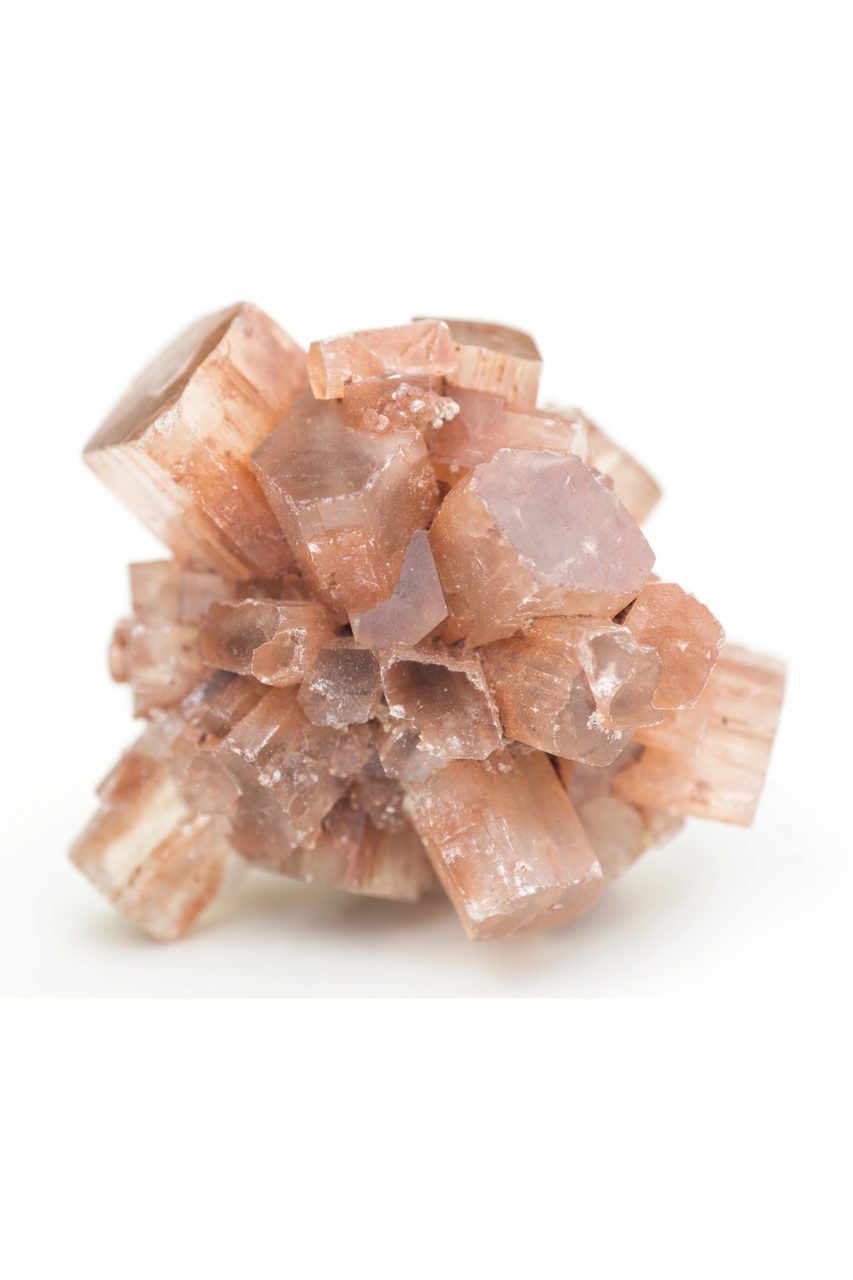
Aragonite is calcium carbonate, the same compound as calcite, with its atoms packed in a different way. The tighter packing makes it a little harder and denser than calcite, and less stable. Given enough geological time, aragonite turns into calcite.
Its name came out of a muddle. Large six-sided crystals from Spain were first filed with calcite, and in the 1780s the German mineralogist Abraham Gottlob Werner wrote about them as "Aragonian apatite". When the chemist Klaproth found nothing in them but carbonate of lime, Werner renamed them aragonite in 1797, and the name appeared in print that year in a mineralogy for beginners by the Viennese abbé Franz Josef Anton Estner. The classic Spanish crystals come from Molina de Aragón, in Guadalajara province. How one compound could make two different minerals was only worked out in 1822, by the German chemist Eilhard Mitscherlich.
In shops it mostly appears as small reddish-brown star clusters from Tazouta, near Sefrou in Morocco, with banded carvings and pale blue pieces further along the shelf. Collectors look for flos ferri, the white coral-like growths from the Styrian Erzberg in Austria. Aragonite is also the mineral in pearls and mother-of-pearl, and in the shells and skeletons of many sea creatures.
Crystal practice treats aragonite as a grounding stone and asks it for patience, steadiness and a closer bond with the earth.
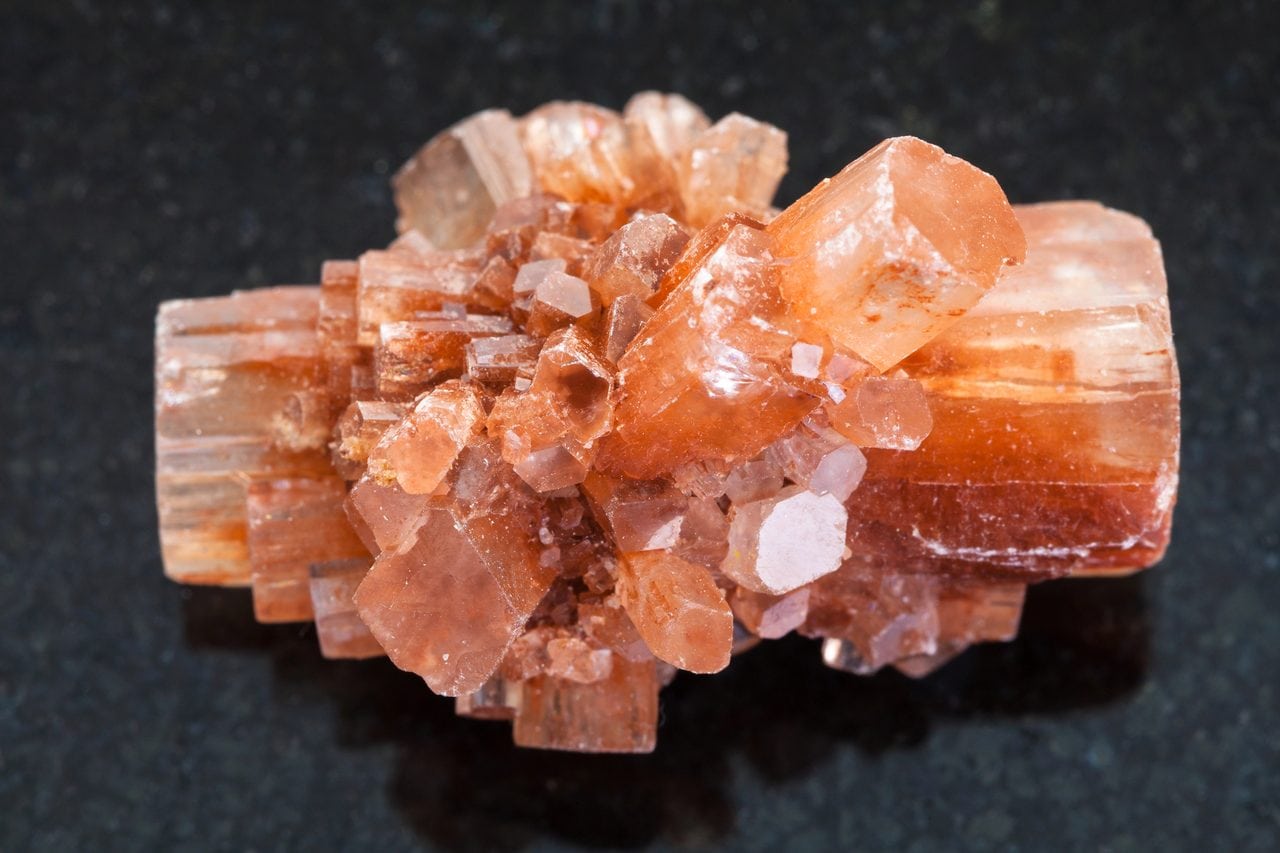
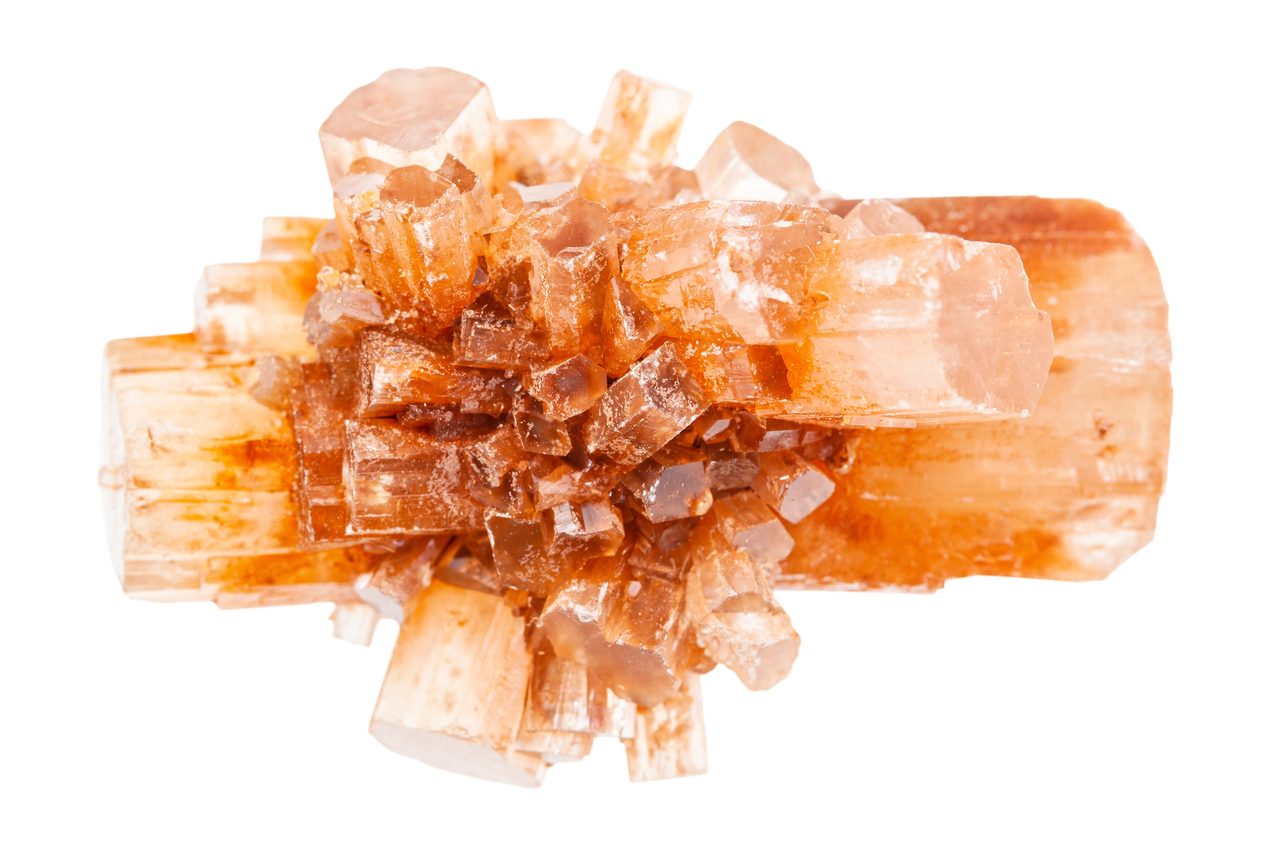
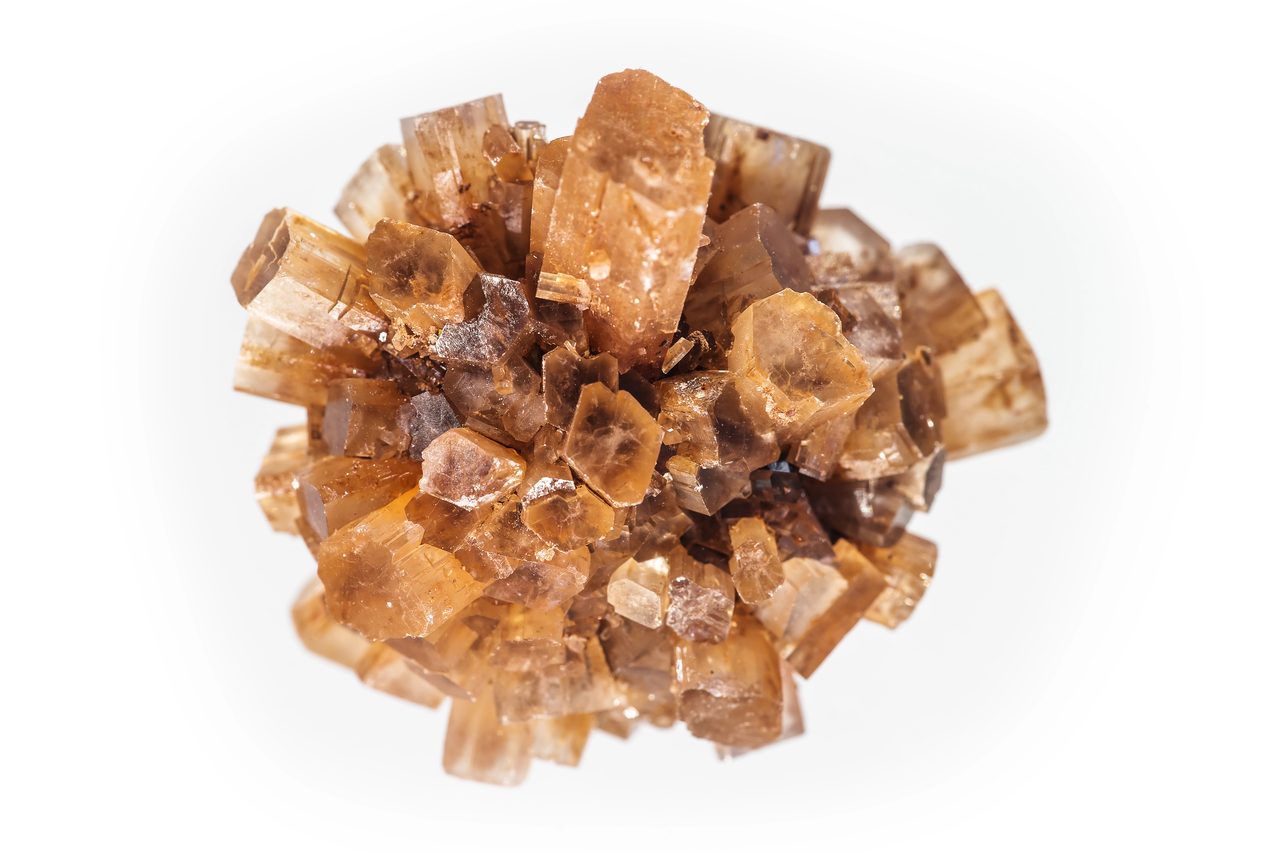
TABLE OF CONTENTS
Properties & Qualities
Physical Properties
Calcite's denser twin. Aragonite and calcite share the formula CaCO₃, and the Handbook of Mineralogy lists a third form, vaterite, as well. What separates them is structure. Erich Zirkl, writing in the Austrian collectors' journal Die Eisenblüte, explains that each calcium atom in aragonite has nine oxygen neighbours, against six in calcite. The closer packing makes it denser, with a specific gravity of about 2.95 against roughly 2.71 for calcite. At the Earth's surface it is the less stable arrangement. The Handbook notes that it converts to calcite over geological time, and the International Gem Society adds that heating it to 400 °C converts it too.
A hexagon that isn't. The crystals look six-sided, but aragonite is orthorhombic. The Handbook explains the illusion as twinning: three crystals grow together at fixed angles and make a column with a hexagonal outline, called a trilling. Zirkl records that the Spanish twins from Molina were found in clay with gypsum.
Soft and brittle. It rates 3.5 to 4 on the Mohs scale and breaks easily. Its cleavage is distinct in one direction only, where calcite cleaves perfectly in three. The International Gem Society considers it too soft to wear safely in jewellery, so a faceted aragonite is a collector's stone. The largest known is a straw-yellow stone of 110 carats from Bílina in the Czech Republic.
Where it forms. The Handbook lists warm seas, where it settles as lime mud and tiny round grains, and the hard parts of marine animals. It also forms in hot-spring deposits, in cave dripstone, and deep in the crust under high pressure. Pearl nacre, GIA explains, is built of aragonite crystals bound with a protein called conchiolin, like bricks in mortar. NOAA tracks ocean acidification by how saturated seawater is with aragonite, which it describes as one of the more soluble forms of calcium carbonate and one widely used by shell-building sea life.
Flos ferri, Austria. The iron mountain at Eisenerz in Styria is famous for snow-white aragonite that branches like coral. Zirkl writes that it was known there in the Middle Ages, when the miners called it "Erblüah", and that Linnaeus described it in 1741 as Stalactites flos ferri, "iron flower" in Latin. Minerals.net warns that it is very brittle.
Morocco and the blues. The star clusters come from Tazouta, near Sefrou, one of the localities the Handbook names. Dealers put their reddish-brown colour down to iron staining. Blue aragonite is rarer. The International Gem Society lists blue material from Lavrion in Greece and from Chile, and Zirkl mentions a blue variety from the Erzberg that is probably coloured by copper. Dealers sell pale blue pieces from Wenshan in Yunnan, China, as copper-tinted.
Metaphysical properties
Aragonite is a grounding stone, handed to people whose energy runs ahead of them. Practitioners describe someone who is busy in the head, scattered across too many tasks and short of patience, and they reach for aragonite to bring that person back to their feet.
Its main place is the root chakra, the centre at the base of the spine that practice links with safety and stability. Some practitioners also give it the earth star, a point imagined below the feet that connects a person to the ground under them. The words that recur around it are steadiness, patience and acceptance, and a few practitioners call it an earth healer, a name for work done on behalf of the land itself, such as a garden or a damaged patch of ground, rather than for the person holding the stone.
The Moroccan stars matter here too. Their prisms radiate in every direction from one shared centre, and practitioners take that as a picture of a life with many demands that still has a root.
Practice keeps it close to the sea as well, since shells and corals are built from it. Our guide to crystals for grounding covers the wider family of stones used for the same work.
Meaning & Symbolism
Physical meaning
The physical reading starts with how slowly aragonite does everything. Cave dripstone builds up one drop at a time, and a pearl oyster lays down its nacre in plates far too thin to see. Then, over millions of years, the aragonite quietly becomes calcite. Practice takes this as a lesson in time, a stone that shows how change can happen without hurry.
The star cluster is read as structure. A bundle of prisms grows outward from one point and holds its shape, and practitioners treat that as a picture of the body standing on firm ground, with weight spread evenly and feet planted.
Then there is the fragility. Aragonite chips and snaps if it is knocked, and practitioners pair its steadiness with gentleness for that reason: it is a grounding stone that has to be handled with care. Flos ferri, white and branching in the dark of an iron mine, is read as growth that keeps going in a place where nothing seems likely to grow at all.
Spiritual meaning
Patience and acceptance are aragonite's spiritual themes. It is kept by people waiting on something they cannot speed up, such as a recovery, a long training, a slow repair or a decision that belongs to someone else.
The mineral's history gives that meaning some weight. For years the Spanish crystals sat in collections labelled as calcite or as apatite, until chemists understood what they were. Practitioners who know the story take comfort from it when an answer of their own is slow in coming.
Practice also links aragonite with care for the natural world. Because shells, pearls and corals are made of it, it is kept by people who want their spiritual life to include the sea, the soil and the creatures that live in them. Some keep a piece by a window that looks onto trees or a garden, to keep that bond in view every day.
The six-sided outline of its twinned crystals, which hides a quite different structure underneath, is read as advice to look past first appearances, in other people and in oneself.
Healing Benefits
Physical healing
Healing practices with aragonite belong to crystal tradition and energy work, and they are not a substitute for medical care.
Practitioners associate it with the bones, the back and the lower body, and with the restless tension of a body on the go for too long. These links are symbolic, drawn from its calcium and its place at the root.
In practice a piece is set near the feet during rest or slow breathing. Because it is soft and slightly soluble, it stays out of water and drinks. Pain, stiffness and anything else physical belong with a doctor.
Emotional healing
Overwhelm is the emotional state aragonite is chosen for. Practitioners reach for it when someone feels pulled in too many directions, when every message seems urgent and every task overdue, and when the person keeps going long after they should have stopped.
It is also kept for oversensitivity, the state in which small slights land hard and other people's moods feel like weather. Practice treats aragonite as a stone that thickens the skin a little, so a person can stay open without being knocked over.
People who push themselves too hard are given it as a reminder that slow progress is still progress. Some keep a cluster on the desk during a long project and look at it when the urge to rush comes back.
Its effect is described as settling. Practitioners do not choose it to cheer a person up. The aim is to bring them down to a pace they can keep.
Spiritual healing
For spiritual healing, aragonite is placed low, at the feet or the base of the spine, when someone in meditation feels unrooted.
One layout puts a star cluster on the floor between the feet and a tumble at the base of the spine, with the person seated or lying still for several minutes. Some picture roots growing down from each point of the star into the ground below, and spreading out a little further with every breath. Others breathe slowly and count, letting each count fall lower in the body until the attention rests in the feet.
It is used for earth work as well. Some practitioners hold a piece while thinking of a place they love, a beach, a forest or a garden, and of what they can do to look after it. When the session is over, the cluster is lifted by its base rather than its points, set on a soft cloth and left on its own.
Use & Care
How to use
- At the feet: Set a star cluster on the floor between your feet while you sit and breathe slowly.
- On the desk: Keep a cluster beside your work during a long project as a prompt to slow down.
- In a pocket: Carry a tumbled piece rather than a cluster, which will break. Our guide to using raw crystals explains why clusters need more care.
- By a window: Place a piece on a sill that looks onto trees or a garden.
- With shells: Arrange a cluster with a few seashells in a shallow dish.
- By the bed: Keep a tumble on the bedside table when your mind races at night.
- Before a conversation: Hold a piece for a minute before a talk you expect to test your patience.
- In a grid: Use clusters at the corners of a grounding grid, with hematite or smoky quartz in the middle.
- In the garden: Some set a piece outdoors for a short ritual and bring it back in, since rain and soil slowly etch carbonates.
- As a gift: Give a cluster to someone starting a long course of study or training.
- As a display piece: Keep flos ferri in a closed cabinet, where nothing can catch its branches.
How to cleanse
- Dry brush: Flick dust out of a cluster with a soft, dry paintbrush.
- Damp cloth: Wipe tumbled pieces with a soft cloth that is barely damp.
- Mild soap, quickly: The International Gem Society advises only a soft brush, mild detergent and warm water. Dry the piece at once. Our guide to which crystals should not be put in water explains why soft stones stay out of soaks.
- No acids: Minerals.net notes that aragonite fizzes in cold, dilute acid, so keep vinegar, lemon juice and descalers away from it.
- No ultrasonic or steam: The International Gem Society lists both as methods to avoid.
- Smoke: Pass it slowly through incense or herb smoke.
- Sound: Strike a singing bowl or tuning fork near it and let the note die away.
- Moonlight: Put it out on the sill on a clear night and bring it in at breakfast.
- Selenite plate: Leave it on a selenite plate for a few hours, lifting the cluster on and off by its base so the points do not drag.
- Dry salt: Nest the stone in its own small glass dish inside a bowl of salt, so no grains lodge between the points.
How to charge
- Morning light: Give it a short spell of morning sun on a sill. Our article on charging crystals through a window covers whether the glass matters.
- Full moon: Leave it by an open curtain on the night of a full moon.
- On soil: Rest it for an afternoon on the dry soil of a potted plant.
- Underfoot: Hold it while standing barefoot on grass or earth for a few minutes.
- With intention: Hold it in both hands and name the thing you want to be patient about.
- Next to quartz: Rest it alongside a clear quartz cluster for a few hours. Quartz is far harder, so keep the two from touching.
- Grid: Put it at the centre of a ring of hematite tumbles.
- Sound: Play a low drum or singing bowl near it for a few minutes.
- Visualisation: Picture each point of the star drawing light down into the ground.
Combining with other stones
- Calcite: The same compound in its stable form, paired for a gentler, lighter version of the same work. See Calcite.
- Septarian: Its veins can carry aragonite as well as calcite, so the two make a natural pair. See Septarian.
- Hematite: A heavy grounding stone that adds weight to aragonite's steadiness. See Hematite.
- Black tourmaline: Paired when grounding should come with protection. See Tourmaline (Black).
- Smoky quartz: Used with aragonite in grounding grids, for calm under pressure. See Quartz (Smoky).
- Jasper: Earthy and steady, chosen for patience with practical tasks. See Jasper.
- Selenite: Gypsum, which grows with aragonite in Spanish clays, added for a lighter, clearer note. See Selenite.
- Celestine: Found with aragonite in Sicily's sulphur deposits, and paired for calm. See Celestine.
- Unakite: Another stone of slow growth, paired for patience. See Unakite.
- Clear quartz: Added to amplify aragonite in a layout or grid. See Quartz (Clear).
Identification
Can be mistaken for
- Calcite: The closest look-alike. Minerals.net notes that calcite is slightly softer, cleaves perfectly in three directions and is trigonal, where aragonite is orthorhombic. See Calcite.
- Calcite after aragonite: The same source warns that some "aragonite" sold to collectors is calcite that has replaced aragonite crystals and kept their shape.
- Strontianite and witherite: Members of the same mineral group with similar crystals, but much heavier in the hand, Minerals.net notes.
- Cerussite: A lead carbonate that can look alike, also far heavier.
- Hemimorphite: The pale blue botryoidal kind from China resembles blue aragonite, but Minerals.net describes it as harder and heavier.
- Satin spar: Fibrous gypsum can pass for fibrous aragonite, but it is softer, at about 2 on the Mohs scale. See Selenite.
- Onyx marble: Banded carbonate from hot springs sold as "onyx" can be aragonite or calcite. True onyx is banded chalcedony. See Onyx.
- Coral: Flos ferri and coralloid aragonite can look like branching coral, and reef corals do build their skeletons from aragonite. Coral itself is grown by animals, and its trade is restricted for many species.
How to spot a fake
- Look for striations: The Handbook records fine lines along twinned aragonite crystals. Points that are glassy-smooth and identical on every face deserve a closer look.
- Check the joins: A point glued back onto a cluster shows a fine seam or a shiny spot of adhesive at its base.
- Question strong blues: The copper-tinted blue material dealers sell from Yunnan is pale sky to powder blue. A deep, even blue should prompt a question about dye.
- Check the cracks: Look into fractures and pits with a loupe. Colour that pools there and fades towards the surface points to dye.
- Read the label: "Onyx", "Mexican onyx" and "onyx marble" on a banded carbonate carving describe the look, not the mineral.
- Ask about coatings: Ask whether a tumbled or carved piece has been waxed or coated to protect the soft surface. A seller should say so. The terms sellers use are explained in what "natural" means when buying crystals.
- Ask for a locality: A dealer who knows the stone can usually name the mine or district, such as Tazouta in Morocco or Wenshan in China.
- Skip the acid test: Aragonite and calcite both fizz in dilute acid, so the test cannot tell them apart, and it marks the piece.
- Get it tested: Minerals.net notes that small crystals may need optical or X-ray testing to separate aragonite from calcite.
Sources: Handbook of Mineralogy, Aragonite; International Gem Society, Aragonite value, price and jewelry information; Minerals.net, Aragonite; Zirkl, E.J. (1984), Aragonit, Die Eisenblüte, Fachzeitschrift für Österreichische Mineraliensammler, 5 (11), 3-8; GIA, Gems & Gemology Winter 2021, Spiral nacre in natural pearl; NOAA Science On a Sphere, Ocean acidification: saturation state.