Obsidian is natural volcanic glass, jet black straight from the earth. Black onyx is a quartz, chalcedony, and its solid even black almost always comes from dyeing pale grey stone, an old and accepted treatment. Hardness and fracture, not weight, tell the two apart.
In the agate workshops of Idar-Oberstein in the early nineteenth century, cutters were soaking pale, porous chalcedony in a sugar or honey solution, then bathing it in hot sulphuric acid, which charred the sugar trapped in the stone’s pores to a deep, permanent black. The technique was written up in detail in the 1820s to 1850s, and it is, in all essentials, how black onyx is still made. The deep even black of an onyx ring, then, is usually not the colour that stone came out of the ground wearing. It is a colour a craftsman put there. Obsidian, by contrast, needs no such help at all, since it comes out of the ground already black, and that is the first thing to say about the pair.
What you are buying
Onyx is a variety of chalcedony, the microcrystalline quartz family that also holds agate and carnelian. Strictly, onyx is banded chalcedony, layered in parallel stripes, but the solid-black onyx of jewellery is sold as an even, unbroken black. In its true banded form onyx runs in black-and-white layers, while its cousin sardonyx runs brown-and-white, and it is those clean parallel bands that a cameo cutter historically wanted. That even, unbanded black is the giveaway, because naturally solid, evenly black chalcedony is uncommon. The overwhelming majority of black onyx on the market is pale or greyish chalcedony that has been dyed, by the sugar-and-acid method above or a modern equivalent, and the colour it takes is stable and permanent.
None of that makes it a fake, and the word dyed should not set off the alarm it usually does. Dyed black onyx is genuine chalcedony wearing an old, understood, accepted treatment. Set it beside something like howlite dyed to pass as turquoise, where a cheap mineral is disguised as a pricier and entirely different one. Black onyx is not disguised as anything. It is still onyx; only its colour has been deepened. The stone is honest even where the colour is assisted. If you ever want to see the treatment rather than take it on trust, a loupe sometimes shows the dye pooled a shade deeper along a hairline fracture, or a colour that reads slightly uneven in raking light. On most pieces you will see nothing, which is rather the point: the process is good, old and undramatic, and the trade has never pretended otherwise.
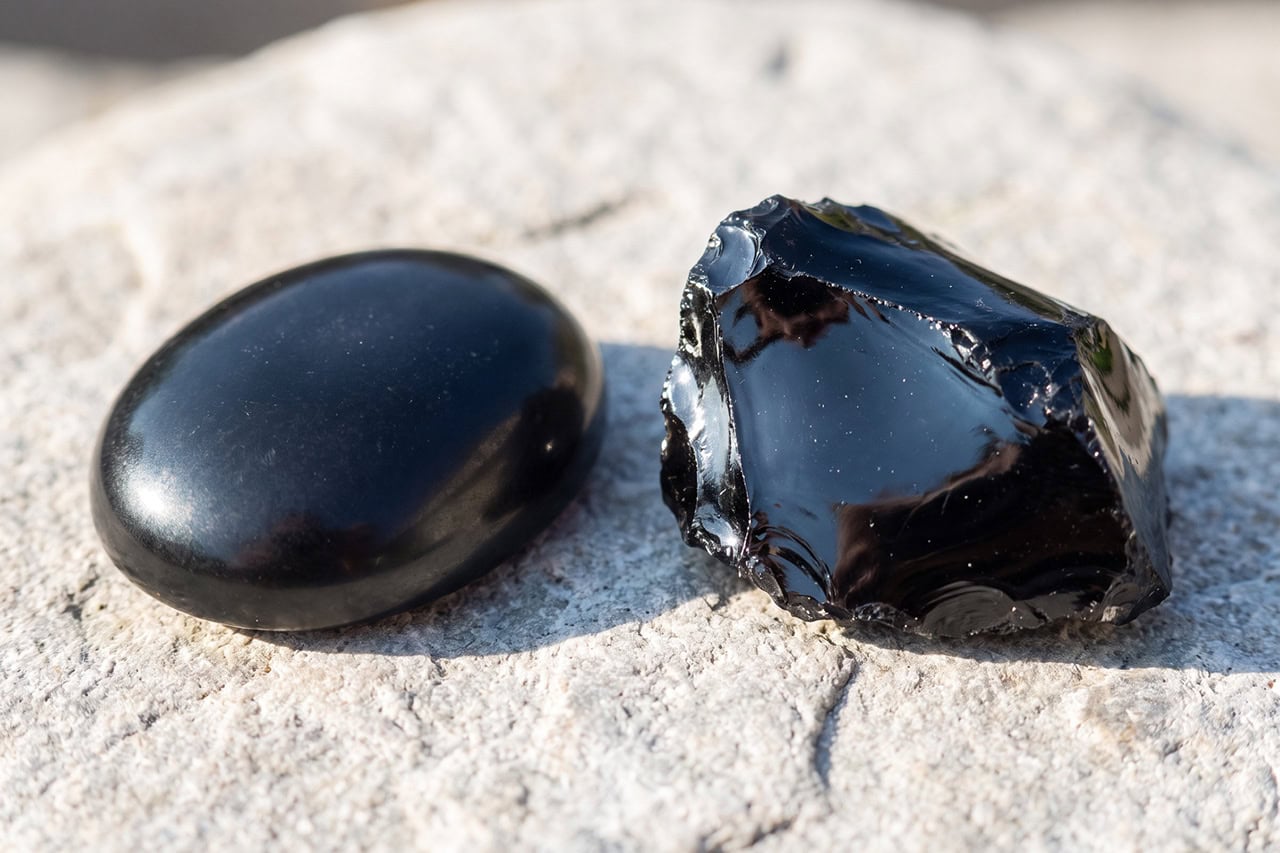
Obsidian asks none of this. It is not a mineral at all but a volcanic glass, formed when lava cools too fast for any crystal to grow, and it comes out of the ground already jet black with a glassy, mirror-bright shine and the smooth curved fracture of glass. Where onyx borrows its black from a workshop, obsidian was handed its black by a volcano. Two black stones, then, arriving at the same look by opposite routes, one coloured by human hands and one by the earth.
How old is the black, really?
There is a tidier story about onyx than the evidence quite supports, and it repays slowing down for, because it gets repeated everywhere including on this site’s older pages. The story is that the Romans were already dyeing chalcedony black by the sugar-and-acid method. The better-supported version is more careful. Pliny the Elder, writing in the first century, described stones boiled in honey for days to alter their colour, and some later readers took that as the ancestor of the modern technique. Nineteenth-century scholars of classical literature were not convinced, dismissing the passage as too vague to pin a method to.
What can be said with confidence is that the honey-and-acid carbonisation method is clearly documented from the 1820s onward, kept for a while as a trade secret among Idar merchants before it was published. Its rise across that century ran alongside a Victorian appetite for mourning jewellery, which wanted more deep, even black stone than nature readily supplied, and dyed onyx answered the demand. That the Romans loved onyx is not in doubt: they carved banded onyx and sardonyx into cameos and signet rings, prizing the layers a cutter could work into a portrait. Whether they blackened pale stone the way a modern workshop does is a separate question, and the answer is that we simply do not know. The craft is certainly old. Whether it is Roman-old is a claim the sources will not quite carry.
Telling the two apart, and why weight is a red herring
A lot of guides reach first for weight, on the idea that onyx is the heavier stone. It is a poor test. Chalcedony and obsidian both sit near two and a half times the density of water, close enough that the hand cannot reliably separate a piece of one from a piece of the other. Lift them by all means, but do not decide on heft.
Hardness is the tell that works. Onyx, as a quartz, is hard, around 6.5 to 7, while obsidian is a softer glass at about 5.5, so onyx will resist a scratch that marks obsidian, and a discreet test on an inconspicuous spot decides it. Fracture confirms the verdict. Broken or chipped obsidian shows the smooth, curved, shell-like surface of glass, often with a wet, almost oily lustre and a faint brown glow at a thin edge. Onyx breaks more like a stone, with no true conchoidal shells, and takes a flatter, stonier polish that never quite reaches the wet gleam of glass. Between the scratch and the fracture there is no real room for doubt. Obsidian also gives itself away in its decorated forms, since the snowflake and rainbow varieties carry inclusions and sheens that dyed onyx, uniform by design, never shows.
Whether the difference matters much in practice depends on what the stone is for. Both are worn as grounding, protective black stones, and crystal practice reads onyx as a stone of steadiness and self-command, set out in what black onyx does, while it gives obsidian the sharper, truth-facing character it draws from its cutting past. For a ring or a stone handled every day, onyx has the edge that its greater hardness suggests, since it resists the scuffs that a softer glass picks up. That durability is much of why onyx, and not obsidian, became the classic black stone of signet rings and carved seals in the first place. If you are weighing several dark stones for wear, our note on black obsidian and black tourmaline covers a third contender to weigh before you choose.
The useful habit these two leave you with is to ask, of any black stone, where its colour came from. Onyx wears a black that a workshop deepened with sugar and acid, obsidian a black that a volcano gave it whole, and both are honest about it. The more interesting fact about a dark polished stone is usually not what it is but who, or what, did the colouring. For where each sits among the darker stones, see the Crystalance Mineral Library.
Sources
- Daniel Russell, Historic Methods of Artificially Coloring Agates (mindat.org), on the sugar or honey and sulphuric-acid method of blackening chalcedony, its documentation from the 1820s to 1850s at Idar-Oberstein, and the disputed reading of Pliny as its Roman ancestor: https://www.mindat.org/article.php/170/Historic+Methods+of+Artificially+Coloring+Agates
- Geology.com, Obsidian, for obsidian as natural volcanic glass of hardness about 5.5 with conchoidal fracture: https://geology.com/rocks/obsidian.shtml
- Geology Science, Carnelian, for chalcedony as a microcrystalline variety of quartz, the family black onyx belongs to: https://geologyscience.com/gemstone/carnelian/