Carnelian and red jasper are the same mineral, chalcedony, coloured by the same iron. The only real difference is how much other material got trapped inside as each grew. Carnelian grew clean and lets light through. Red jasper grew crowded with impurities and blocks it.
Line the two up and everything says different stones: one glows, one is solid, one has been the jeweller’s darling for millennia and the other the plain charm carried for steadiness. Look inside them at the scale of the crystal, though, and the difference all but collapses. Both are silica laid down in grains too small to see, tinted by the same iron. They are not cousins. They are one material that grew up under two different sets of conditions, and almost everything that separates them on a shop shelf comes down to how much foreign matter each one collected on the way.
The long histories bear the sameness out even as the reputations diverge. Carnelian was one of the most carved stones of the ancient world, cut into seals and signet rings across Mesopotamia, Egypt and Rome, favoured for intaglio work because it took a crisp impression, with beads of it travelling the old trade routes for thousands of years. Jasper was worn just as widely, but as an amulet and a steadying talisman rather than a jeweller’s showpiece. Same stone underneath, two different careers.
The same stone, grown two ways
Both carnelian and red jasper are varieties of chalcedony, which is quartz, silicon dioxide, in a microcrystalline form, meaning it is built from crystals far too small for the eye to resolve rather than the clear six-sided points people picture when they hear quartz. Both take their warm colour from iron oxide dispersed through that silica. At the level of raw ingredients they are the same stone, and that shared chemistry is why they turn up in the same bins, at the same prices, doing similar jobs.
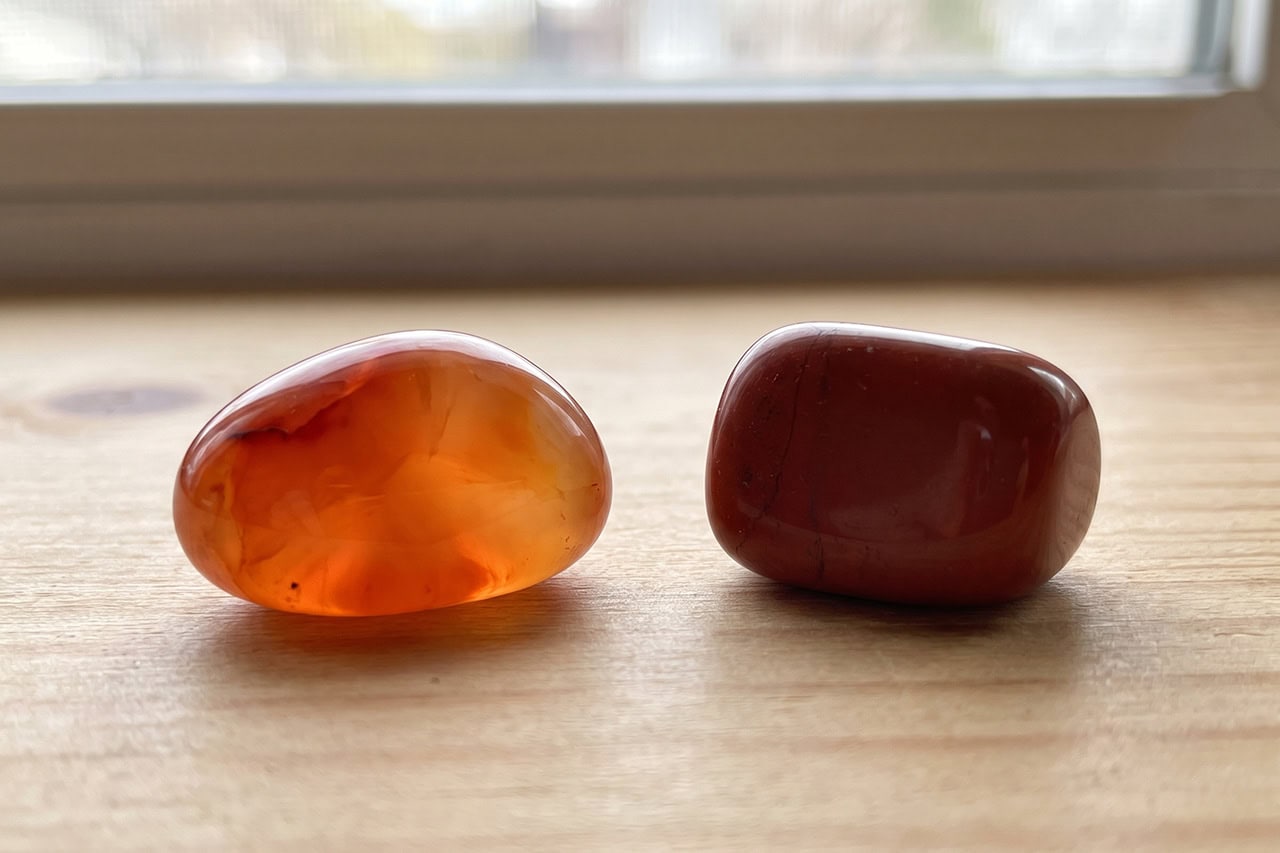
What parts them is the amount of everything else. Carnelian is a comparatively pure and even chalcedony, so light travels a fair way into it before scattering, which is why a piece held up to a lamp glows around its edges. Red jasper is chalcedony packed with a heavy load of extra material, iron oxides above all but also clays and other trace minerals, and that clutter scatters and absorbs light before it can pass, so the stone reads as solid, opaque and often patterned rather than evenly coloured. The impurities do double duty: they block the light and they draw the patterns, the spots and streaks and orbs that give the many jaspers their names. One jasper we have had occasion to handle carries pale creamy ground scattered with dark golden-brown circles so crisp they look painted on, and that decorated surface is impurity made visible, the same crowding that stops the light.
Whether a chalcedony grows clean or crowded is set at the moment it forms. Both stones precipitate from silica-rich fluids seeping into cavities and cracks in rock, and what else those fluids carry, and how slowly the silica settles out, decides the result. A fluid low in other minerals lays down the even, translucent silica that becomes carnelian. A fluid thick with iron and clay bakes its cargo into the growing stone and yields jasper, which is why the many jaspers come named for their patterns, dalmatian jasper for the manganese spots, others for their orbs and bands, each one a record of what was dissolved in the water when it formed.
The upshot is a single test that never fails, and it beats any colour chart. Hold each stone up to something bright, a lamp, a window, a phone torch. Carnelian passes light and seems to glow, warmly, right through a thinner piece. Red jasper stays dark and solid and lets nothing through. Colour can mislead here, because both range across reds and oranges and the two overlap, but translucency does not. If it glows, it is carnelian. If it stays stubbornly solid, it is jasper. As tendencies, carnelian leans to a brighter, warmer orange-red and jasper to a deeper brick or brownish red, often mottled, but read those as hints and let the light have the final say.
A word on names, since this corner of the quartz family wears them loosely. Carnelian shades into sard, a browner, darker version, with no sharp line between them, and red agate, sardonyx and other red chalcedonies get swapped in and mislabelled all the time. It is rarely worth arguing over a borderline stone. The light test tells you the thing that matters for handling it, which is whether you are holding the glowing kind or the solid kind.
Does the difference matter?
For once, very little rides on getting it exactly right, which is a pleasant change in a field full of consequential mix-ups. Both stones are chalcedony sitting at about 7 on the hardness scale, so both are durable, affordable and easy to live with, and there is no fragile or costly option waiting to punish a mistake, and no treatment to disclose or fake to fear. You can wear either daily, drop either in a bag, and cleanse either under water without much thought, since both are quartz and neither minds a rinse the way a soft stone would. If you would like the wider map of which stones belong to this family, our note on what crystals are types of quartz lays it out.
Where the two do diverge is in the reputations crystal practice has given them, and there the look and the role have travelled together for a very long time. Practice reads carnelian as the brighter, more active of the two, a stone of motivation, courage and getting started, and its glow suits that lively character, which is set out in what carnelian is good for. Red jasper it reads as the steadier one, tied to endurance and slow, reliable strength rather than a quick spark, its opaque, earthy solidity matching the grounding job. Where carnelian is asked to light a fire, jasper is asked to bank it for the long haul. That the bright translucent stone became the one worn and displayed, and the solid opaque one the charm carried for steadiness, is a pattern that reaches back to their ancient uses and has barely shifted since.
There is one quiet consequence of all those impurities worth naming. Because each jasper’s pattern is a fingerprint of the exact fluid it grew in, no two pieces are alike, and a jasper is bought as much for its markings as for anything else. Carnelian, more uniform, is chosen instead for the depth and evenness of its glow. So which of the two you should choose turns on nothing weightier than what you are after and which you find lovelier, and you can hardly go wrong. Pick the one that glows or the one that stays solid, and know that under the polish you are choosing between two versions of a single stone, told apart only by how crowded a space each one grew up in. For where both sit in the wider quartz family, see the Crystalance Mineral Library.
Sources
- Geology Science, Carnelian, for carnelian as a translucent chalcedony (microcrystalline quartz) coloured by iron oxide: https://geologyscience.com/gemstone/carnelian/
- Geology Science, Jasper, for jasper as an opaque chalcedony whose colour, pattern and opacity come from iron oxides, manganese and other mineral impurities: https://geologyscience.com/gemstone/jasper/