Aquamarine is a naturally blue variety of beryl, coloured by iron, and most is gently heated to purify a blue it already has. Almost all blue topaz began colourless and was turned blue by radiation and heat. Aquamarine costs more, and its blue starts in the ground.
Open a jewellery box packed before about 1970 and you will find sapphires, turquoise, the odd pale natural topaz, and almost no blue topaz at all. The saturated sky-blue and London-blue stones that fill every high-street tray today barely existed as a commercial gem then. They arrived when the trade worked out, in the early 1970s, that abundant colourless topaz could be irradiated and heated into a dependable blue. So one of these two stones has been prized for its blue since antiquity, and the other has worn its blue for barely fifty years.
That gap in history explains most of why they get compared, and why one is dear and the other cheap.
Where the two blues come from
Aquamarine is a variety of beryl, the same mineral species as emerald, with the formula Be₃Al₂Si₆O₁₈. Its blue-to-sea-green comes from small amounts of iron sitting inside the crystal: ferrous iron leans the colour blue, ferric iron pulls it toward green. Most aquamarine on the market has in fact been heated, because gentle heat drives off a yellow or greenish cast and settles the stone into a cleaner blue. What matters is that the heat is only tidying a colour the crystal already carried. The stone came out of the ground blue, somewhere along a range from the faintest wash to a deep sea shade, and the treatment purifies rather than invents.
Topaz begins in a different place. It is an aluminium silicate, Al₂SiO₄(F,OH)₂, and in nature it is most often colourless. A genuinely strong natural blue topaz is one of the rarer things in the gem world. What sits in the shops instead is colourless rough that has absorbed a dose of high-energy radiation and then been heated until the induced colour settles into blue. The familiar trade grades, Sky Blue, Swiss Blue and London Blue, are the shades that process yields. Here the treatment does not tidy an existing colour. It makes one where there was none.
There is a step in that process most buyers never hear about. Freshly irradiated topaz can carry a faint residual radioactivity, so in the United States the stones are set aside, typically for a couple of months, to let it decay, and a licensed handler surveys them against safety limits before they reach a counter. The blue topaz in a ring is entirely safe to wear. It simply had to wait out a quiet cooling-off period that no aquamarine ever needs.
All of which drives the price. Aquamarine’s colour is scarce and native to the stone; topaz’s is manufactured in quantity from cheap material. When treated blue topaz first reached the market it sold for a few tens of dollars a carat, and oversupply soon pushed it to a few dollars or less. Because beryl grows in large, clean crystals, a sizeable aquamarine is easier to come by than a sizeable fine ruby or sapphire, which quietly caps how far its price can run at the top end. The tidy irony sits alongside that. The stone people take for the exotic one, that electric London blue, is the industrial product, and the softer, quieter sea-blue is the one the earth made.
Telling them apart
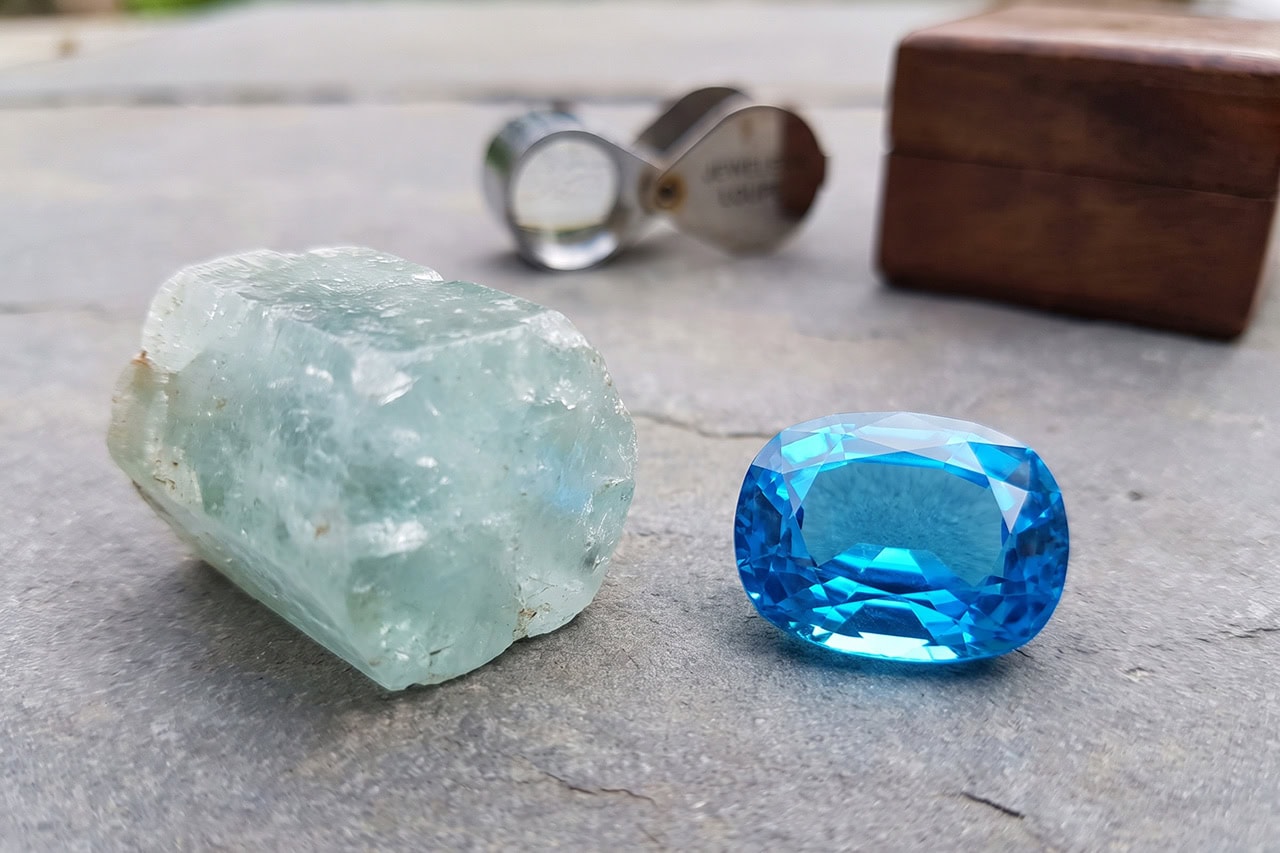
Held side by side, colour is the first hint and the least trustworthy one. Aquamarine tends cool, soft and faintly green, the shade that earned it a name meaning sea water. Blue topaz tends brighter and colder, and the intense Swiss and London blues reach a saturation aquamarine rarely manages unaided, so a vivid, evenly saturated blue is a fair sign of treated topaz. A pale stone settles nothing, because a modest topaz and a good aquamarine overlap in the hand.
Weight is a better guide, because the two minerals differ in density in a way you can feel. Topaz is markedly denser, measured at 3.49 to 3.57, against beryl’s 2.63 to 2.97 and an average nearer 2.7. Two cut stones of the same size, and the topaz sits heavier. Both are hard enough for any jewellery, topaz at 8 on the Mohs hardness scale and aquamarine at 7.5 to 8, but they differ on cleavage. Topaz has one perfect cleavage plane, a direction along which a sharp knock can split it clean, and aquamarine has no such weakness. For a stone worn every day that makes aquamarine a little more forgiving of the accidents of a life, whatever the hardness numbers imply.
In the rough, before cutting, the crystals help too. Aquamarine grows as long six-sided prisms, the hexagonal habit of the beryl family, often water-clear and sometimes in strikingly large clean pieces. Topaz grows as prisms as well, and confusingly its faces can carry the same lengthwise striations, so the grooves alone settle nothing. Its giveaway is that one flat cleavage direction, which can appear as a mirror-flat facet across the crystal or as a fine crack starting square to the length. On a finished stone that plane is the thing a setter watches, because a knock along it does what no amount of hardness prevents.
None of this is proof. A gemmological laboratory identifies the species outright and discloses the treatment, and for any purchase dear enough to matter that report is the only certain answer, and the only way to know exactly what you are paying for.
Does the difference matter?
For most of what people do with these stones it matters less than the price gap suggests. Both are durable, both are lovely, and blue topaz is a good gem sold honestly at a low price. In crystal practice the two are read as calm, throat-centred stones of clear speech and steadiness, and aquamarine, the March birthstone, carries a long tie to water and calm that is set out in what chakra aquamarine belongs to. There is even a small practical edge to the density gap: at large sizes topaz’s extra weight tells in a pair of earrings, where a heavy stone drags, so a big aquamarine wears lighter than a big topaz of the same spread. Someone who simply wants a blue stone to wear and enjoy can reach for either and be well served.
Where it matters is money and honesty. The one bad outcome is the quiet substitution: treated blue topaz sold at aquamarine’s price, or a large, cheap, vividly blue stone labelled aquamarine when its colour and its heft both say topaz. The premium is not snobbery. It tracks a real difference in how the two blues came to be, and a seller who discloses the treatment is not hiding anything.
The premium, then, is really paying for a negative. Not for a brighter stone, since the treated one is often brighter, and not for a harder one, since both shrug off ordinary wear, but for the fact that nobody had to invent the colour. The earth’s blue costs more than the one we learned to make, and buyers keep deciding it is worth the difference. For where each stone sits in the wider family of blues, see the Crystalance Mineral Library.
Sources
- GIA, Topaz Quality Factors, on natural blue topaz being extremely rare and on radiation-and-heat treatment reaching a broad market since the 1970s: https://www.gia.edu/topaz-quality-factor
- Geology.com, Blue Topaz, on almost all blue topaz being irradiated and heated colourless rough, and on the early-1970s origin of the treatment: https://geology.com/gemstones/blue-topaz/
- U.S. Nuclear Regulatory Commission, Backgrounder on Irradiated Gemstones, on irradiated topaz being set aside for about a couple of months to let radioactivity decay before sale: https://www.nrc.gov/reading-rm/doc-collections/fact-sheets/irradiated-gemstones
- Geology.com, Aquamarine, on most aquamarine being heat treated to remove yellow or green and purify the blue: https://geology.com/gemstones/aquamarine/
- Handbook of Mineralogy, Topaz, for hardness 8, perfect {001} cleavage and density 3.49 to 3.57: https://handbookofmineralogy.org/pdfs/topaz.pdf
- Handbook of Mineralogy, Beryl, for hardness 7.5 to 8 and density 2.63 to 2.97: https://handbookofmineralogy.org/pdfs/beryl.pdf
- Geology Science, Aquamarine, for aquamarine as a beryl variety coloured blue to blue-green by iron: https://geologyscience.com/gemstone/aquamarine/