Bloodstone
Silicate (Tectosilicate); a variety of chalcedony
Dark green with red to orange-red spots; sometimes yellow or white spots
Waxy to vitreous
6.5 - 7
2.55 - 2.70
Trigonal (microcrystalline); no visible crystals
India, Brazil, Australia, China, Madagascar, USA (California, Nevada, Oregon, Washington), Scotland (Isle of Rum)
Common and inexpensive; a deep green ground with sharp, bright red spots is less common
SiO₂ (chalcedony), with red spots of iron oxide
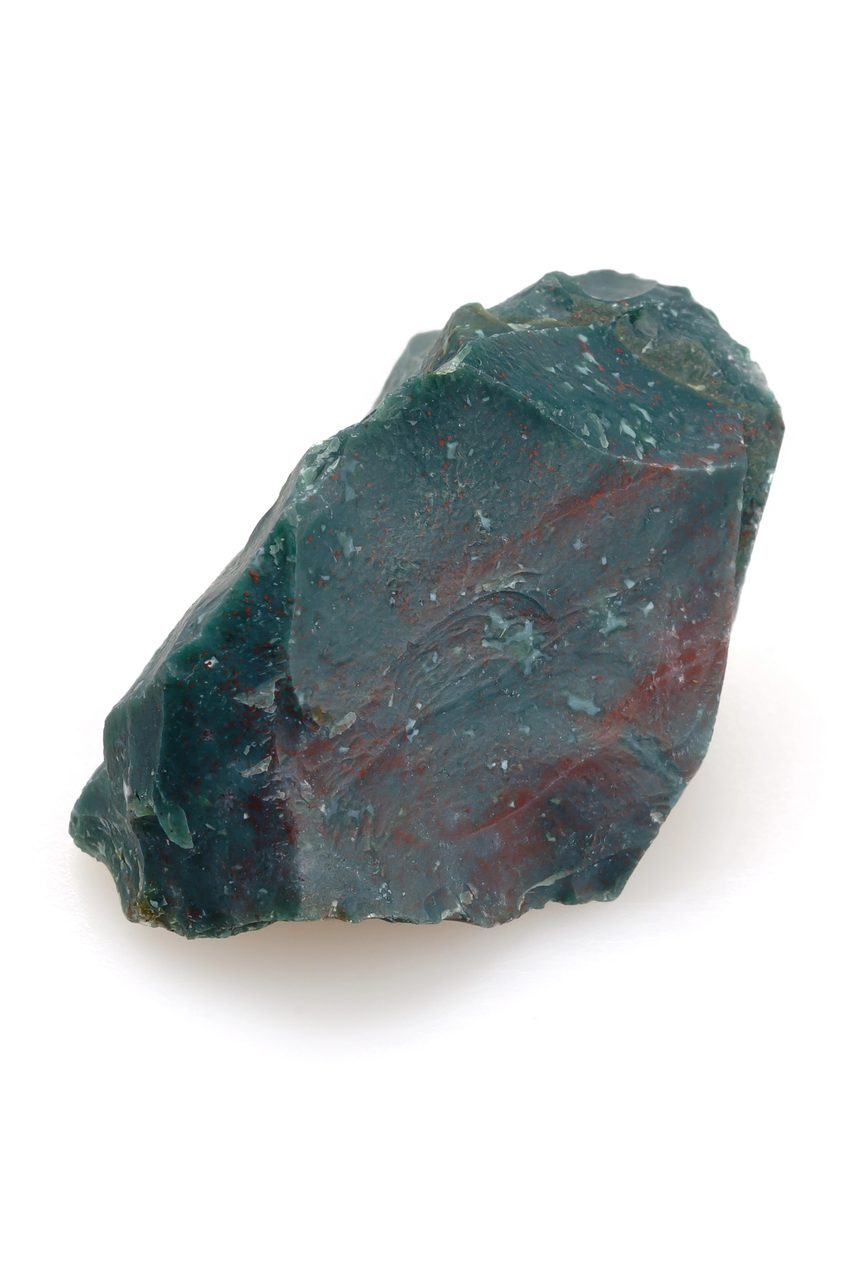
Bloodstone is a dark green chalcedony scattered with spots of red. Chalcedony is quartz made of crystals far too small to see, and in bloodstone it holds fine green mineral inclusions through its body and small patches of iron oxide, mostly hematite, that show up as the red. GIA describes it as a semi-translucent to opaque dark green stone with red inclusions of iron oxides.
It is a variety rather than a mineral species, and it has an older name, heliotrope. GIA traces that word to an ancient Greek phrase meaning "to turn the sun", from a belief that the stone turned the sun red when it was placed in water. Pliny the Elder described the trick in the first century, and was already doubtful about what the magicians of his day claimed for it.
For about two thousand years bloodstone has been cut into seals, cameos and signet stones, because it takes a fine engraved line and keeps it. It is also on the March birthstone list. The American list of 1912 printed bloodstone first for the month, with aquamarine as the alternative. GIA still lists both.
Most bloodstone sold today comes from India, according to GIA, with more from Brazil, Australia, China and the United States. Crystal practitioners use it for courage, stamina and grounding, and place it at the root and the heart.
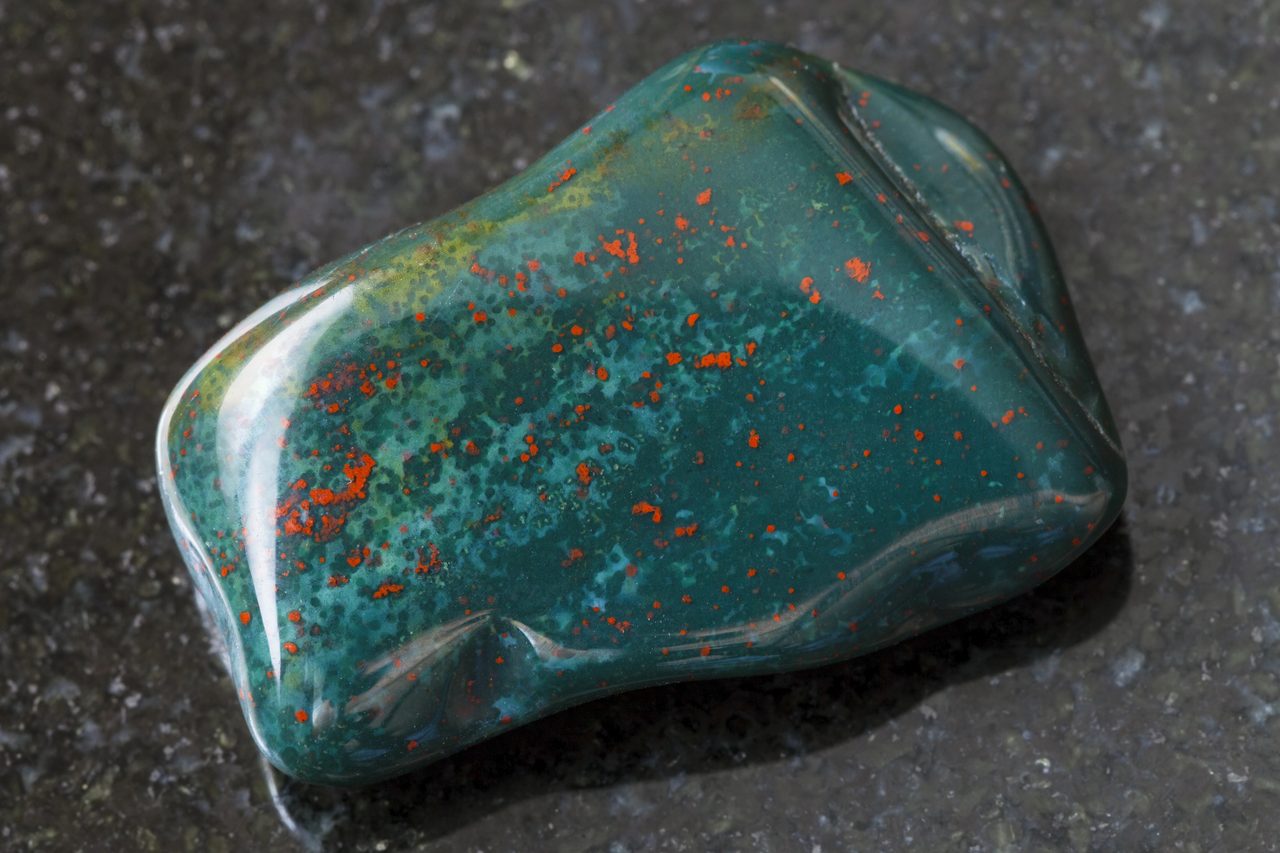
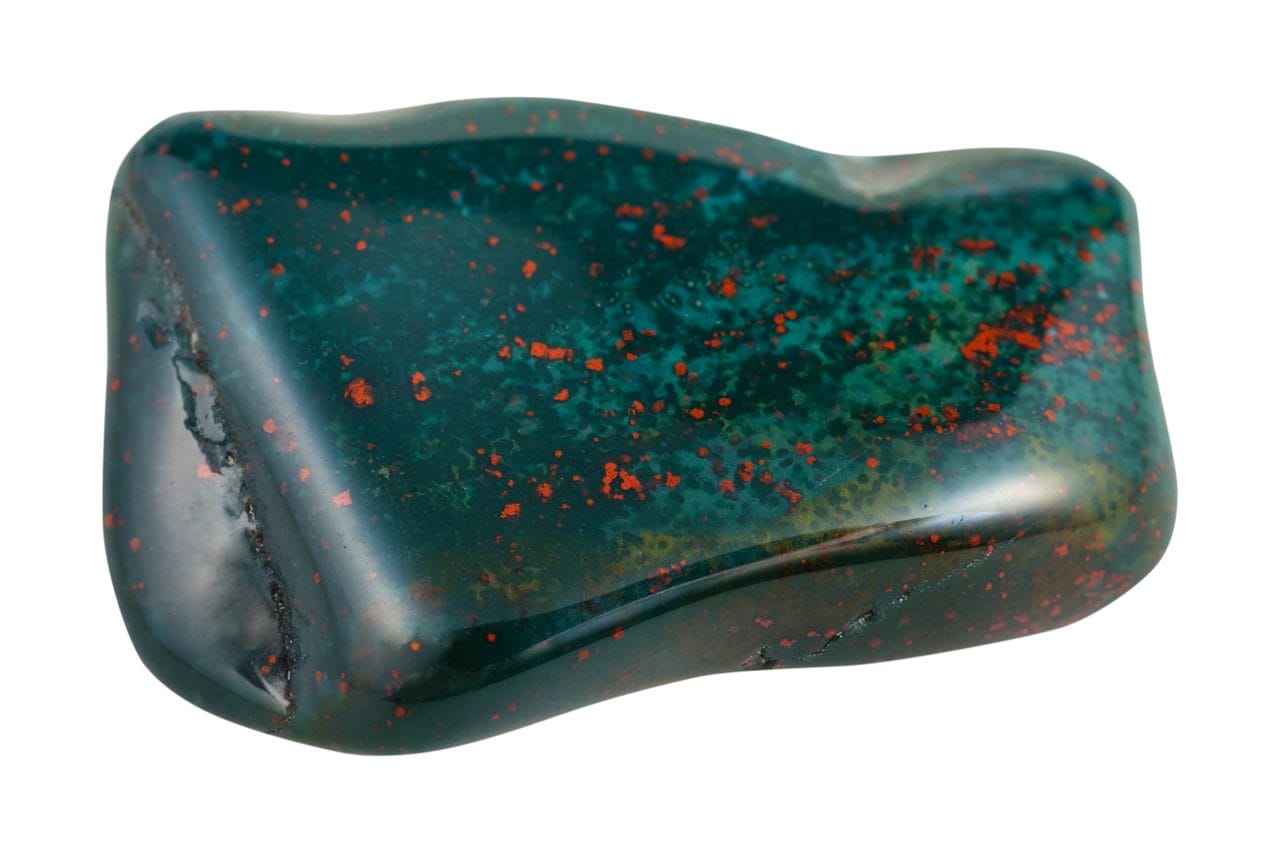
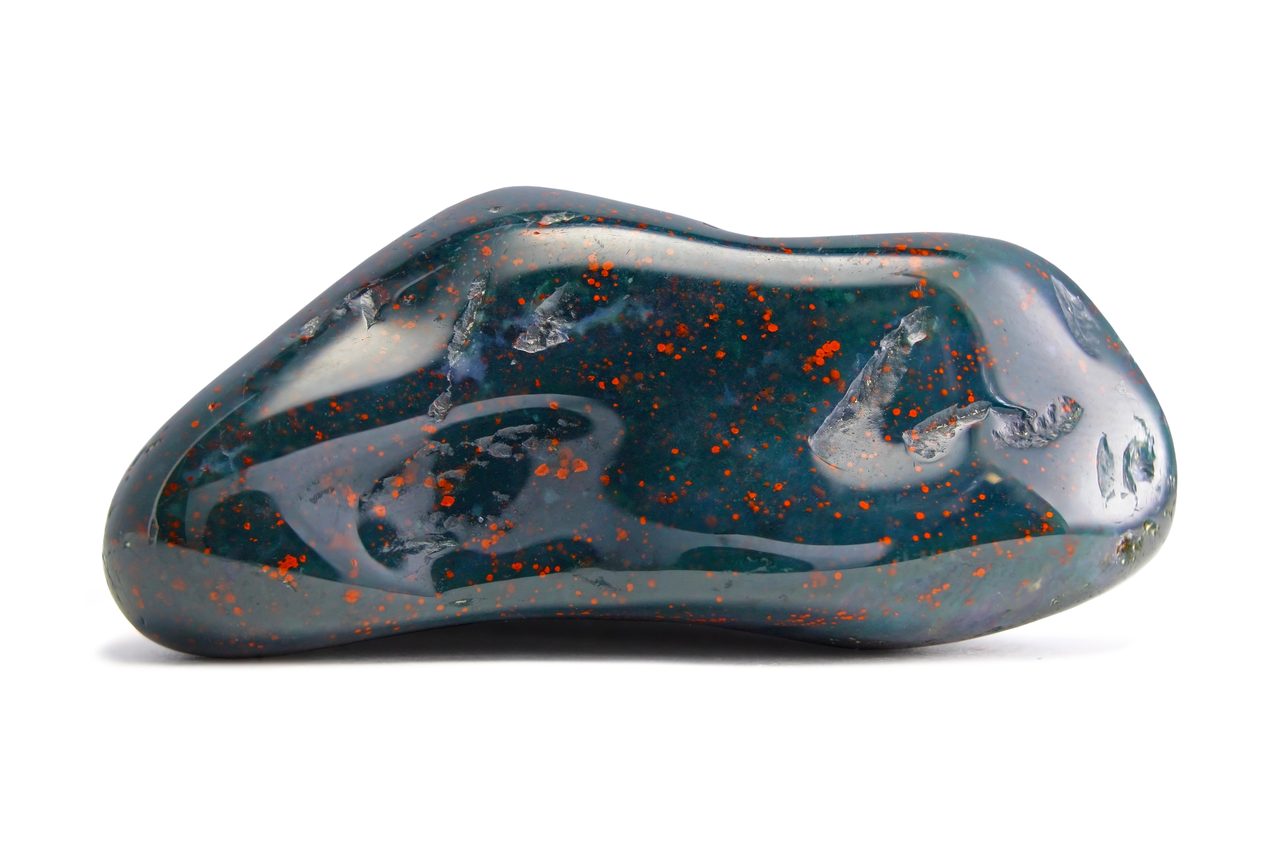
TABLE OF CONTENTS
Properties & Qualities
Physical Properties
A variety of chalcedony. Bloodstone is silicon dioxide, SiO₂, the same compound as quartz, but grown as a dense mass of microscopic crystals. Geology.com notes that included minerals make up at least several percent of its weight, which makes it opaque and brings its hardness down a little. The International Gem Society groups it with plasma, the plain dark green chalcedony, and describes bloodstone as plasma with red to orange spots. Some pieces carry few spots or none. Our article on which crystals are types of quartz places it in the wider quartz family.
Where the colours come from. The green comes from tiny inclusions of other minerals. Gemdat names chlorite particles or hornblende needles, the International Gem Society names actinolite or hornblende, and Geology.com lists chlorite, amphibole and pyroxene. The red spots are iron oxide, most likely hematite according to Geology.com. Some stones show yellow or white spots too, and GIA illustrates a slab from Asia with all three colours.
Chalcedony or jasper? Sources disagree on the label. GIA calls the traditional stone a dark green jasper within the chalcedony family. The International Gem Society keeps it out of jasper, because it lacks the grainy structure jasper has. Both describe the same material underneath, fine-grained quartz.
Hard, tough and without cleavage. Bloodstone rates 6.5 to 7 on the Mohs scale, a little below a quartz crystal, and the International Gem Society gives its specific gravity as 2.55 to 2.70. It has no cleavage and breaks with a smooth, curved conchoidal fracture. The same source calls it more durable than most gemstones and fit for any kind of wear. That toughness made it a carver's stone. A seal has to hold a fine line against wax many times over, and a dark, opaque ground makes an engraved figure stand out.
How it forms. Geology.com describes bloodstone forming at shallow depths and low temperatures, as silica-rich groundwater fills fractures and cavities in other rock. GIA adds that it is also found as pebbles in riverbeds.
Where it is found. GIA names India as the main source, with Brazil, Australia, China and the United States among the others, and Geology.com adds Madagascar and small deposits in California, Nevada, Oregon and Washington. Scotland has a small source with a long history on the Isle of Rum. Excavations at Kinloch in the 1980s found that bloodstone from the island's west coast was the main stone that Mesolithic people there used for tools, from the eighth millennium BC. Pieces of it turn up on the mainland as well, carried across by boat, and the excavation report names Bloodstone Hill as the main prehistoric source.
Metaphysical properties
Crystal practice treats bloodstone as a stone of courage and staying power. Its two colours give it two placements. The dark green puts it at the heart, and the red ties it to the root, the centre practitioners connect with the body, safety and the ground underfoot. Our article on crystals for the root chakra describes it as the stone used where grounding meets a wish for vitality.
The red carries most of its reputation. The International Gem Society links bloodstone with bravery and blood, and with the Roman god Mars. GIA notes that many people treat it as a lucky charm, and that athletes who want to build strength prize it. In crystal practice the strength in question is endurance. It is chosen for a long training block, a demanding job, the hard week that simply has to be got through, and a quick burst of energy is usually sought from other stones.
It is read as protective too, a steadying stone for unfamiliar places or difficult company. Practice classes it as an active stone, suited to doing and pushing on, where softer green stones are kept for rest. Its warmth is called earthy, the kind that keeps a fire going overnight rather than the kind that flares.
Meaning & Symbolism
Physical meaning
Bloodstone is a green stone marked with red, and practitioners read its physical meaning from that contrast. The green ground is taken as steady growth and a body at rest. The red is blood and effort, the energy to keep going, and since it only ever appears as spots inside the green, the stone is read as strength held inside calm.
Its toughness feeds the same reading. It has no cleavage and resists chipping, and for centuries it carried carved seals that were pressed into wax again and again without wearing away. Practitioners take that as endurance, a stone that keeps its shape under repeated pressure.
The red spots sit wherever the iron oxide happened to gather, so no two pieces are marked alike. Practice reads that as individuality, and as a sign that the marks left by effort belong to a thing rather than spoil it. It is also dark, opaque and solid in the hand, which is a large part of why practitioners file it under the body and not the mind.
Spiritual meaning
Spiritually, bloodstone is a stone of courage spent on behalf of someone or something else. Its Christian history is the main reason for that reading. GIA records that the name is said to come from a belief that the red spots represent the blood of Christ, and carvers used the stone for religious images. The Metropolitan Museum holds a seventeenth-century Italian bust of Christ crowned with thorns in which the red flecks were used to suggest drops of blood. Our article on the March birthstone follows that history further.
Practitioners draw on an older layer as well. Its other name, heliotrope, ties it to the sun, and in practice it is a stone of renewal, of light coming back after a dark stretch.
Some keep it through Lent or another season of restraint. Others carry it through a period of service, looking after a relative or holding a hard role steady at work, as a token of the strength that kind of work asks for over months rather than days.
Healing Benefits
Physical healing
Healing practices with bloodstone belong to crystal tradition and energy work, and they are not a substitute for medical care.
The stone has been linked with blood for centuries. In the eleventh century Marbode of Rennes wrote that it staunched bleeding, and today practitioners associate it with circulation, stamina and recovery after effort. These connections are symbolic.
In practice a piece is held during rest after training, or carried through a long physical working day. Bleeding, circulation problems and anything else physical belong with a doctor.
Emotional healing
Emotionally, bloodstone is used for steadiness under pressure. Practitioners reach for it when fear or tiredness makes a task feel bigger than it is, and when someone needs to stay in a situation rather than leave it.
It is not a soothing stone in the way blue and lilac stones are. Our article on crystals for anger traces its lineage to endurance and standing your ground, and suggests it for the day after a conflict, when the problem has not gone anywhere and you still have to be civil.
It is also kept for grief that has to be carried while ordinary life goes on, and for the tiredness that builds up over a long stretch of caring for someone. Some hold it before a difficult appointment or a confrontation they cannot avoid, breathing slowly until their hands are still. Others keep a tumble in a pocket through an exam season, as a reminder that they have come through hard weeks before.
Spiritual healing
In spiritual healing, bloodstone is placed low on the body during meditation, at the base of the spine or on the lower belly, and used in practice aimed at feeling present and supported.
A simple grounding layout sets one piece between the feet and a second over the heart, with the person lying flat and breathing into the lower body for several minutes. Some picture roots running down from the lower stone into the earth, then let their attention rise slowly to the heart stone. The session ends by sitting up gradually and drinking a glass of water.
Practitioners also use it for protection during spiritual work. A piece is held in the hand or set at the edge of a meditation space to mark a boundary. After an emotionally heavy session, some sit for a minute with a piece in each palm before going back to their day. The stones are then cleansed and put away until they are needed again.
Use & Care
How to use
- In a pocket: Carry a tumbled piece through a long or demanding day, as a reminder to pace yourself.
- At the root: Lie down with a palm stone resting low on the belly for a few minutes of slow breathing.
- Over the heart: Hold it against the chest when you need courage for a conversation or a decision.
- As a ring: Bloodstone is tough enough for everyday rings, and signet rings are the setting it has filled for centuries.
- In a sports bag: GIA notes that athletes who want to build strength prize it. Keep a piece with your kit.
- On a desk: Place a polished piece beside the work that is slow and dull and has to be finished anyway.
- By the front door: Some practitioners set a piece near the entrance as a protective stone.
- For a March birthday: Give it as the traditional March birthstone, on its own or beside aquamarine.
- Before exercise: Hold it for a minute while you set an intention for the session.
- After a tiring stretch: Keep a piece on the bedside table while you rest and recover.
- As a worry stone: Rub a smooth tumble with your thumb when you need to stay put rather than walk out.
How to cleanse
- Running water: Bloodstone is a tough chalcedony and can be rinsed under the tap, then dried with a soft cloth.
- Warm soapy water: GIA recommends warm soapy water and a soft brush for cleaning, which suits set jewellery too.
- Avoid harsh chemicals: GIA advises keeping it away from harsh chemicals and very high temperatures.
- Smoke: Pass it through incense or herb smoke a few times.
- Sound: Ring a bell or singing bowl near it and let the sound fade out.
- Earth: Some bury it in a pot of soil overnight, in keeping with its grounding reading, then rinse and dry it.
- Moonlight: Leave it on a windowsill or outdoors under the moon overnight.
- Selenite plate: Rest it, dry, on a selenite plate for a few hours.
- Dry salt: Set it in a small glass dish nested in a bowl of salt, so the stone does not touch the salt itself.
- Breath: Hold it in cupped hands and breathe across it slowly a few times.
How to charge
- Morning sun: In keeping with its old name, heliotrope, practitioners charge it in early sunlight. Our article on charging crystals through a window covers whether the glass matters.
- Away from strong heat: Keep it off radiators and hot sills, as GIA advises keeping it away from extreme heat.
- On the ground: Lay it on bare earth or a garden stone for an afternoon.
- With intention: Hold it to the lower belly and name the effort you need it for.
- On the move: Carry it in your hand on a walk or a run.
- Beside hematite: Practitioners set it next to a piece of hematite, the iron oxide that colours its spots.
- Grid: Place it in the centre of a ring of red jasper and carnelian tumbles.
- Drumming: Hold it near a slow, low drumbeat for a few minutes.
- Visualisation: Hold it in both palms and picture dark green light with sparks of red gathering in it.
Combining with other stones
- Hematite: The iron oxide behind its red spots. The two are paired in grounding work. See Hematite.
- Carnelian: An orange-red chalcedony that practice links with courage and drive. See Carnelian.
- Red jasper: The classic root stone, added when the aim is staying power. See Jasper.
- Black tourmaline: Brings protection to bloodstone's courage. See Tourmaline (Black).
- Smoky quartz: Gentler grounding, with a note of letting go that balances bloodstone's push. See Quartz (Smoky).
- Aquamarine: Its partner on the March birthstone list. Calm beside courage. See Aquamarine.
- Almandine: A deep red garnet linked with vitality. See Almandine.
- Rose quartz: Covers the heart side of its reading. See Quartz (Rose).
- Chalcedony: The material bloodstone is made of, used for steadiness. See Chalcedony.
- Tiger's eye: Held with bloodstone before a challenge, for nerve. See Tiger's Eye.
Identification
Can be mistaken for
- Plasma: The same dark green chalcedony without the red spots. The International Gem Society notes that some bloodstone has few spots or none, so the line between the two is a matter of degree.
- Green jasper: Opaque green with no red spots, and a grainier texture. See Jasper.
- Hematite: Sometimes called "bloodstone", since its name comes from the Greek for blood. It is metallic grey, far heavier, and leaves a red-brown streak. See Hematite.
- African bloodstone: A trade name, also seftonite, for a green and red stone from southern Africa. Sellers describe it as paler or greyer green with bigger red patches, and it has no formal mineralogical description.
- Unakite: Green epidote with pink feldspar. The pink is in larger patches and the grain is coarser. See Unakite.
- Ruby in zoisite: Green zoisite holding pink to red ruby, which forms as distinct crystals rather than spots. See Zoisite.
- Red stones sold as bloodstone: The International Gem Society warns that mainly red stones, or stones with notable red spots, are sometimes sold under the name. True bloodstone has a dark green body.
- Glass: "Maple stone", a green glass with red "flowers" made by the Japanese manufacturer Iimori, resembles bloodstone, the International Gem Society notes.
How to spot a fake
- Check the body colour: Bloodstone is dark green first and red second. A mainly red stone sold under the name is something else.
- Look at the spots under a loupe: Natural spots are irregular, uneven in size and sit inside the stone. The International Gem Society notes that under the microscope the red "flowers" in imitation glass look quite different from bloodstone's spots.
- Look for bubbles: Round gas bubbles or flow swirls under magnification point to glass, not chalcedony.
- Expect variety: Every piece is spotted differently. A strand of beads with identical patterning deserves questions.
- Know what "African bloodstone" means: It is a different material from Indian bloodstone. It is fine to buy when it is labelled as what it is.
- Notice the weight: Bloodstone weighs about the same as ordinary quartz. A heavy, metallic grey stone sold as "bloodstone" is hematite or a hematite imitation.
- Ask about treatment: Neither GIA nor the International Gem Society lists a routine treatment for bloodstone, so any dye or coating should be named on the label. The words sellers use are covered in what "natural" means when buying crystals.
- Weigh price against quality: The International Gem Society describes bloodstone as relatively inexpensive, so a high price should come with a deep green ground and sharp red spots.
- Leave proof to a lab: A gem lab can confirm chalcedony from its refractive index, which the International Gem Society gives as about 1.53 to 1.54.
Sources: GIA, March birthstones: aquamarine and bloodstone; International Gem Society, Bloodstone value, price and jewelry information; Geology.com, Bloodstone; Gemdat, Bloodstone (Heliotrope); Pliny the Elder, Natural History, book 37, chapter 60, Bostock and Riley translation; Marbode of Rennes, De lapidibus, Beckmann's edition of 1799; Metropolitan Museum of Art, Bust of Christ crowned with thorns, heliotrope; Wickham-Jones, C.R. (1990), Rhum: Mesolithic and later sites at Kinloch, excavations 1984-86, Society of Antiquaries of Scotland; ScARF, Case study: Kinloch, Rùm.