Sunstone
Silicate (tectosilicate); feldspar group
Orange, red, golden brown, peach, pale yellow, champagne and colourless; Oregon stones also green, red and green in one stone, and rarely blue
Vitreous, pearly on cleavage surfaces, with a metallic glitter (aventurescence) from flat inclusions
6 - 6.5
2.62 - 2.72 (oligoclase sunstone near 2.65; Oregon and Ethiopian labradorite 2.68 - 2.72)
Triclinic (plagioclase); monoclinic for orthoclase sunstone
USA (Lake and Harney counties, Oregon), India (Tamil Nadu), Norway (Tvedestrand, Arendal and Bamle), Ethiopia (Afar), Russia (Lake Baikal), Canada (Bancroft, Ontario), Australia (Harts Range, Northern Territory), Tibet (disputed)
Common in its orange Indian form; natural copper-bearing gem sunstone is known from Oregon and Ethiopia, and large, clean red stones are rare
(Na,Ca)(Al,Si)₄O₈ (sodium calcium aluminium silicate) for plagioclase sunstone, from oligoclase to labradorite; KAlSi₃O₈ (potassium aluminium silicate) for the rarer orthoclase sunstone
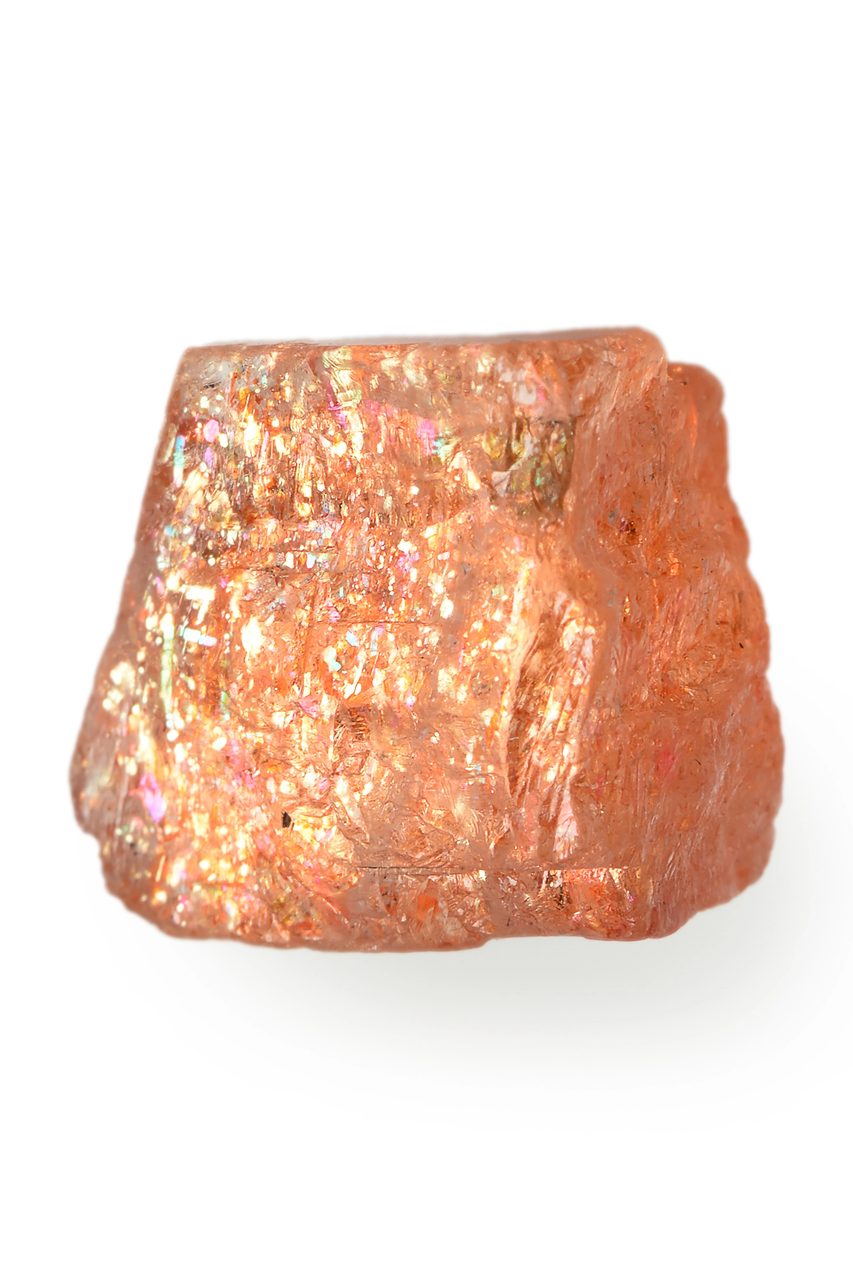
Tilt a piece of sunstone under a lamp and a scatter of tiny flat crystals inside it flashes copper and gold at once. Gemmologists call the effect aventurescence, and the name sunstone covers any feldspar that shows it, so the word describes a look rather than a single mineral. GIA notes that both branches of the feldspar family, the plagioclase feldspars and the potassium feldspar orthoclase, have a sunstone form.
GIA's history of the stone says it was little known, rare and costly in the early 1800s, and that finds in Norway and Siberia later made it cheaper and easier to buy. The 1911 Encyclopaedia Britannica still named Tvedestrand in southern Norway as the best-known locality, where it sat in a quartz vein running through gneiss. In 1915 the mineralogist Olaf Andersen defined sunstone as the gem variety of aventurine feldspar, the definition a 2023 GIA study of Oregon sunstone still starts from.
Oregon sunstone is a different material, labradorite flecked with native copper, mined from old lava flows in Lake and Harney counties, and the state made it the official gemstone in 1987. That is the date in GIA's 2013 field report, while a 1991 GIA paper gives 1985. Ethiopia became a second source of copper-bearing sunstone when stones from the Afar region reached the Tucson shows in 2019.
Crystal shops sell sunstone as the stone of the sun itself, for warmth, cheer and confidence.
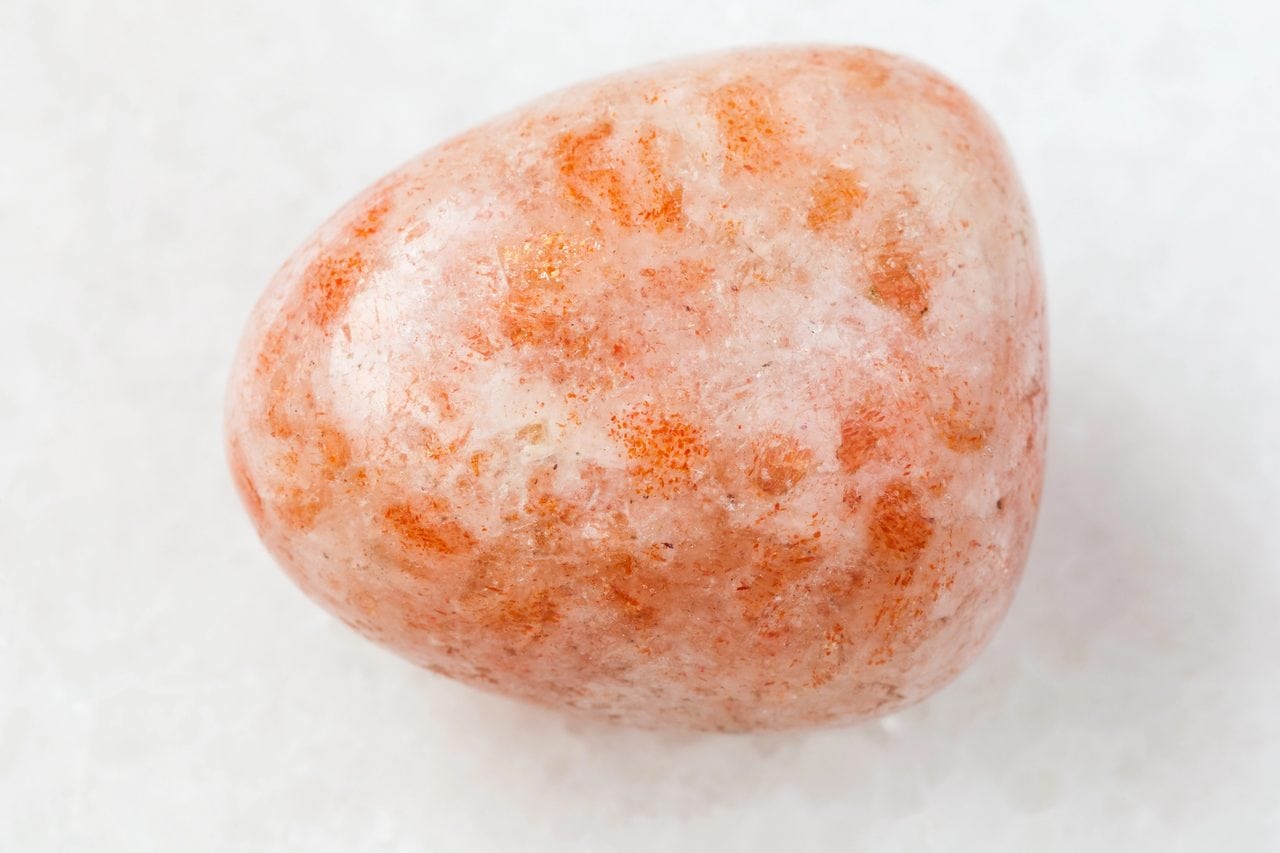
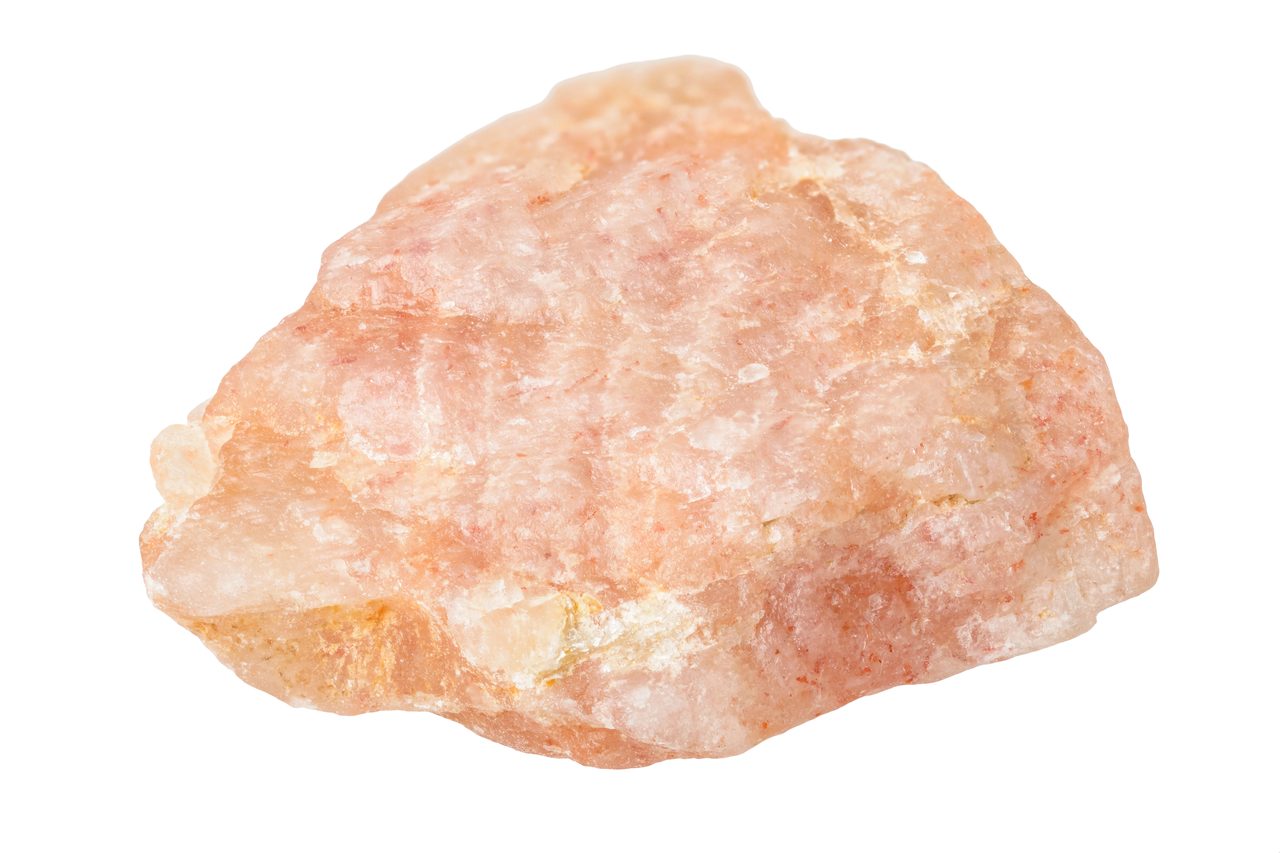
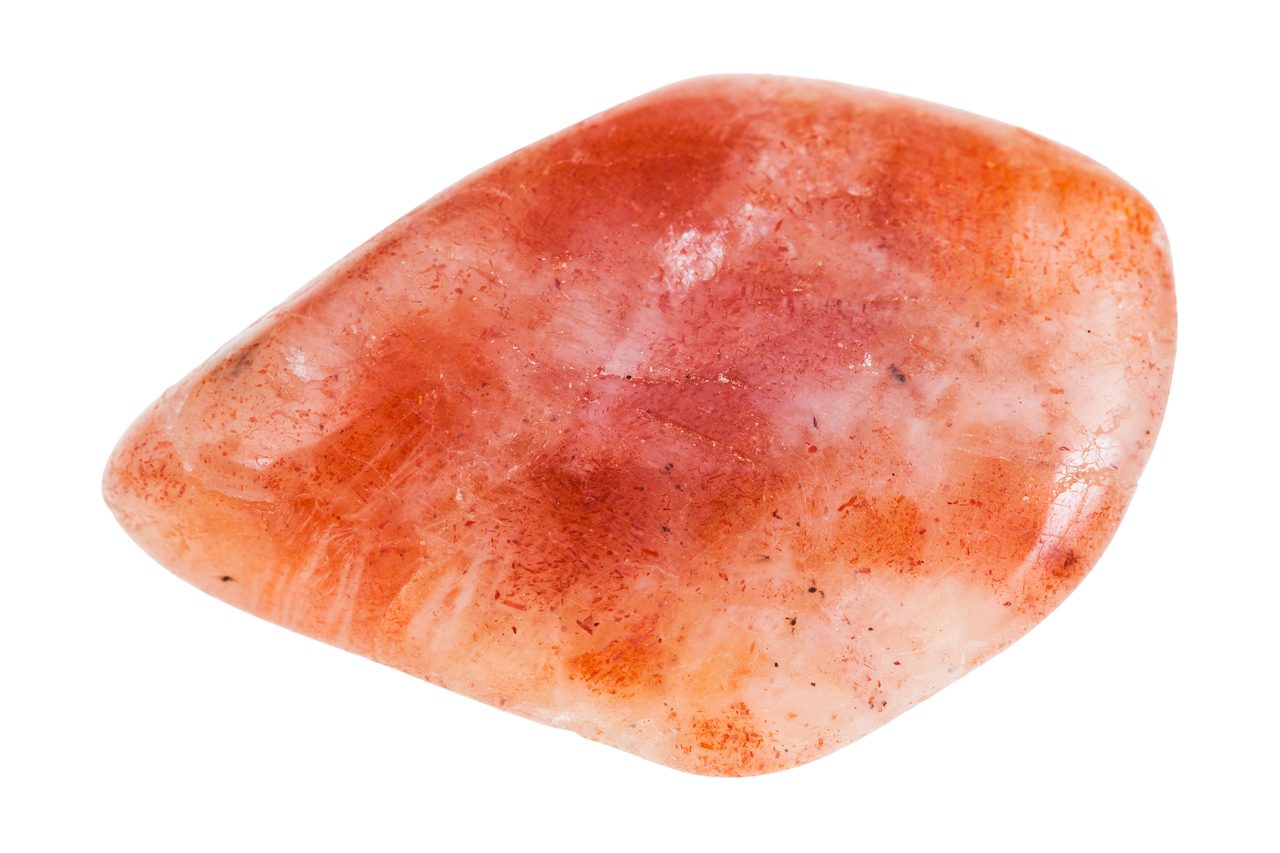
TABLE OF CONTENTS
Properties & Qualities
Physical Properties
Three different feldspars are sold as sunstone. In southern Norway and India it is oligoclase, a sodium-rich plagioclase. In Oregon and Ethiopia it is labradorite, which holds more calcium. A smaller share is orthoclase, the potassium feldspar that also gives moonstone. The Handbook of Mineralogy gives oligoclase and labradorite the same hardness, 6 to 6.5, and the same pair of cleavages, one perfect and one slightly weaker, meeting close to a right angle. GIA's care guide puts sunstone a little higher, at 6.5 to 7.2, and rates its toughness as poor because of those two cleavages.
Copley and Gay, writing in Norsk Geologisk Tidsskrift in 1978, examined Norwegian sunstone under a scanning electron microscope and found thin, well-shaped platelets of hematite, an iron oxide. For the International Gem Society, the sheen comes from hematite or goethite. In a 1982 paper in Mineralogical Magazine the same authors heated these feldspars in the laboratory and watched the platelets lighten and fade, and concluded that cooling alone probably does not explain how the plates formed.
Oregon sunstone carries copper instead. Hofmeister and Rossman argued in the journal Geology in 1985 that the copper is metallic and separates out of the feldspar as it cools. A 2023 GIA study by Jin, Palke, Renfro and Sun found that about 20 parts per million of copper is enough for a saturated colour. Very small rounded copper particles make the stone red, slightly larger elongated ones scatter light and make it green, and flakes a few thousandths of a millimetre across, lying along the cleavage planes, make the schiller. Some stones are red at the core with a thin green band and a colourless rim, and change from red to green as they are tilted.
GIA's 2013 field report places Oregon sunstone in basalt lava flows erupted 15 to 17 million years ago. The crystals weather out onto the desert floor, and the Dust Devil mine has produced one of 1,093 carats.
In the International Gem Society's figures, sunstone has a refractive index of 1.537 to 1.550 and a specific gravity of 2.62 to 2.67. Labradorite reads higher. GIA measured 1.562 to 1.571 and 2.70 to 2.72 on Ethiopian stones, overlapping the Oregon figures.
Red feldspar sold in the 2000s as andesine from the Congo, Tibet or Inner Mongolia started a long dispute. George Rossman's 2011 review in Gems & Gemology concluded that much of it was pale Inner Mongolian andesine with copper diffused in by heating. A field study by Abduriyim and colleagues the same year found that one Tibetan deposit, at Zha Lin, appeared genuine. GIA adds that sunstone is occasionally fracture filled.
Metaphysical properties
In crystal practice sunstone stands for the sun: warmth, cheer, vitality and the confidence to be seen. Practitioners place it on the sacral chakra below the navel and on the solar plexus above it, the two centres modern charts link with creativity and with personal power. They offer it to people who want more daylight in their lives, in mood as much as in the calendar. Modern sign lists give it to Leo, and our guide to crystals for Leo traces how recently that pairing appeared.
These readings are young. One early printed entry is in Scott Cunningham's Encyclopedia of Crystal, Gem and Metal Magic of 1988, which later writers quote for physical strength and energy.
Shop pages that tie sunstone to the Vikings have it confused with another stone. Icelandic texts of the 13th and 14th centuries mention a sólarsteinn for finding the sun under cloud, and the physicists Ropars, Le Floch and colleagues argued in 2012 and 2013 that it was Iceland spar, a clear calcite, not a feldspar. GIA also retells a Native American legend in which a wounded warrior's blood turned Oregon sunstone red, without giving the story's age.
Meaning & Symbolism
Physical meaning
Sunstone's glitter is made of countless flat mirrors, thin plates of hematite or copper lying parallel inside the feldspar. They flash together only at one angle. To a practitioner that is warmth that was there all along and shows when the light is right. GIA's description notes that small inclusions give a soft reddish or golden sheen and larger ones a bright glitter.
Oregon stones grew in lava, and many weathered out of it to lie loose on the desert floor, so practice links them with things that come to light in their own time. Some carry a red heart inside a green ring and a clear edge, and practitioners see warmth kept safe at the centre.
The two cleavages make sunstone a stone that asks to be handled kindly, and owners like a rounded tumble that sits warm in the hand. Our piece on which crystals are the sparkliest sets its glitter beside pyrite's and labradorite's.
Spiritual meaning
The spiritual reading of sunstone begins with daylight. Practitioners treat it as a stone for the turn towards light: mornings, spring, and the days after the winter solstice when the afternoons lengthen again. Some keep a piece out through the dark months and put it away in summer.
It is also given to people learning to lead, in the plain sense of going first. Its sparkle shows only when light meets the inner plates at the right angle, which practice turns into advice about facing a hard thing instead of turning from it.
In some practice sunstone and moonstone are kept as a pair for day and night. Both are feldspars, so the pairing has a mineral basis as well as a symbolic one.
The Oregon Encyclopedia records that Native Americans traded sunstone and placed it in burials and sacred bundles, while GIA says only that they might have been its first collectors. For practitioners who know this, sunstone has been passing between hands for a long time.
Healing Benefits
Physical healing
Nothing here is medical advice. Sunstone has not been shown to treat any condition, and the uses below come from crystal practice alone.
Practitioners link sunstone with warmth and energy. It is placed over the stomach, between the navel and the ribs, during a rest in the afternoon slump, or held in cold hands on a winter morning. They pair it with the ordinary things that restore energy, such as daylight and a walk, and call the stone a reminder to do them.
Tiredness or low spirits that hang on for weeks deserve a doctor's attention, whatever the season.
Sunstone is not a substitute for medical care. If something in your body worries you, see a doctor.
Emotional healing
Sunstone is the stone practitioners hand to someone who has gone quiet. It is offered to the shy colleague who has good ideas and keeps them to herself, and to anyone who has spent so long fitting in with other people that their own wishes have gone fuzzy.
Practice also gives it for saying no. A person who agrees to everything holds the stone before answering a request, asks what they want, and then says that, kindly.
Its warmth is used for grey stretches, the weeks after a holiday or a long winter, when nothing is wrong but nothing feels bright either. Practitioners keep it where it catches the morning light, so that the first thing they see each day is a small glitter.
Underneath all of it is self-worth. Practitioners describe sunstone as the stone for taking a compliment without brushing it away, or for being proud of a piece of work and saying so. Our guide to crystals for confidence sets it beside tiger's eye, carnelian and the other solar plexus stones.
Spiritual healing
In spiritual healing, sunstone goes into morning practice. A practitioner sits facing an east window with eyes closed and a piece in the open palm, and feels the warmth on face and hand for a few slow minutes. Then they name one thing they will do that day purely for their own pleasure.
Solstice work uses it as well. On the shortest day of the year some people light a candle beside a sunstone at dusk and, while it burns, write down what they want to grow in the coming months. The list stays folded under the stone until the spring equinox, when it is read again.
A third practice pairs it with moonstone. The sunstone rests in the right hand and the moonstone in the left during meditation, and the person attends to each side in turn, action and rest, speaking and listening, until both feel equally present.
Afterwards the two stones go back on the windowsill together.
Use & Care
How to use
- Over the navel: Rest a tumble just below the navel while you lie down for ten minutes after lunch.
- On a short chain: A cabochon worn high sits close to the solar plexus.
- Studs and pins: GIA suggests pendants, earrings and pins over rings for sunstone, because rings take more knocks and the stone has two cleavages.
- On a bracelet: A strand of orange Indian beads suits the dull weeks of the year.
- On the breakfast table: Set a piece where the morning light lands on it.
- Beside the keyboard: A small tumble near the screen is a cue to look up and stretch.
- In winter gloves: Slip a smooth stone into a glove on cold walks and hold it as your hand warms.
- Before a talk: Hold it for a minute before a meeting, an interview or a speech.
- With moonstone: Keep one of each on the nightstand, the sunstone for the morning and the moonstone for the night.
- In a sunny room: A rough Oregon crystal glows on a south-facing sill.
- For a Leo birthday: Wrap a small piece for someone born between late July and late August, since modern sign lists give sunstone to Leo.
How to cleanse
- A bowl of soapy water: GIA calls warm, soapy water always safe for sunstone. Swish it, brush gently and pat it dry.
- Keep it out of machines: GIA advises against ultrasonic and steam cleaners.
- Skip the bleach: GIA warns that feldspars are rapidly attacked by hydrochloric acid and says to avoid bleach cleaners, so plain soap is the safer choice.
- Treated pieces: GIA notes that sunstone is occasionally fracture filled, and asks for soap and water only on those stones.
- Wipe after wearing: A soft cloth lifts the skin oils that dull the glitter.
- Sage or cedar smoke: Wave a smouldering bundle of sage or cedar around it a few times.
- A singing bowl: Ring a singing bowl next to it and wait until the hum dies away. Chimes and spoken lines are covered in cleansing with words and sound.
- Sunset: Prop it where the setting sun reaches it for the last hour of daylight.
- Next to salt: Stand it beside, not in, a dish of dry salt overnight.
- Cupped hands: Cup it in both palms and picture the day's worries draining away.
How to charge
- Midday sun: GIA says sunstone's colour is stable in light and won't fade, so a full day on a sunny sill does it no harm.
- Through the glass: A window sill works too, and whether glass gets in the way is a question we have looked at separately.
- Summer solstice: Leave it outdoors from sunrise to sunset on the longest day.
- Beside a candle: Set it near a lit candle for an evening, a safe distance from the flame.
- With citrine: Another warm-coloured stone, placed beside it overnight.
- In a copper dish: A nod to the copper inside Oregon stones.
- On a written aim: Write one goal on paper, fold it, and set the stone on top.
- Humming: Hum a low, steady note over it for a minute.
- Warm hands: Hold it until it reaches the temperature of your skin.
- Under a clear sky: Leave it out on a bright, cloudless morning.
Combining with other stones
- Moonstone (feldspar sister): The classic partner, a fellow feldspar with a cool sheen, kept with sunstone for balance between day and night. See Moonstone.
- Labradorite: The same mineral as Oregon sunstone, but the labradorite of the shops flashes blue and green, and the two are paired for courage with intuition.
- Carnelian: Orange like Indian sunstone, used together for creative energy at the sacral chakra, where practice also places carnelian.
- Citrine: Warm yellow citrine joins sunstone for optimism and plans that get finished.
- Tiger's eye: A solar plexus partner for steady nerve; read about tiger's eye in the library.
- Pyrite: Brassy pyrite adds a practical, get-it-done note.
- Bronzite: Bronzite brings a quieter, self-possessed confidence beside sunstone's brighter one.
- Black tourmaline: Kept with sunstone to stay grounded while feeling bold. More on black tourmaline.
- Aventurine: The other glittering stone of the trade; green aventurine and sunstone are paired for luck and good cheer.
- Hematite: The iron oxide inside Norwegian sunstone, here as a polished stone for grounding. Hematite has its own page.
Identification
Can be mistaken for
- Goldstone: GIA warns of goldstone as a common imitation. It is glass holding small, flat copper crystals, and its sparkles are all much the same size and spread evenly through the piece. Our goldstone guide covers how the glass is made.
- Aventurine quartz: Aventurine is quartz with flat inclusions, often green fuchsite and sometimes red-brown. The Handbook of Mineralogy gives quartz a hardness of 7, and it is grainy rather than a single crystal with cleavage.
- Copper-diffused andesine: Red and green feldspar coloured in a furnace. Jin and colleagues measured 500 to 700 parts per million of copper in a treated stone, against 2 to 130 in the natural Oregon stones they measured.
- Labradorite: Oregon sunstone is labradorite, but the stone sold under that name shows broad flashes of blue and green over a dark body. Our comparison of moonstone and labradorite explains that effect, and the labradorite page covers the species.
- Orthoclase moonstone: Another feldspar, with a soft, floating blue-white sheen rather than points of light.
- Carnelian: Carnelian is orange chalcedony with an even, glowing translucency and no platelets. It is a form of quartz, which the Handbook of Mineralogy rates at 7.
- Citrine: A pale, schiller-free faceted Oregon stone can look like citrine. The Handbook gives quartz a specific gravity of 2.65, below the 2.70 or so of Oregon labradorite.
- Orange calcite: Waxy and glowing, without glitter, and much softer at 3 according to the Handbook of Mineralogy. Our comparison of orange calcite and citrine shows the look.
How to spot a fake
- Even sparkle means glass: In goldstone the copper crystals are similar in size and scattered evenly in every direction. In sunstone the plates follow the feldspar's cleavage and catch the light together.
- Tilt and watch: Natural plates lie parallel, so a sunstone lights up across one angle and goes quieter at another.
- Bubbles point to glass: Round gas bubbles under a loupe belong to glass, not to a feldspar.
- Red and green in one stone: Jin and colleagues found pleochroism much stronger in natural Oregon stones than in copper-treated feldspar, and found that treated stones often have a red rim around a green core, the reverse of natural zoning.
- Names to question: "Tibetan sunstone", "red andesine" and "Congo andesine" are the names under which diffused feldspar was sold. Ask the seller in writing whether the colour is natural.
- A price that fits the colour: GIA's 2013 report says fine Oregon stones over 5 carats can sell for more than $1,000 a carat, so a large, vivid red stone at a bargain price deserves a second question.
- Cheap is fine for Indian beads: Orange Indian sunstone with hematite glitter is natural and inexpensive because there is plenty of it.
- A named mine: Oregon material comes from named mines such as Ponderosa, Dust Devil and Sunstone Butte, so a seller can usually say which one.
- Chemistry for important stones: GIA's 2020 study of Ethiopian sunstone found that laboratory chemistry was needed to separate Ethiopian, Oregon and copper feldspar of uncertain colour origin. For more on choosing a seller, see our guide on how to buy real crystals.
Sources: GIA, Sunstone description; GIA, Sunstone history and lore; GIA, Sunstone care and cleaning; GIA, Are there sunstone imitations?; Handbook of Mineralogy, Oligoclase; Handbook of Mineralogy, Labradorite; International Gem Society, Sunstone value, price and jewelry information; Pay, D., Weldon, R., McClure, S. and Schumacher, K. (2013), Three occurrences of Oregon sunstone, Gems & Gemology 49 (3); Jin, S., Palke, A.C., Renfro, N.D. and Sun, Z. (2023), Special colors and optical effects of Oregon sunstone, Gems & Gemology 59 (3), 298-322; Sun, Z. et al. (2020), Sunstone plagioclase feldspar from Ethiopia, Gems & Gemology 56 (1); Rossman, G.R. (2011), The Chinese red feldspar controversy, Gems & Gemology 47 (1), 16-30; Abduriyim, A. et al. (2011), Research on gem feldspar from the Shigatse region of Tibet, Gems & Gemology 47 (2), 167-180; Copley, P.A. and Gay, P. (1978), A scanning electron microscope investigation of some Norwegian aventurine feldspars, Norsk Geologisk Tidsskrift 58; Copley, P.A. and Gay, P. (1982), The heat treatment of some Norwegian aventurinized feldspars, Mineralogical Magazine 45, 107-110; Hofmeister, A.M. and Rossman, G.R. (1985), Exsolution of metallic copper from Lake County labradorite, Geology 13, 644-647; Ropars, G. et al. (2012), A depolarizer as a possible precise sunstone for Viking navigation by polarized skylight, Proceedings of the Royal Society A 468; Le Floch, A. et al. (2013), The sixteenth century Alderney crystal: a calcite as an efficient reference optical compass?, Proceedings of the Royal Society A 469; The Oregon Encyclopedia, Oregon sunstone; Encyclopaedia Britannica, 11th edition (1911), "Sunstone", vol. 26, p. 110; Cunningham, S. (1988), Cunningham's Encyclopedia of Crystal, Gem and Metal Magic, Llewellyn; Handbook of Mineralogy pages for quartz and calcite.